Reflections are everywhere - in crystal bluelakes and shining, marble surfaces, in the glass of towering skyscrapers and the concave lenses of ever-present cameras. Theycapture my thinking and mesmerize me, enticing me to look again because there's more in the picture!
Nobody really likes for the government to give deadlines and force people to conform. Not now and not in the Roman Empire of old. The story found in Luke 2.1-20 starts with the oppressive Romans forcing their will once again on their provinces. It began with a royal decree and with two people in a difficult situation that no one in the world had ever really heard of. Mary and Joseph were married, yes, but they shared no intimacy until the child was born that Mary was pregnant with. She was about to deliver that child, so the decree to register at a designated census center was awful timing. It meant traveling about 3 days on foot, disastrous for a woman ready to deliver a child. And for what? Just to register for a census? The world power Romans were demanding a count of people in its provinces. Ridiculous! But the two obeyed the decree.
Joseph and Mary both knew the child would be special. They had had visitations and dreams that God himself was coming to be with his people through their child. So far, Joseph and Mary and Mary's cousin Elizabeth had shared this secret. But, the circle was about to widen. It would start with this census although Mary and Joseph didn't know that. Once in Bethlehem, Joseph tried to stay at the local inn, but it had no vacancy. The innkeeper offered them the stables where the donkeys, sheep, and goats were being kept for his tenants. Since they didn't have a choice, they took the stable.
It doesn't take much imagination to know what a long journey can do to hasten a pregnant woman's delivery. Joseph set up an area in the stable for sleeping. But as he was about to settle in, he heard Mary's cry.
"What is it?" he said, turning to look at Mary as she cried in pain.
"He's coming. I'm having the baby!" She could barely draw breath to talk because of the contraction seizing her.
He swung into action. He ran to get a large bowl of water and a number of cloths for both baby and Mary. Then he delivered Jesus, their baby boy. After several trips for water, Joseph had both wife and baby washed and clean. He wrapped the little baby in a cloth. Mary and he took turns holding their newborn, gazing lovingly into his face. After a long while, they all needed rest, so they laid him in the trough filled with hay where usually the animals ate. He settled down next to Mary to admire the new life that had just come to them and to wonder what might lie in store. It crossed his mind how much less than ordinary this birth was. This special child was born away from its home, so no relatives were there celebrating his birth. He lay in a feed trough in a town not his own where nobody knew of his coming into the world. After all the messages from God to prepare him and Mary for this birth, surely God from his highest place in the heavens hadn't let this birth slip his notice.
In front of the inn, a group of men were running to its entrance demanding to know if a child had been born to anyone that night. The innkeeper didn't know, so he said, "No! Everyone with a room was sleeping."
But, the men were insistent. "No?" they shouted questioningly. "The answer cannot be no. We have just experienced something extraordinary. There has to be a child here. The rest of the town is silent. There would be families together in the houses if one of the women of the town had had a baby. Someone must be here who has had a baby."
Joseph heard the rising tone of voices in front of the inn. He roused himself from his and Mary's make-shift bed to see if the excitement was a danger to them. As he rounded the corner, one of the men ran over to him, "Do you know of anyone who has had a baby tonight?"
"Why? Who are you?" Joseph asked.
"We are local shepherds. We were watching a flock just on the other side of this hill." The man's voice betrayed his uncontained excitement.
"Tell me what you experienced that was so extraordinary?" Joseph asked.
Then Joseph heard the astounding sequence of events that had just occurred outside of town.
(And the angel said to them. "Don't be afraid! I am here to deliver news to you that will bring tremendous happiness to everyone.")
Joseph recognized immediately that God was now starting to announce the special nature of this child to a broader circle. Mary lay completely exhausted in the stable trying to sleep, but Joseph knew she would want to hear this story, so he brought the shepherds to her for her to hear. The shepherds repeated their experience to Mary, then continued telling why the angel said they had appeared to them.
(And here's a sign for you - you will find a baby just born, wrapped and lying in his baby bed)
I would imagine Joseph and Mary were brought to tears recognizing the magnitude of what had happened. God was starting to make others aware of his plan to be among them in this child. They had to have been ecstatic. But, the shepherds were not finished. "That's not all," they spoke with heightened speech. "Right after the angel told us about a savior being born..."
(Suddenly, with the angel, a crowd of many more angels appeared from the sky with these words: )
Verse 14 δόξα ἐν ὑψίστοις θεῷ καὶ ἐπὶ γῆς εἰρήνη ἐν ἀνθρώποις εὐδοκίας (Great honor to God in the highest heavens! And on Earth, peace. From its inhabitants, their highest praise!)
"That's why we're here. We had to come see the new baby boy who deserves our highest praise!"
And people everywhere through all generations since that time continue to come see. That's because we, as did the shepherds, feel the awe and splendor of someone in the highest heavens announcing to us on Earth - peace. I, for one, am here with my highest praise to tell the story's beginning again... again... again... again...
[Introductory photo of reflection by David Kingham retrieved from https://www.borrowlenses.com/blog/best-seasons-and-locations-for-night-sky-photography/] [The first song is Oh, Holy Night by Josh Groban. The middle song is Let the Heavens Open by Kari Jobe. The last song is I Heard the Bells on Christmas Day by Casting Crowns] [The Greek text used is the Nestle Aland 28th edition] [Translations from Greek are my own.]
Morsels of food are delicious because of the little things, the subtle seasonings, the dash of salt, the sprinkle of garlic, the garnish of parsley, the touch of glaze, or the hint of lemon. Ahhhh - so delicious!
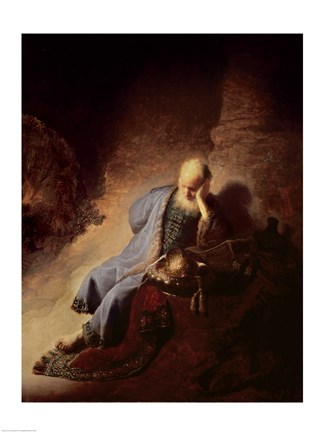
Jeremiah Mourning Over the Destruction of Jerusalem
by Rembrandt van Rijn
John addressed the need for God to rescue his people from the Roman leaders and their provincial governors in trumpets 1-4 and from the Roman army in trumpet 5. He included the Persian army and their disdain for anyone not Persian in the 6th trumpet. John referred to the plagues used against Pharaoh to remind Christians that the Romans had the same arrogance and would face the same end since the same God was going to deliver them. He used analogies of Roman and Parthian armies to locusts and scorpions to show how powerful, and yet how limited these two forces were in the face of God's power and control. But there was one more group of people that the Christians suffered at the hands of.
John turned his attention to the Jews. A little historical information helps one to see that the Jews had been at work actively distinguishing themselves from Christians since Jesus had ascended to God's realm. Although Jesus was a Jew, the Jews would not accept that he was God's son. So, Jews distanced themselves. Especially after the 50s ACE, after Paul's considerable work in taking the gospel to the non-Jewish groups of the Roman Empire, the Jews felt that they should make themselves distinct in the Roman leadership's eyes.
Seutonius' Lives of the Twelve Caesars, written in 119 ACE, bears out this determination on the part of the Jews. Rome was a bustling city in the year 50 ACE. Claudius was emperor of this huge and very powerful empire with legions and legions of military force at his disposal. He could have easily quelled the unrest. But, instead, Claudius decided to expel the Jews, or at least a portion of the Jews, because of the disturbances they were causing over "Chrestus," thought to have been the Latin name for Christ. Acts 18.1-18 also refers to the expulsion. Some think that Claudius didn't distinguish between Christians and Jews, since Christ was a Jew, and expelled "Jews" (both orthodox and Christian) that were causing the disturbance.
Seutonius also mentions that Jews in Tiberius' time, 19 ACE, were punished, some expelled, because of a scandal concerning converting an important woman in Rome, then taking funds allocated to her for a Roman building to send to the Jerusalem temple. This incident was well before Jesus, but Jews had certainly built a reputation for being a devious and rebellious group in the empire.
The Jews' actions in the provinces of Rome were not any different than what Seutonius recorded about Jews in Rome. Acts 18.1-18 also records the uprising in the Grecian province, in Corinth. It, too, was about Christ, and Gallio, the proconsul, dealt with it in keeping with Roman tradition, that is by not showing concern about provincial religions unless they threatened the security of Roman peace. Acts also includes uprisings in other cities in the provinces, such as the one in Ephesus in Asia Minor and Thessalonica in Macedonia.
It is no wonder, then that by the time Revelation was written, probably in the last year of Domitian's reign in 96 ACE, that the Jews were still at it. They had continued to actively persecute Christians. In Revelation 2.8-11and 3.7-13, in the letters to the churches of Asia Minor, John mentions the Jews in a very derogatory manner, calling them the "synagogue of Satan," and contrasting the Christians to them. John commends the Christians at Sardis for standing up under the slander of the Jews and the Christians from Philadelphia for holding on against Jewish ostracism.
It was important to John to reassure Christians that not only was God hearing their cries of suffering at the hands of the Romans mainly, but that he also heard their cries of the things they had suffered at the hands of the Jews. John created an interlude in the presentation of the seven trumpets to show Christians that God had seen the works of the Jews and wanted to reinforce the idea that Christians were God's designated people. In the seals, John had created a similar interlude in Chapter 7 between the first 6 seals and the 7th seal to show that God was acknowledging them specially, by sealing them. He created an interlude in Chapters 10 and two-thirds of Chapter 11 between the first 6 trumpets and the 7th trumpet for the same reason - to reassure them that they were God's people, distinct from the Jews. And what better way to indicate this than to use a couple of Old Testament, twin sister passages to his own apocalypse - apocalyptic sections from Ezekiel and Daniel.
Daniel 12.7-13 depicted two angels, both standing with feet planted on opposite sides of a river, one a little further downstream than the other. One angel asked the other how long it would be until the things that Daniel was asked to seal in a book would take place. The other angel took an oath in God's name, exclaimed that God's people would be persecuted for 3 1/2 years, then told Daniel to keep secret the words of how the end will happen.
(But that, in the days when the seventh angel would intentionally play his trumpet loudly, God's mystery would be competed, just like he announced to his servants, the prophets. )
The second half of Revelation 10 uses Ezekiel 2.8-10 and 3.1-15 to portray a message. Perhaps John was building on the previous idea from Daniel, so he was explaining that the following action from Ezekiel contained the mystery of God. Or, perhaps Ezekiel was just an additional voice in reminding his audience that God needed to explain a mystery that he had created many years ago. God's oracle to Ezekiel was to speak specifically to his people the Jews and tell them how defiant God considered them to be. God strengthened Ezekiel against the Jews' very chilly reception by giving him a scroll to eat containing the griefs of the people. Ezekiel did, and it tasted sweet in his mouth and filled his stomach. It made him stubborn and tough, like the Jews were, and gave him the strength to stand up to them even though they never listened to him.
The comparison to Ezekiel's experience is unmistakable in Revelation 10.
(I went to the angel to tell him to give me the little scroll, but he said to me, "Take it and eat it until it is completely gone. It will cause pain in your stomach, but will be as sweet as honey in your mouth.)
(I took the little scroll from the angel's hand and ate it. It was as sweet as honey in my mouth and caused indigestion in my stomach.)
What follows in Chapter 11 makes it very clear that God gave John the message that God's people of the Old Testament didn't accept Jesus. Because of this, his people of the New Testament shouldn't be confused. God did send his son. All of their suffering at the hand of the Jews would be vindicated.
The first two verses of Revelation 11 depicted an angel asking John to measure the temple. The precedent for this was found in two places, Ezekiel 40-43 and Zechariah 2.1-2. In Ezekiel, God asked the prophet to measure all the gates and all the courtyards so that they people could be given the exact plan. With the exact plan, they would hopefully not sin anymore, but repent and change their ways, as indicated in Ezekiel 43.10. With the exact plan, they also would hopefully quit worshiping idols from surrounding nations and stop following their kings' morality rather than God's laws, as in Ezekiel 43.7. They had been disgracing God's name, but hopefully they would change. The 1260 days referred to symbolize a shortened time or a Godless time, or both. 1260 = 42 months = 3 1/2 years, which is half of 7, the number representing a perfect time or a Godly time since 7 was the number of Heaven (3, the trinity) and Earth (4, the four corners of the Earth).
Verses 3-6 of Revelation addressed two witnesses. They were identified in verse 3 with two olive trees and a lampstand, a reference to Zechariah 4.11-14 where two witnesses were chosen by God to serve him. Although the two witnesses were not further identified in Zechariah, there were two witnesses that people in Jesus' day referenced when speaking of Jesus, Moses, referenced in John 1.21 and Elijah, referenced in Matthew 11.14. The reference from John is based on Deuteronomy 18.18, the Matthew reference was based on Malachi 4.5. Revelation 11.6 tells who the two witnesses were in case Revelation 11.3-4 left any doubt.
(In the days when they were representing God, they had the power to prevent the sky from a drop of rain making anything wet and the power to turn rivers and lakes into blood and strike the land with plagues whenever they desired.)
These two witnesses were powerful. They could stop rain and inflict plagues. Very clearly, these were the two actions of Elijah ( 1 Kings 17.1) and Moses (Exodus 9-11). These two men as witnesses had to have been representative of the Jewish nation and how they should have represented God to the nations of the Earth.
Revelation 11.7-14 shows what happens to the two witnesses. In this case the two witnesses were not the focus of the passage. They symbolized the Jews as a group during the days of Jesus. He came to give a new covenant, or at least a new understanding of the Old Covenant, before the Jews killed him. The lifeless bodies of the witnesses were paraded in the streets of Jerusalem for all to view. Everyone should have taken note that when Jesus was killed, the Jewish nation's life was gone, not because Jesus represented the Jews, but because he represented a new beginning for God with the Jews, a new understanding of the kind of people God expected his own to be.
Three more references from the Apocalyptic sections of the Old Testament were echoed in Revelation 11.7-14 and applied to the Jews. The first echo is from Daniel 7.7, 19-28. The fourth beast of Daniel's vision comes to mind.
(And when they had completed their testimony, the beast who had risen from the Earth's depths went to war against them, subduing and killing them.)
Interestingly, the Roman army, which is many times correlated to the fourth beast in Daniel, closed in on the group of people who had been a thorn in their sides in this region of the world. They sacked Jerusalem in 70 ACE and 3 years later finished off the last of the dissenters on the top of a bluff called Masada. One might say the Jewish nation had been subdued and killed.
As a result, when people wanted to talk about what might come after this in the grand scheme of things, Daniel was brought up. It talked about the times of the end. Other apocalypses, such as the book of 2 Esdras written shortly before the time of Jesus, also dealt with the end through a series of visions delivered by angels. And, extant in Jesus' day were the Dead Sea Scrolls. The War Scroll in particular spoke of the Sons of Light and the last days. So, yes, people talked about the idea of the end in the two hundred years either side of the life of Jesus. The written format used to capture the discussion that took place was the apocalyptic form. In fact, some believed that one of the most popular books read before and during the time of Jesus, the book of Enoch, with all of its apocalyptic characteristics, written and compiled over the course of this 400 year time period, could be the sealed scrolls referred to in Daniel.
Revelation came along most of the way through the four hundred year period referred to above. Since the interpretation of the fourth beast presented in Daniel 7 was the Roman Empire to many Jews, it is altogether possible and likely that John picked up the storyline of Daniel with his beast from the depths of the Earth to be the fourth beast who would destroy the enemies of the Christians. These enemies would include the Jews who lost their second temple in the sack of Jerusalem and who continued to harass the Christians.
The second reference is from Isaiah 1. The chapter could not be clearer. God's people were acting disdainfully. They directly disobeyed the Law given to them. God was finished with them. He would have destroyed them all like he did with the residents of Sodom, but he had compassion on the few who were trying. One can see this reflection in Revelation 11.8.
(Their bodies will be paraded in the streets of the great city, which is symbolically called Sodom and Egypt, where their lord was crucified.)
In addition to Sodom, Egypt was mentioned as the symbolic name for the Jews. God had wiped out the Egyptians' first-born progeny and all of Pharaoh's army in the Reed Sea because of Pharaoh's impudence. The comparison to the same attitude of the Jews in John's time cannot be missed.
The third reference is from Ezekiel 37.1-14, the vision of the valley of the dry bones. God took skeletons and slowly made the bones ready to live again. Then he breathed life back into the bodies. The video reading of these verses above is a striking visual of the reference John was using. The application was to the renewal of Israel. And that was Jesus' mission as well - to renew a clearer understanding or make a new covenant with Israel. So, John speaks of life reentering the witnesses because that was Jesus' stated reason for coming to Earth (John 10.10).
(And after three and a half days the spirit of life from God reentered them, and they stood on their feet. Those who had been watching this were speechless and tentative of what might come next.)
But the witnesses weren't allowed to continue on the Earth. God called them to Heaven in much the same way that he had taken Elijah in the first place. Their purpose on Earth was finished. Symbolically, the image of the witnesses was that the purpose of the Jews, which had been communicated to the prophets in the first place, was finished. Now the people who believed in God's son would carry on. There was an earthquake and destruction of a tenth of Jerusalem's population to depict the Jews' destruction of purpose, then everyone praised God. Both of the chapters of Isaiah 1 and Ezekiel 37 end with the renewal of God's purpose after he promised to destroy them in captivity for their evils. Revelation 11 presents the metamorphosis of Judaism into Christianity to reassure the Christians that God was not leaving any matter untended in redeeming those who had suffered for Jesus' sake.
There is a bit of subtle seasoning nestled in the wording of Revelation 10.10. The little scroll, which in Ezekiel contained the Jews' preoccupation with God's giving up on them and their sighs and chants of sorrow for God's abandonment of them had to be eaten. The analogy was that the scroll tasted sweet, as supplications often seem to people who make them, but the effect of the list was that they had to be expunged from Ezekiel's body, they had caused indigestion. If something is that onerous to God, then he would try to rid himself of the cause and rebuild, renew, and recreate something new that would have a different effect on people's lives.
I am eternally grateful that Jesus paid the price and offered me life and a room in his father's great complex of heavenly rooms. I am also glad to know that belief in God's son is worth everything I have on this Earth. I feel affirmed by this portion of Revelation that God will come to his people's rescue. I feel a part of his people because after John ate the scroll, he was told to tell everyone, all people of every language, nation, and race that God has renewed and recreated his relationship with his people. I live many years after the collapse of the Roman Empire. The empire I live in has oppressions of its own against Christians. But, God still defends his people and seeks to restore a relationship with those who accept the life given by his son. I am eternally grateful.
Historical note:
The Letter of Barnabas, written probably in the reign of Emperor Hadrian about 40 years after Domitian, interprets the Old Testament prophecies in exactly the same way as John does in this interlude in Revelation. The letter helped Christians and others see how different their faith was from the beliefs of the Jews. Hadrian had very great tolerance for Christianity, allowing it to flourish. God did show up for his suffering people under Domitian.
[Songs used are How Great Is Our God by Laura Story and Our God by Chris Tomlin.] [Introductory artwork Jeremiah Mourning Over the Destruction of Jerusalem by the Rembrandt van Rijn, retrieved from http://www.fulcrumgallery.com/Rembrandt-van-Rijn/The-Prophet-Jeremiah_155724.htm , and YouTube ofDry Bones by doulos lesou christou, retrieved from https://www.youtube.com/watch?v=6dafYxu8cQQ.] [The Greek text used is the Nestle-Aland 28th edition, for all verses except Revelation 11.11] [The Greek text used is Westcott Hort, UBS4, for Revelation 11.11] [Translations from Greek are my own.]
Morsels of food are delicious because of the little things, the subtle seasonings, the dash of salt, the sprinkle of garlic, the garnish of parsley, the touch of glaze, or the hint of lemon. Ahhhh - so delicious!
These Precious Hands
Revelation 8-11 is many times thought of as the beginning of the end in a countdown to Earth's last days. But there is another way to look at all the imagery that is used in the vision of the seven trumpets. If one keeps in perspective the purpose of John's writing the Revelation in the first place, the vision shows a picture of reassurance for the Christians who were being slandered by Jews and pagans alike. Rome had not understood the Christian movement at all. Any attempt to liken it to the Jewish religion received immediate backlash from the Jewish communities around the empire. So, they attempted to marginalize Christians by ostracism or to stamp them out by killing them at the first hint of trouble in a community. So, first and foremost, John needed to reassure those Christian communities that God saw their suffering and would soon free them from it. The vision of seven seals preceding the trumpets had been all about Christians receiving a reward for their endurance. The vision of the seven trumpets were all about a signal of power from God that the Romans weren't invincible, and Christians' lives were not being lived in vain.
The structure of the vision of the trumpets is the same as the structure for the vision of the seals. The first four objects are speaking on the same subject. The fifth and sixth objects change the direction of the vision somewhat. Then, there is an interruption to the action, something of an interlude, an event happening between the 6th and 7th objects. Finally, the 7th object depicts a tribute to God, the seals through silent reverence for God, the trumpets through enormous praise for God.
It is through this structure that a person makes sense of the vision and the imagery used to accomplish John's purpose. Below, the two passages are put alongside each other for easier comparison of the structure used.
Chapters 5-8 Chapters 8-11
Introduction - A scene in Heaven: The lamb Introduction - A scene in Heaven: alone is worthy to open the seals 7 angels are given trumpets, an 8th angel stands by an altar
and throws the altar's fire onto the Earth
Four seals - Matching the horses of Zechariah, Four trumpets - Using imagery
the horsemen report the status of the Earth matching the central event
to God of the Old Testament, the Exodus, angels announce
God's intentions
Two seals - A plea to God is made for him to Two trumpets - two woes represent
act on his people's suffering two armies released upon
on those causing his people's suffering
Interlude - God's seals his people and gives Interlude - God gives hope to his
them white robes people through giving his words
and raising two witnesses to inspire them
Final seal - There is reverent awe in Heaven Final trumpet - Loud voices in
Heaven praised God for
his people justice for their
suffering
The place to start in any understanding of the Jewish faith is the Exodus and all its surrounding events. It was the seminal event for several reasons. God dueled with Pharaoh to show his supernatural power in order to free his people. He illustrated to his people that he could and would deliver his people from Egypt and establish a Law with them at Mt. Sinai. He sustained his people in a desert wilderness wandering. And, through 40 years of wandering he taught his people to depend on him to get them the promised land. So, when John wanted to reassure Christians that God was more powerful than Rome, it was very natural to turn to the Exodus event.
(The first angel sounded his trumpet and there was hail and fire mixed with blood, which was thrown to the Earth burning a third of it including a third of the trees and green pastures.)
The mighty Pharaoh who controlled every step the Israelites took was not convinced by this God of Moses to free them. He needed them to complete all of his buildings and statues honoring him. He was considered deity in this part of the world. He wouldn't tolerate a rival. So, God sent a storm, the likes of which Egypt had never seen in its history. The thunder and lightning were ferocious, covering the entire sky. Hail was embedded in the storm and crashed into everything. Trees were broken, plants were pummeled to shreds. Even people were injured if they went out in it. The ferocity of the storm was continuous and unrelenting. This storm is recorded in Exodus 9.22-25. It was a storm to remember - for centuries - from the time it occurred until the time it was remembered in this first trumpet, almost a 1400-year span of time. To show the Christians reading John's visions that God was announcing travesty for the Earth, he started with the central event of God's show of power to Pharaoh. In John's time, the same power was going to be demonstrated for God's people the Christians. The Egyptians had lived through their worst storm. So would the enemies of the Christians because only a third of the earth was affected. But, there would be suffering and a very natural demonstration of supernatural power. A very, very extreme storm was about to be released against the enemies of his son. That was just the first trumpet.
(A third of all sea life died and a third of all ships carrying food were destroyed at sea.)
A mountain on fire? That sounds a lot like the original Mt. Sinai event. Exodus 19.18 speaks of the mountain on fire. God met Moses while the whole of Israel was watching. God knew how to draw a crowd and get people's attention. The blood in water was the first of the plagues that God visited on the people of Egypt. Blood killed the staple item in the Egyptians' diets, the fish, with blood in the Nile and all of its tributaries. All of their water in their water jars was blood. Everything containing water, contained blood. People suffered. The plague is written about in Exodus 7.14-25. For John's audience, they saw a burning mountain splash into the sea. Immediately the water turned to blood. The staple item of the Roman empire, the ships that brought all of Rome's products, the luxurious items for the rich and the everyday food for the regular people, sank in the sea, the waves were so tumultuous. Once again, the destruction was partial. The Roman Empire would not be totally affected, but it would notice that the one true God, the God of the Christians being persecuted, blamed, and slandered was putting them on notice that he was about to come against them with raging anger.
(The star's name is Bitter Taste [of absinthe]. A third of the water turned bitter in taste, and many people died from its toxicity.)
Rome was powerful. Its reach went around the Mediterranean. It was the brightest star in the sky because it controlled two previous great empires in Greece and Egypt. But even Rome would fall before the Lord of the skies. He could make Rome drop like a star from its place in its sky and be made submissive. They had failed their character test with God unlike the Israelites who had faced the test of bitter water at Marah. The story is told in Exodus 15.22-27. They had been 3 days without water after coming through the Reed Sea. Moses sought God's help about the problem and he was told to throw a particular piece of wood into the water to make it sweet enough for the people to drink. The bitter water had been a test for the people to turn to the Lord for healing. Those who were persecuting and provoking the Christians in John's time were facing the same test. But as the vision indicated Rome was failing the test. They were dying and not turning to the Lord, the healer.
(The fourth angel sounded his trumpet and a third of the sun, moon, and stars were darkened so that the day and night were affected by one-third.)
There was one plague that broke the stalemate between Pharaoh and Moses. It was the death of the first born son of every Egyptian family. The whole reason for all of the plagues was to show God's superiority to the king of the most powerful country on Earth. So, by the death of the first born, Pharaoh acquiesced and acknowledged God's superiority. The plague that helped pave the way for the pharaoh's response to the last plague was the 9th plague of darkness that covered the whole land for three solid days (Exodus 10.21-22). Funny - after no lights in the sky for three days, Pharaoh hardened his heart for the last time. It had symbolic value for him. Because of his darkness, the next plague gutted his soul and the souls of many, many families in his realm. So, when the fourth trumpet blew and the lights in the sky above Earth went out, there was darkness. And it was no wonder that the very next verse mentioned that the darkness was a precursor to something very ominous. "The most painful and agonizing sound, 'Ay-y-y-y,'" was the terrible, horrific cry that begin the announcement for the next 3 trumpets. What agony was being saved for those opposing God's people during this time.
(I looked and heard the cry of an eagle flying in mid-sky, making the most painful and agonizing sound, "Ay-y-y-y-y!" because those still living on the Earth have yet to hear the doom that will be announced by the trumpets of the three angels left.)
The Exodus event stands above all other events in God's covenant with the Hebrews. They saw God's raw power in their deliverance from Egypt and in their witness of God's giving the law on Mt. Sinai. The Psalms reflect God's power in this event over and over. And interestingly, the oracles of the prophets about how God would deal with people who disobey him contain the imagery of the plagues and/or the Mt. Sinai experience as well. In a number of versions of the Bible, the verses of the trumpets indicate the prophets' oracles in footnotes or cross references as being the sources for the trumpets' images, but since the oracles were rooted in the Exodus event, it seems to me that it is more logical to refer to the seminal occurrence than the secondary occurrences more indirectly related. The Exodus is a match between God and a powerful empire for release of a suffering people. The Day of the Lord in the prophets is more about disobedience and idolatry of not only other nations, but Israel as well. The verses here in Revelation seem more connected to the match between God and the Egyptian dynasty because God was about to free his people the Christians from their suffering at the hands of the Romans. In addition, trumpets are used in the seminal event to announce God's meeting with Moses to give him the Law whereas the oracles use a person to express God's opinion for him.
One of the tasty morsels in this passage is the use of the fraction one-third. The parallel in the Exodus event is that God would end the plague before it affected everyone to the extent they died. The plague was to make a point. Thus, the plague had a mitigated, or partial, effect. The death of the first born was not mitigated, so it had a full effect. In Revelation the first four trumpets revealed damage on the Earth to a partial extent, one-third. God was trying to make a point - he is more powerful. He didn't need to kill everyone. But apparently it was not enough, as nine of the plagues were not because people had the hard heart of Pharaoh. Thus, the last three trumpets announced a painful and agonizing outcome represented by a dreadful cry rather than with words.
Generally speaking, the American experience of Christianity doesn't reflect the same conditions that existed in John's time. However, in the world at large, many suffer and die for their faith. That dark specter of death and persecution could come to America. At the time it does, the familiar words of John here in Revelation will be in the forefront of our minds. Some say that even now there is persecution in certain aspects of American life. Higher education, for example, pursues the scientific study of a discipline without regard to what the Bible might have pertaining to it. Being published or attaining tenure is sometimes connected to one's stated beliefs in faculty offices or in works published. Great financial gain is often linked to a lack of faith rather than to whether a person has a moral a moral conscience. If faith is not expressed, then the dollars roll in. If faith is expressed, dollars are withheld or withdrawn. Other areas in American life are included too.
I know that right now there is not this great empire that I as a Christian suffer under. But should the time come, I know that although the state will shine as the brightest star in the sky, their day to meet God will come. They will be made to drink the Bitter Taste. The absinthe's toxins will kill them. Justice will come. I will be listening for that trumpet blast to sound.
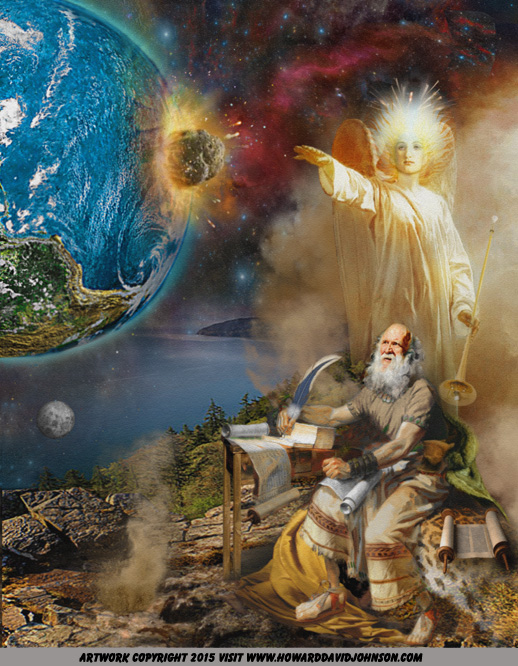
[The Greek text used is the Nestle-Aland 28th edition.] [Songs used are Giants Fall by Francesca Battisteli and Hidden by Will Reagan and United Pursuit.] [Introductory photograph These Precious Hands, retrieved from http://www.fulcrumgallery.com/These-Precious-Hands_663811.htm, after Revelation 8.9, The Second Trumpet by Howard David Johnson, retrieved from http://www.howarddavidjohnson.com/The_SECOND_TRUMPET.jpg.]
Morsels of food are delicious because of the little things, the subtle seasonings, the dash of salt, the sprinkle of garlic, the garnish of parsley, the touch of glaze, or the hint of lemon. Ahhhh - so delicious!
Be Not Afraid Greg Olsen
Revelation is structured as a series of letters at the beginning and a series of visions for the rest of the book. There are 4 main visions with sets of 7 objects that God used to bring justice to the world and bring his children to himself in Heaven. In the first main vision, Jesus broke open 7 seals on a scroll and read a report on the state of the world, a plea for justice from martyrs, and an assurance from God that he would protect his children. The next set of seven objects were 7 trumpets to reveal how fed up with the world's actions God had become and to warn them to "let his people go." The third vision used 7 plagues to show that God was still in control of the world's events. Finally, 7 bowls filled with anger were dumped on the world to show that God's visit would close down those who set themselves up against his children. Other visions existed to serve as a setup and conclusion for the four sets of 7 and create a storyline for the 4 sets to elaborate on. But, the main visions are found in the four sets seven objects.
Each set of 7 develops further a revelation to people reading the book that God sees what is happening to his people and is working on their behalf. The second in the sets of 7 is found in Revelation 8.2-11.19. In this part God builds on what he started with the first set of 7. In that part, each seal depicted a condition of the world or the status of his people, so in a transitional vision between seals 6 and 7, God let his people know that he would bring an end to the injustices they were experiencing at the hands of the Romans and their provincial governors by giving them white robes and his personal seal. The next main vision uses 7 trumpets to warn people of God's awesome and supernatural power and to announce to the them that because of the scenes portrayed in the first 4 seals, he is fed up with their horrific behavior.
In order for people to see this awesome and supernatural power of God, though, John takes everyone on a short trek through Old Testament imagery found in Exodus and various prophets. Exodus 30.1-10 was the starting place, the golden altar of God. It was the place for sweet smelling incense and only incense to be burned because it was the place God would meet with Moses. So, as this second set of visions opens, and after the 7 angels that stand before God's throne received trumpets, then God wanted to meet his people at his golden altar.
(Another angel carrying an incense holder made of gold came forward and stood by the altar. He was given a lot of incense so that he could offer it on the golden altar in front of the throne along with the prayers of all the ones God had set apart.)
But going to the altar of God to meet with him was not always a pleasant experience as time wore on for the Jews. The farther from Moses a person traveled on the timeline toward Jesus, the worse the experience was at the altar of God. About 500 years after Moses, the entire book of Amos contained oracles of God chastising both his own people and people of other nations for terrible behavior against him. Israel in particular takes the brunt of God's anger. By the time the next-to-last oracle of the book was given, God decided to stand at his altar, his place for meeting people, and tell Amos to smash the temple columns to express how he felt toward Israel.
(I saw the Lord standing beside the altar, saying, "Strike the lintels of the temple columns so that they crumble and fall on the heads, wounding many of them. I will kill the rest of them with the sword. None of them will get away by trying to escape.")
About 50 years after Amos, Isaiah experienced God's glory filling the temple and saw angels around him. Isaiah confessed he was unclean, so one of the angels brought a coal from the altar and touched Isaiah's lips in an atonement ceremony. Then God told Isaiah to tell the people they would see and hear but have no understanding of events that were happening around them, and impending doom was at hand.
(Then I said, "Until when Lord?"
And he answered, "Until after the cities and houses people are now living in are empty and sitting in ruins. Until both the people and their land are totally desolate.")
(Yahweh will remove many of the people to places far away, forsaking the whole region.)
So, when John says he saw an angel at the altar of God, people knew the message would not be good. Its symbolism matched giving the 7 trumpets to the angels because trumpets had been used for announcing important messages for hundreds of years. The altar of God had also been used to call someone as a messenger to warn pagan nations and God's people alike for ungodly behavior.
Since the main purpose of the altar was to offer incense as atonement for God's people, the angel at the altar did so. He filled his incense holder with incense and offered its sweet fragrance to God as the prayer from his people for deliverance from their evil and as a plea to be rescued from those evils suffered at the hands of the Romans, including the suffering of martyrdom for the sake of Jesus, as was presented in Chapter 6 of Revelation in the fifth seal.
The dots are easy to connect here. God gets the report of the martyrs in Chapter 6. He marks them for life in Heaven in Chapter 7. Then, in Chapter 8, an angel appears at the altar to offer a prayer of atonement and express God's disdain for the ill treatment of his people by the nations they live in, especially Rome. In order to foreshadow what the trumpets would be announcing as they were blown, the angel at the altar does something in addition to offering prayers for atonement.
(Then the angel took the incense holder, filled it with smoke and coals from the altar fire, and threw the mixture on the Earth. Thunder rumbled, lightning flashed, voices echoed, and the ground shook.)
The angel threw a censer-full of incense and prayers on the Earth. The act illustrates John's purpose for writing Revelation. Given the nature of the letters and the first set of 7 objects (seals), it would seem evident that the Christians felt very oppressed. Antipas is specifically mentioned as a martyr in Pergamum (Revelation 2.13), apparently as a result of Jewish persecution. But even if not, the Jews had worked against or at least verbally attacked the Christians in Smyrna and Philadephia (Revelation 2.9, 3.9). The fifth seal reported in Chapter 6 depicts souls under an altar who cried out to God for their suffering. Together, the seals made a plea to God for help and reassurance. The sixth seal portrays a scene that suggests that God is seeing that a Day of Wrath is necessary to cleanse the evil from the Roman empire in Asia Minor, the place where John was living. Then there was reverent silence in Heaven.
Saving Grace
Garrett Walker
John was called to send a message to the world that God would act against those who had devastated his people. They would face a Day of the Lord, a day of reckoning. The angel threw incense and prayers on the Earth. Sky and Earth shook in the aftermath. God was about to vent his anger. He would restore his people, come among them, and give them the assurance they needed that they belonged to him. This idea operated in the background as each trumpet was blown. God had heard the report of the seals. The angel throwing the incense and prayers signaled to all who would hear that God was about to deal with those causing his people great suffering for their belief in him and his son.
The scene seemed familiar to many of John's readers. It reminded them of events they had read about in the Old Testament, beginning with the original announcement of God's covenant to Israel. Moses had gathered Israel together to witness this event at the bottom of a mountain. When he left to meet God, the people saw that he was amidst dark clouds of smoke, lightning, and thunder (Exodus 19.16-19).
John also had in mind showing a number of other occasions where God had made announcements to people. The whole of Ezekiel 30 describes God's actions against Egypt. Verses 2 and 3 specifically tell Egypt that on a day of terror, God would act. The announcement of the magnitude of the destruction appears in the verses after verse 3. And finally, the chapter ends (verse 26) with the reason for God's pronouncement of terror on their country.
Jeremiah 30.23-34 also contains an oracle against the nations that had treated Judah terribly. God says that he would send a furious storm against them that would cause great pain and suffering. The prophet Amos spokes of a Day of the Lord in Amos 5.18-20. It would be a terrible day of darkness with no light at all and a day in which a great storm would hit the earth (verse 8c) for the people who had paid no attention to having godly ways.
Perhaps the best parallel to all that happens in this set-up to the second set of seven and in the subsequent trumpet announcements is found in Joel 2. At the beginning of the chapter, God announced that a terrible day of anger was coming. Verse 10 stated that the Earth shook and the skies trembled as the Lord began his vengeance the same as was happening in Revelation 8.5. In Joel, there is one final call for repentance at the altar of God before he acts on his anger. Then God foreshadowed his terrible actions with warnings of the Day of the Lord in the sky and on the Earth with fire and smoke. The chapter ended with an invitation to come to the Lord to be rescued from his impending terror.
So, it is no wonder that John used the image of the angel throwing fire down on the Earth to get its inhabitants' attention as to what was going to happen next. The first four trumpet announcements would serve as warning shots over the bow and time to repent if they would be willing. The second three trumpets would be notices that people were too late. God was ready to act on behalf of his people without further warning.
A tasty morsel is found in verse 5 of Revelation 8. The last part of the verse about the thunder, lightning, and earthquake has an interesting combination of words. Literally, the words are καὶ ἐγένοντο βρονταὶ καὶ φωναὶ καὶ ἀστραπαὶ καὶ σεισμός (and there were thunders and voices and lightnings and shaking.) The word φωναὶ had the usual translation of voices, but sometimes it meant sounds or noises. The result is that there are two ways to translate the four words in this substantive list. First, thunders, lightnings, and sounds, are natural phenomena in the sky. Thus sounds might be the sounds of the sky accompanying thunder and lightning, like wind, or blowing rain. Second, thunders, lightnings, and voices represent the result of a mixture of the smoke and coals mixed with prayers when they reach the Earth. The voices of people's prayers caused a strong reaction from God, a day of terror and its attendant signs. God sends a message that a storm is gathering because his people have petitioned him and he is going to act.
Although the first way of translating the word φωναὶ as sounds in the sky has the weight of immediate context going for it, I like the second way of translating the idea because it fits into the larger context better. I have to believe that God reassures his people, that he is always there noticing how things are going. When times are fierce for his people, he sees their tears and hears their voices. He acts with cleansing fury to remind the world that they have crossed I AM. Without that assurance, life gets too tedious. It becomes hard to take another step in faith. Evil is forcefully strong. I, like those readers of Revelation in John's tumultuous times, need to know that an angel is flinging myvoice and the voices of many others mixed with the incense from the altar of God down to the Earth, and those around me should hear the voices and feel the rumble under their feet because God is answering his people and forcing an encounter with I AM.
[The Greek text used is the Nestle-Aland 28th edition.] [Songs used are Touch the Sky by Hillsong United and I am not alone by Kari Jobe.] [Introductory photograph Be Not Afraid, by Greg Olsen retrieved from http://render.fineartamerica.com/images/rendered/search/print/images/artworkimages/medium/1/be-not-afraid-greg-olsen.jpg, after Revelation 8.5, Saving Grace by Garrett Walker, retrieved from http://www.fulcrumgallery.com/c7594/christian-art.htm?page=6.]
[The Hebrew text used is the Biblia Hebraica Stuttgartensia, 1967/77.]