Reflections are everywhere - in crystal bluelakes and shining, marble surfaces, in the glass of towering skyscrapers and the concave lenses of ever-present cameras. Theycapture my thinking and mesmerize me, enticing me to look again because there's more in the picture!
I am surprised by people from time to time, but not usually. However, Jesus surprises me with his teachings and actions frequently. Reading the New Testament over a number of years produces little surprise for some people who have studied it. Reading it again is merely a mundane or routine exercise in duty for them. But for me it offers enchantment in places I have glossed over in the past or enrichment to the passages that I thought I had milked for meaning. Here at the time of year when Jesus died and rose on the third day of death, a passage I have read a huge number of times has resonated in my mind and enriched me this weekend.
One aspect of the New Testament's rising from death has always been amazing to me. The three famous "raisings" Jesus performed, Jairus' daughter, the son of the widow of Nain, and Lazarus, were mentioned as just one of many miracles and were not given "magnanimous" status. The Church Fathers that followed in the years and centuries later didn't highlight those ocurrences either. That's surprising to me. Nobody returns from death, and so to be a living example of someone back from the dead should have been given tremendous more press than it received. There should be an apocryphal book ascribed to Lazarus or to the widow's son, or to Jairus' daughter. Church historians should have follow-up biosketches of the people Jesus raised, but they don't. That's so amazing to me.
Matthew 27 records an event that should be just as amazing. It should be in the annals of the Church Fathers for sure. The examples in the above paragraph are raisings of single individuals, but Matthew records "many" people all at once being released from death, walking out of their graves, and mixing again with the people of Jerusalem. If there is a superlative term greater than magnaninous, stupendous, or incredulous, I would use it for this miracle of miracles. But the event is mentioned as a matter of course in the two effects of the aftermath of Jesus' death.
(They left their tombs after his resurrection, came into the Holy City, and were seen by many.)
Many dead people mixing with many live people, πολλοῖς (many). How does that get overlooked in a city of 75,000 inhabitants (an average of what scholars have estimated)? Were they Christians or devout Jews since they were referred to as the ἁγίων (holy ones, good people)? What kind of lives did these people live before and after their raising? Did some of them change? Did they wholeheartedly embrace the Christian movement as it separated itself from Judaism in the decades following their resurrection? Were they all followers of Jesus to begin with when they died or good Jews who would turn to Christianity after coming back? Did they become Christian leaders in the years following Jesus' ascension?
The wording of the passage, πολλὰ σώματα (many bodies) could be interpreted that these many people who came back to be seen in Jerusalem appeared to others in the same way Jesus did when he appeared to the men from Emmaus or to his apostles and Mary. He had qualities not quite like the rest of us humans. He could just appear and disappear at will, and the ones mentioned above didn't recognize him at first. However, he was in bodily form and everyone did finally recognize him. Also, each of the main verbs used in the three verses, with the exception of came (verse 53), is passive. Every action was caused by someone other than the subject of the sentence. The agent causing the action is not mentioned except in the case of were seenby many in the Holy City (verse 53). The other actions or verbs could only have one agent, but an implied one rather than an explicit one. Only God or Jesus who had been charged by God could cause the earth to quake, the temple curtain in the Holy of Holies to rip in half, the rocks to split, tombs to open, and dead people to come alive again. Only one person. This would imply that that they were not under their own power. So they didn't enter Jerusalem as if they were doing it of their own accord. They were made manifest (were seen), ἐνεφανίσθησαν, so they might not have been continuously seen like they were when they were alive.
Either way the record reads many people! They were dead but came back to life. That is no small event.
But I get it. They are not the main attraction. They were not the ones who taught about the Dominion of God. They didn't raise themselves from the dead or perform many other miracles. They didn't die a criminal's death or have all authority over the affairs of Heaven and Earth. That was someone else - Jesus - God's son and chosen deliverer for his people of Israel. Jesus, who said he could lay down his life and take it up again, told us he was going away to prepare for us a place and come again to take us to live with him. Jesus, who told us he came so that we could have life and an extraordinary place, is the one with the story of stories to repeat for the generations to come - not Lazarus, the widow's son, or Jairus' daughter, and right, not even many people back from the dead, all at one time.
I plan to wake up from death when my life on Earth is over. I look forward to having life in an extraordinary place after life here because Jesus was true to his father's charge to share his life with us. He laid it down, he took it up again. He woke up three days after he stopped breathing, appeared to many, many people, and is now preparing places for me and for all those who say, "You are the one who was chosen, the son of the living God."
[Introductory photo of reflection is found on Instagram's Natural Mirrors Amazing Places to Visit, retrieved from https://www.pinterest.com/qaisarazeem/photography-of-nature/. The second work of art Welcome Home is by Danny Hahlbohm and retrieved from http://www.fulcrumgallery.com/Danny-Hahlbohm/Welcome-Home_663673.htm] [The first song is Alive in You by Jesus Culture. The musical narration, He is Here, is found on Creative Sheep.com. The last song is He Reigns by Newsboys] [The Greek text used for the New Testament references is the Nestle Aland 28th edition] [Translations from Greek are my own.]
Reflections are everywhere - in crystal bluelakes and shining, marble surfaces, in the glass of towering skyscrapers and the concave lenses of ever-present cameras. Theycapture my thinking and mesmerize me, enticing me to look again because there's more in the picture!
When Doing Battle with Gazing Globe
by Lynnette Henderson
Death for four decades of my life was such a note of finality. Yes, I knew about the resurrection. Yes, I knew that Jesus provided his followers the promise of life after death. And, yes, I believed in that I would be "raised" after I die to live in a place called Heaven.
But, death has a different aspect to it now for me. At the end of four decades my son died an agonizing death from a rare bone cancer. I went through every agonizing moment of his life between diagnosis and his departure along with my wife and daughter. His death immediately affected all three of us, and over time we have all three sought God in very different ways.
But this blog is not about my son's death. It was the starting point to a new aspect about life. It started with the selection of John 14.2,3 to be read at my son's graveside service.
(And if I have gone away to make a place ready for you, then I am coming back for you to join me so that where I am, you can be too.)
At the beginning of seeing with new eyes, I read this as a place to go. But, as I have reflected many a time on this passage, I see that Jesus is talking about leaving this place, the Earth, merely going to another place to make some preparations. Death was merely the break point between the two. There is no separation at death, no note of finality, nothing to show a time lapse of dying, going through a Judgment Day, then "making it" to Heaven. There is only mention of Jesus coming again so that we can join him in specially prepared family accommodations. Jesus said it himself, "I came to give you life and an extraordinary place. Life here, life there... no death, merely transition, merely exchange of one environment for another.
That was the start of considering again what Jesus offers his followers. Then I started noticing Jesus' statements about life. It didn't seem that he was talking about the way we lived our lives on Earth to obtain a position in an afterlife. His idea of life was what happens at conception and stops when the body wears out or whose heart stops. But the emphasis was not on what stops, but what is interrupted here on Earth, but continues in a dimension not known or seen by those left behind. When I read for the thousandth time Jesus' conversation with his Twelve one day about a good shepherd, I thought I might have a grasp on Jesus' idea for life.
(No one takes it from me. I lay it down of my own accord. I have the authority to lay it down and take it up again. This charge I have obtained from my father.)
When Jesus was on trial before Pilate, Pilate tried to play the life and death card with Jesus where death is so final (John 19.11). Pilate thought Jesus was being too coy and complacent with him for Jesus to be in such dire straits. So, Pilate told Jesus he had the power to stay his execution or command his execution. Jesus replied,
(You have no authority over my life except what is given to you from above. So, those who delivered me to you have a greater wrong.)
So, my mind finally saw that following Jesus gives me access to life (not a synonym for lifestyle). The life that comes into us in a mother's womb and that stops at our last heartbeat... unless, of course, we have decided that Jesus is God's son, in which case life does not stop when our heartbeats quit. We simply have a transition from one place where a certain type of life existed to another place, made ready for us when we join Jesus. Life is laid down on a planet in a solar system, taken up again in a dimension elsewhere. Our DNA encodes when our heart will wear out given a certain set of circumstances, much like Pilate's dictate to Jesus. But, I hear the words Jesus spoke to our DNA by extension of his answer to Pilate, "You have no authority over my life."
That added nuance of insight for me has liberated me from thinking that I would die, my life stopped, my lifestyle evaluated, my soul making the lifestyle cut and spirited away to Heaven at some future point in time. My new way of thinking allows me to live freely here, honor God, acknowledge his son and his teaching, and transition to live freely again in another dimension. Death is robbed of its note of finality.
"My soul will dance on the wings of forever."
[Introductory photo of reflection is When Doing Battle with Gazing Globe by Lynnette Henderson and retrieved from https://www.flickr.com/photos/lynnette_henderson/2513227934/. The second work of art Welcome Home is by Danny Hahlbohm and retrieved from http://www.fulcrumgallery.com/Danny-Hahlbohm/Welcome-Home_663673.htm] [The first song is Say the Word by Hillsong United. The second song is Touch the Sky by Hillsong United] [The Greek text used for the New Testament references is the Nestle Aland 28th edition] [Translations from Greek are my own.]
Reflections are everywhere - in crystal bluelakes and shining, marble surfaces, in the glass of towering skyscrapers and the concave lenses of ever-present cameras. Theycapture my thinking and mesmerize me, enticing me to look again because there's more in the picture!
(He took a seat facing the collection box and watched how the crowd tossed their copper coins into the collection box. The wealthy people were tossing in a lot.)
I'm not sure what the point of the story is here. Jesus, at the end of his last week on Earth, sat across from the box that people put money in. Why was he there watching that? He had already cleaned house in the temple courts to say that all the money changing that was going on wasn't what God was about (previous chapter, Mark 11). He had answered questions of the Jerusalem religious leaders targeting the blasphemous tenants of his teaching in their opinion. They had tried to trap him all week in saying something that would be against their law. So, what was his strategy in sitting down to watch people put in money? The prophet Malachi had made it clear God expected his people to bring their money to him.
(A widow who begged tossed in two of the lowest denomination coins.)
It was just another Passover for this lady. Passovers were particular grueling for her. She had had to figure out how to make ends meet for a while now. Her husband had been able to do that previously for the two of them, but he had met his end before his wife. She had been reduced to eeking out a living these days. During this week, people from all around the whole region were coming to the city. She didn't have anything to give, but these travelers had good hearts. They were coming to celebrate with relatives the goodness God had shown them. By asking them for a little help, she could at least ask for a couple of coins to drop into the collection box at the Temple courtyard to show God that she still placed her trust in him.
When she received this from a generous visitor, she made her way to the Temple courtyard. She was unashamed. She had to show appreciation to God for taking care of her these days and for his good care of her husband and her when he had live. She walked right up to the box and tossed in her coins like any other person even though she knew the coins were a very small amount of money. She quickly walked away for the next person to come to the box.
Yeah, Jesus noticed. Immediately, she was the center of his focus. Although his followers were with him, he didn't know if they had seen just what had happened. He reigned in their attention.
(He called his followers around him and spoke to them, "Honestly, of all those who have tossed into the collection box, this widow who begs has tossed in the most of anybody!")
The Twelve were used to Jesus giving contrasts about what people thought was good and what God thought was good. They had heard it many times. Jesus didn't speak about money much, though, so he had their attention. They might have expected him to comment on the "one-tenth" giving that good Jews were supposed to give or on giving from the great wealth above and beyond the tenth that these Jerusalem wealthy elite were capable of giving. No. He said the beggar widow gave more than any other person. They knew to wait. Jesus would explain what he meant to them.
("They all tossed in from their great wealth, but she from her abject poverty tossed in as much as she had, everything, from her means of living.")
So, why is his last direct teaching lesson before death done at the giving box at the temple? Because it was the universal setting to acknowledge appreciation AND trust in God's care of his people. In the capital city of the Jews, appreciation and trust were doled out in limited measures because of the wealth of the party leaders, their dependence on a written code rather than a living God, and their "place" for God since they had to work most of their daily living with the Roman governors and military commanders to control their own population. They trusted a great deal in their own wisdom.
Likely Jesus had a day left to live on the Earth. He had accomplished his teaching mission. He had come to Jerusalem and tangled with the scholars of the Talmud and the party elites. He had made a huge statement in cleansing the temple in order to show how far off-base the establishment was in conducting God's business - the temple needed to return to being a house of prayer for the nations, not to continue being a money collection location for God. He had one last lesson to give to his Twelve. This was it. Now he could rest. The end would unravel over the next several hours.
I don't know that the lady's income was replenished, but if she was like every other person, she had a means or a hope that the little that she put in the box would be replenished. It was her trust that God would replenish that supply that Jesus complimented. His last lesson would be about trust. God gives us what we need. We simply honor and trust.
The widow woman has a lot to teach me. Jesus was right to focus my attention on her. I usually exhibit a lot of pride. I seem to have a surplus of it. My years are supposed to have taught me to trust God and honor what he has done. I'm a slow learner. So, God draws me again to something his son did. The lesson he taught before undergoing his last hours on Earth. I am grateful to have in my mind the picture of the woman who begged giving her two coins amounting to almost nothing. If only I could have that amount of trust in my God who gives me everything I need and so much more.
[The song is Sovreign by Chris Tomlin] [Introductory artwork retrieved from http://www.spanishdict.com/answers/267625/la-palabra-del-dia-liso]
[The Greek text used is the Nestle Aland 28th edition] [Translations from Greek are my own.]
Reflections everywhere capture my thinking - in crystal bluelakes and shining, marble surfaces, in the glass of towering skyscrapers and the concave lenses of ever-present cameras - and mesmerize me, enticing me to look again because there's more in the picture!
It was the end of his life on Earth. He knew it. He had deliberately come to Jerusalem in order to encounter the Jewish leaders in the heart of the teaching center of Judaism. Jesus knew they wouldn't tolerate him any longer, brand him as a heretic, and kill him. The time in Jerusalem had gone exactly as he had thought it would (or exactly as was planned).
But, his Twelve didn't know this was the end of his life on Earth. He had to make certain that they understood the unfolding events to the fullest extent possible. In John 16, Jesus begins by telling the Twelve about events that would happen after he left, such as being ostracized from synagogues, and being martyred. The purpose was to reveal ahead of time some events so that they would not lose their faith.
He also had a second purpose. Jesus needed to let them know about someone else - someone who would follow him. His end was the beginning of the time when another would come to stand beside each of them. In all their endeavors, they would come to count on this third person to be by their sides. The Twelve had to be introduced. And this was the time.
(Truthfully, it is better for you that I leave this world. If I don't leave, the one who will stand beside you and help you cannot come to you. If I leave, I can send him to you.)
Jesus answered what the obvious questions would have been if he had stopped talking. The questions on the table would have been, "When he comes, what exactly will he say or do? How will he help us?" But the Twelve didn't have a chance to ask; Jesus knew they needed to know because they lived in a world at large that didn't have a clue what was happening in Judea, nor did they care, and because they lived in a land where people of their own kind would represent God differently than the way Jesus had represented him. Both groups of people had "worldly notions."
(When he comes, he will refute worldly notions about failure and guilt, about decent living, and about sitting in judgment of others.)
That probably was enough information to answer the obvious question the Twelve would have had. But, Jesus took it a step farther. He gave the reasons for his answer. The Greek word μέν is a word used to show that what followed would be connected to the statement that went before it, usually by way of explanation. The Greek word δέ following the clause with μένcreated a series of parallel phrases that explain. In this case there were two additional parallel phrases. This rhetorical formula was perfect for Jesus to succinctly clarify his answer.
Verse 9
περὶ ἁμαρτίας μέν, ὅτι οὐ πιστεύουσιν εἰς ἐμέ
(He will verify what I said about failure and guilt by showing what happens when people don't believe me.)
(And he will verify what I have said about sitting in judgment by showing that the ruler of this world has been tried and condemned.)
When a person works with an artist, all the artist needs is the idea, then we can appreciate the idea through the artist's representation of this idea. People can do this for themselves with the website fotosearch.com by typing in a word in the search bar and then scrolling through the 25,000 photos of the idea. If I type in summer, I am returned thousands of images of summer, all different, all representations of the season. In such a way, a linguist can take the words on the surface of an utterance and peer into the mind of a person as to the meanings being represented by words.
One can hear some deafening sounds coming from the words being used here. The three ideas of failure and guilt, decent living, and sitting in judgment are what the Jews specialized in when it came to representing their law. They had a narrow view of creating their system of justice for not living what they considered to be a decent life, ostracism and negative critique being a part of it. The world beyond the Jews was no better. Their idea of justice, might makes right, made for a harsh and brutal society. I am deafened by the ideas of bound, break out, and freedom. The Jews seem to have set themselves up for failure since they expected human beings to miraculously perform to the letter of their law, which was layered with traditions and well-intended rabbis' applications. Honor, too, was in the world at large, but it was a table set for family members and strong men mostly. Others were just miserable failures. I can't help but hear the idea that those outside the ring of honor could not be helped and never would amount to much in life. And, the idea of judgment came in many forms, but one of the most prevalent was the prestige games of trying to be better than or keep up with the Joneses. Most people couldn't be better, allowing the ones who were, to condescend to them and judge them as worthless.
Jesus had taught about all three of those ideas. Now he was turning his teaching over to someone else, someone who couldn't come until he departed. The Twelve had to know so that they could tell others. There is another person coming after Jesus leaves. He will refute the deafening noises of the worldly notions about decent living, failure and guilt, and judgment. He will verify what Jesus had taught. He will stand beside them to help them break free of ostracism, low self esteem, and low caste in society.
The Twelve were faithful to tell Christians who followed their generation, and they to the generation after them, and they.... Even today, one of the main differences between my world view and many of the acquaintances I have, is my honor, contentment, and guilt-free mode of operation because of the verification of the appropriateness of Jesus' teachings against their belief of ostracism, prestige, and condemnation of others. I am free of their view, not bound by it in any way. People, of course, can't see Jesus anymore, but they see me and the reflection of the one that stands beside me helping me break out. Yes, that's right.
[The beginning song is Does anybody hear her by Casting Crowns, the second song is Broken Girl by Matthew West, the ending song is Grace Wins by Matthew West] [Introductory artwork retrieved from http://www.fotosearch.com/CSP859/k8597169/]
[The Greek text used is the Nestle Aland 28th edition] [Translations from Greek are my own.]
Morsels of food are delicious because of the little things, the subtle seasonings, the dash of salt, the sprinkle of garlic, the garnish of parsley, the touch of glaze, or the hint of lemon. Ahhhh - so delicious!
At the beginning of Matthew 18, Jesus is dealing with the idea of "greatness" because his twelve still had the value system of the society around them. Jesus would change that idea for them over time. But, on this occasion, he called a child over to the group of men to begin his reconditioning of their thinking.
He began by saying some easy things like become as a little child to enter his kingdom and accept and welcome a little child and in so doing welcome Jesus himself. He went on to some ideas harder to put into practice such as the verses listed below. Perhaps Jesus' comments were literal, perhaps metaphorical, but they are hard to achieve.
(The ones who would put an obstacle in the way of little ones who trust me, would be better off hanging a grinding stone for grain around their necks and drowning themselves out in the open sea.)
(How terribly bad it will be for the world because their obstacles inevitably come, but it will be especially terrible for the person responsible for the obstacle.)
(If your hand or foot gets in the way of having a good life, remove it. It is better for you to participate fully in life crippled than to participate with two hands and feet and wind up being thrown into the eternal fire.)
(And if your eye is an obstacle to good living, take it out and throw it away. It is better for you to participate fully in life with one eye than to participate with two eyes and wind up being thrown into the despicable fires of the Valley of Hinnom.)
Two ideas stand out in these verses that make Jesus' point. Each one of the 4 verses uses either the noun form or verb form of σκανδαλίζει (to put an obstacle in the way). After telling the Twelve that they should become like children, he next had a message for those practicing Judaism. Don't change the trust factor that little children had in their Heavenly father. The literal interpretation is daunting. As children become adults in the world, there are many, many opportunities for them to dump trust in God and direct their trust elsewhere. That's why he made the statement about "the world's" obstacles that appear for everyone. The Romans and every other nation under the sun had their own beliefs about gods and lifestyles. Jesus told them that it would not go well for them ultimately.
But, he also personalized the statement to responsible parties who make life rough enough on children to make them switch loyalties from God to something else. As a parent, I know how easy it is to get in the way of a teenager's developing faith. Intentions to take soft or hard lines can have backlashes on faith that redirect a teen's fragile faith. Guiding one from child to adult required me to be the responsible party. In light of Jesus' words that task was daunting because I was not a perfect, responsible party. At some point the child is responsible for his or her own faith, but parents standing in that gap between childhood and adulthood as a guide know the perilous nature of that decade's journey from 10 to 20. If the words are more figurative in nature, then the peril doesn't disappear from the situation. We all go through different stages of faith. We can look back to a time when our faith was developing. What kind of voice did we listen to? Whose choices of what was important for lifestyle habits did we look around to adopt from? Which books did we read to develop faith. And when we were more mature, if I was one of the voices someone listened to, then what did that person younger in faith hear me say? If my lifestyle was under scrutiny from someone who respected me, then what in it was worth adopting? And, if someone heard my teaching, from a book, class, counsel, or casual conversation, then did it further develop trust in God or deflect that trust to another place or entity? The other idea in the passage is that of how a person's life ends. Jesus used his typical reference to a terrible end, the Valley of Hinnom. The reference is to the days of King Ahaz of Judea. He built an idol to Ba'al there for people to worship, even sacrificed his own sons there to the God Molech as did others. The story is carried in 2 Kings 23.10, 2 Chronicles 8.3, and Jeremiah 32.35. The fires that burned in the valley were kept going for a long period of time. The Jews eventually had a change of heart. The fires of Hinnom became the place to burn animal carcasses in order to show their disgust for what previously had happened there. Eventually, all kinds of garbage was incinerated there, so the fires never went out. The connotation of the place was one of "despicable" fires in this valley. Because the Jews kept the fires going over such a long period of time, they were also referred to as the eternal fire.
Some say the first is referring to not misleading literal children and the second is the figurative rendering of Valley of Hinnom's fire as hell's fire. Others say that the first is meant as a figure of speech not to lead people who have young faith astray and the second is the literal rendering of the image of the despicable fires of Hinnom.
Either way, I know that during the many years of my Christian journey I have violated the principle involved . I have pushed ideas that others were not ready to accept. I argued for ideas that worked for me at my various stages of understanding, but that didn't benefit others at their stages of understanding. For my lack of insight, I depend on God's forgiveness, his grace. I try much harder these days to understand the principles at work in Jesus' teachings. This determination is at the heart of the blogs I write.
[The beginning song is Never Too Late by Three Days Grace, the ending song is Handprints on the Wall by Kenny Rogers] [Introductory artwork retrieved from http://images.clipartpanda.com/pal-clipart-pal-clipart-of-a-digital-collage-of-couples-of-black-silhouetted-children-playing-together-by-dero-329.jpg]
[The Greek text used is the Nestle Aland 28th edition] [Translations from Greek are my own.]
Morsels of food are delicious because of the little things, the subtle seasonings, the dash of salt, the sprinkle of garlic, the garnish of parsley, the touch of glaze, or the hint of lemon. Ahhhh - so delicious!
At the outset of Jesus' public teaching, people probably thought that it was a bit unusual. But then, people come along from time to time who present the unusual to us. We recognize it and take it in stride. Jesus' teaching was unusual, but it very quickly hit a different level. Changing water to wine was a benevolent thing to do as a first miracle. But Jesus' response to John the Baptist in the early part of Matthew 11 shows a broader scope. Jesus had made the lame walk, the deaf hear, the lepers whole, and the blind see. Those who had had the life seep out of them, had had that life returned to them. That was far more than a bit unusual. It was over the top, extreme, unimaginable, and inimitable. And his teachings were every bit the same way. They were distinct, easy to implement, sensible, and irreplicable.
From the beginning of the time Jesus had appeared in public, he had referred to his father. As the Jews listened, they knew he wasn't speaking of Joseph. In fact, he claimed not just to be a child of God like everyone else, he claimed to be the personal child of God whose origin was in a different realm. In the closing part of Matthew 11, the clarity of his words about God cannot be missed.
(At that time Jesus began speaking, "I agree with you, Father, Lord of Heaven and Earth to have hidden these things from the clever and educated and disclosed them to those with childlike understanding.)
(Everything has been given to me by my father. No one understands everything about a son except a father, nor about a father by anyone except a son and others the son wishes to disclose him to.)
This, of course, set the stage for his teachings. After giving teachings about having God's favor and shouting sounds of pain (Luke 6.20-26), slightly earlier in his public teaching, Jesus wanted to further distance God's way from the teachings so prevalent in the current instruction of the Talmud. Topics in the Talmud were tedious, long, easy to forget, and applied to selective areas of life. Although there were many topics in the Talmud, the sabbath topic was a long-standing one, and one surely Jesus heard often as a child. It serves as an example to illustrate the laborious nature of an expounded topic. Below is a sampling of this teaching from the Babylonian Talmud.
_______________________________
Mishna II - The principal acts of labor (prohibited on the Sabbath) are forty less one: sowing, plowing, reaping, binding into sheaves, threshing, winnowing, fruit-cleaning, grinding, sifting, kneading, baking, wool-shearing, bleaching, combing, dyeing, spinning, warping, making two-spindle-trees, weaving two threads, separating two threads (in the warp), tying a knot, untying a knot, sewing on with two stitches, tearing in order to sew together with two stitches, hunting deer, slaughtering the same, skinning them, salting them, preparing the hide, scraping the hair off, cutting it, writing two single letter characters, erasing in order to write two letters, building, demolishing (in order to rebuild), kindling, extinguishing (fire), hammering, transferring from one place to another. These are the principal acts of labor - forty less one.
Gemara - For what purpose is the number (so distinctly) given? (They are enumerated.) Said R. Johanan: if one labored through total ignorance of the (laws governing the) Sabbath, he must bring a sin-offering for every act of labor performed...
... Said R. Aha in the name of R. Hyya b. Ashi quoting R. Ami "One who prunes is guilty of planting, and one who plants, transplants, or grafts, is guilty of sowing." Of sowing and not of planting? I mean to say of planting also...
... "Binding into sheaves." Rabha said: One who gathers salt from salt works is guilty of the act of binding into sheaves. Abayi, however, said that binding into sheaves applies only to produce of the soil.
[For the complete Chapter VII on Acts of Labor on the Sabbath containing the complete Mishnah II and four other Mishnahs concerning the Sabbath, click or press here.]
______________________________________
One of the groups the gospels refer to as trying to trap Jesus in his words is the "scribes" as they have been called for many years. The word is γραμματεῖς (scholars of the law). These were the people who studied the Law and Talmud and could cite them by heart. They were scholars and treated Jesus as an upstart who didn't know the depth of God's law as they did. Thus, it became important to Jesus that he show his connection to God as his son in order to demonstrate that he was every bit as knowledgeable as the γραμματεῖς, and more so.
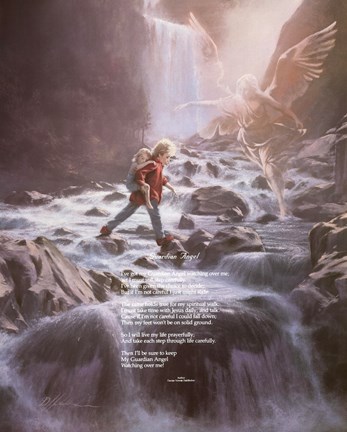
Guardian Angel
by Danny Hahlbohm
Jesus set his words against such teachings as those above. His sayings were original. They may at times have contained echoes of others' teachings to reference his breadth of knowledge, but they would have an original twist. Matthew 11 illustrates this well. Jesus echoes The Wisdom of Sirach. In Sirach 6.21, 23, the author spoke of those to whom Wisdom revealed herself as being the unwise, the unlearned. Likewise, Jesus thanks God in Matthew 11.25-27 for showing his teaching to the unwise and unlearned as well as God revealing himself to the son and those whom the son reveals himself. In Sirach 6.24-30, readers were encouraged to put themselves under Wisdom's yoke and in her fetters, and they would find rest and joy. Sirach 51.26 suggests putting the yoke of Wisdom on one's neck and receiving her instruction. Changing it from from a personification about wisdom to a metaphor about himself, Jesus takes the idea of finding rest and putting on his yoke and makes it original about following his teachings. In addition, Jesus hints that he is Wisdom, thus, his hearers should accept his instruction. But, even though Jesus refers to his teachings as a yoke, showing a knowledge of Sirach, one has to think that Jesus' main purpose was to take full aim at teachings like the sabbath topic above (and representative of all the others found in the Talmud) which turned the ways of God into something laborious and odious. The Talmud's yoke was tedious, heavy-handed, and hard. In contrast, Jesus said his yoke was light and easy.
A couple of the subtle seasonings used in these last two verses are the puns that Jesus uses. Since people translate this verse one way, that is, using the yoke and the heavy load, the value of the pun is lost in the translation. By using the other meanings of the double entendre, the yoke becomes a symbol for shouldering a load together and light burden becomes a contrasting idea to the extensive rules of the Talmud about certain topics. The following translation can be made.
Put on the bar that joins us together and acquire my habits because I am easy to work with and don't mind joining you. The bar that joins us benefits you, my load isn't tedious, long, and odious.
The word ζυγός (yoke) can at times refer to a balance beam or just a balance. So, really, yoke is a triple entendre. The scholars of the law would not have missed this intended meaning. It meant, Take on my teachings because they are balanced. My teachings are not rigid and don't make you high and mighty. The balance makes you good and keeps you steady.
That's my goal - to put on Jesus' yoke and learn from him. It's a beneficial way of life. It's a fluid way of life because his teachings apply to every situation, at least that I have ever encountered. It's a steady way of life that people learn to count on you for. It's a joint way of life.
[The beginning and ending songs are different versions of Prince of Peace by Hillsong United] [Artwork is Guardian Angel by Danny Hohlbohm retrieved from http://www.fulcrumgallery.com/Danny-Hahlbohm/Guardian-Angel_69658.htm] [For a suggested text of the Wisdom of Sirach click here.] [For a suggested text for the Babylonian Talmud of the Mishnah used above click here.] [The Greek text used is the Nestle 28th edition] [Translations from Greek are my own.]
Morsels of food are delicious because of the little things, the subtle seasonings, the dash of salt, the sprinkle of garlic, the garnish of parsley, the touch of glaze, or the hint of lemon. Ahhhh - so delicious!
These Precious Hands
Revelation 8-11 is many times thought of as the beginning of the end in a countdown to Earth's last days. But there is another way to look at all the imagery that is used in the vision of the seven trumpets. If one keeps in perspective the purpose of John's writing the Revelation in the first place, the vision shows a picture of reassurance for the Christians who were being slandered by Jews and pagans alike. Rome had not understood the Christian movement at all. Any attempt to liken it to the Jewish religion received immediate backlash from the Jewish communities around the empire. So, they attempted to marginalize Christians by ostracism or to stamp them out by killing them at the first hint of trouble in a community. So, first and foremost, John needed to reassure those Christian communities that God saw their suffering and would soon free them from it. The vision of seven seals preceding the trumpets had been all about Christians receiving a reward for their endurance. The vision of the seven trumpets were all about a signal of power from God that the Romans weren't invincible, and Christians' lives were not being lived in vain.
The structure of the vision of the trumpets is the same as the structure for the vision of the seals. The first four objects are speaking on the same subject. The fifth and sixth objects change the direction of the vision somewhat. Then, there is an interruption to the action, something of an interlude, an event happening between the 6th and 7th objects. Finally, the 7th object depicts a tribute to God, the seals through silent reverence for God, the trumpets through enormous praise for God.
It is through this structure that a person makes sense of the vision and the imagery used to accomplish John's purpose. Below, the two passages are put alongside each other for easier comparison of the structure used.
Chapters 5-8 Chapters 8-11
Introduction - A scene in Heaven: The lamb Introduction - A scene in Heaven: alone is worthy to open the seals 7 angels are given trumpets, an 8th angel stands by an altar
and throws the altar's fire onto the Earth
Four seals - Matching the horses of Zechariah, Four trumpets - Using imagery
the horsemen report the status of the Earth matching the central event
to God of the Old Testament, the Exodus, angels announce
God's intentions
Two seals - A plea to God is made for him to Two trumpets - two woes represent
act on his people's suffering two armies released upon
on those causing his people's suffering
Interlude - God's seals his people and gives Interlude - God gives hope to his
them white robes people through giving his words
and raising two witnesses to inspire them
Final seal - There is reverent awe in Heaven Final trumpet - Loud voices in
Heaven praised God for
his people justice for their
suffering
The place to start in any understanding of the Jewish faith is the Exodus and all its surrounding events. It was the seminal event for several reasons. God dueled with Pharaoh to show his supernatural power in order to free his people. He illustrated to his people that he could and would deliver his people from Egypt and establish a Law with them at Mt. Sinai. He sustained his people in a desert wilderness wandering. And, through 40 years of wandering he taught his people to depend on him to get them the promised land. So, when John wanted to reassure Christians that God was more powerful than Rome, it was very natural to turn to the Exodus event.
(The first angel sounded his trumpet and there was hail and fire mixed with blood, which was thrown to the Earth burning a third of it including a third of the trees and green pastures.)
The mighty Pharaoh who controlled every step the Israelites took was not convinced by this God of Moses to free them. He needed them to complete all of his buildings and statues honoring him. He was considered deity in this part of the world. He wouldn't tolerate a rival. So, God sent a storm, the likes of which Egypt had never seen in its history. The thunder and lightning were ferocious, covering the entire sky. Hail was embedded in the storm and crashed into everything. Trees were broken, plants were pummeled to shreds. Even people were injured if they went out in it. The ferocity of the storm was continuous and unrelenting. This storm is recorded in Exodus 9.22-25. It was a storm to remember - for centuries - from the time it occurred until the time it was remembered in this first trumpet, almost a 1400-year span of time. To show the Christians reading John's visions that God was announcing travesty for the Earth, he started with the central event of God's show of power to Pharaoh. In John's time, the same power was going to be demonstrated for God's people the Christians. The Egyptians had lived through their worst storm. So would the enemies of the Christians because only a third of the earth was affected. But, there would be suffering and a very natural demonstration of supernatural power. A very, very extreme storm was about to be released against the enemies of his son. That was just the first trumpet.
(A third of all sea life died and a third of all ships carrying food were destroyed at sea.)
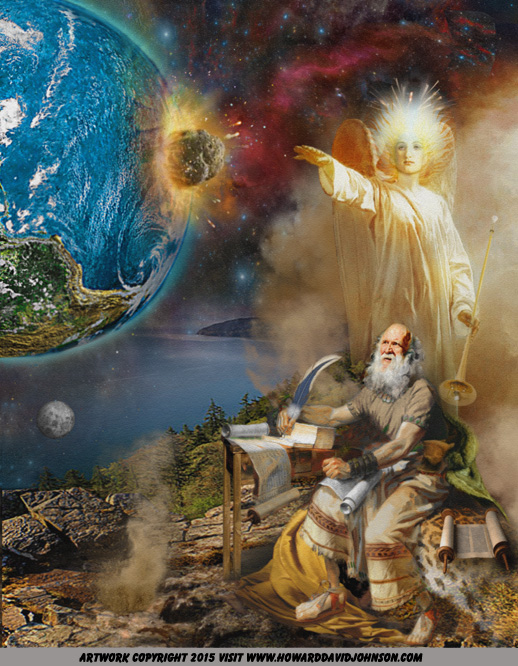
A mountain on fire? That sounds a lot like the original Mt. Sinai event. Exodus 19.18 speaks of the mountain on fire. God met Moses while the whole of Israel was watching. God knew how to draw a crowd and get people's attention. The blood in water was the first of the plagues that God visited on the people of Egypt. Blood killed the staple item in the Egyptians' diets, the fish, with blood in the Nile and all of its tributaries. All of their water in their water jars was blood. Everything containing water, contained blood. People suffered. The plague is written about in Exodus 7.14-25. For John's audience, they saw a burning mountain splash into the sea. Immediately the water turned to blood. The staple item of the Roman empire, the ships that brought all of Rome's products, the luxurious items for the rich and the everyday food for the regular people, sank in the sea, the waves were so tumultuous. Once again, the destruction was partial. The Roman Empire would not be totally affected, but it would notice that the one true God, the God of the Christians being persecuted, blamed, and slandered was putting them on notice that he was about to come against them with raging anger.
(The star's name is Bitter Taste [of absinthe]. A third of the water turned bitter in taste, and many people died from its toxicity.)
Rome was powerful. Its reach went around the Mediterranean. It was the brightest star in the sky because it controlled two previous great empires in Greece and Egypt. But even Rome would fall before the Lord of the skies. He could make Rome drop like a star from its place in its sky and be made submissive. They had failed their character test with God unlike the Israelites who had faced the test of bitter water at Marah. The story is told in Exodus 15.22-27. They had been 3 days without water after coming through the Reed Sea. Moses sought God's help about the problem and he was told to throw a particular piece of wood into the water to make it sweet enough for the people to drink. The bitter water had been a test for the people to turn to the Lord for healing. Those who were persecuting and provoking the Christians in John's time were facing the same test. But as the vision indicated Rome was failing the test. They were dying and not turning to the Lord, the healer.
(The fourth angel sounded his trumpet and a third of the sun, moon, and stars were darkened so that the day and night were affected by one-third.)
There was one plague that broke the stalemate between Pharaoh and Moses. It was the death of the first born son of every Egyptian family. The whole reason for all of the plagues was to show God's superiority to the king of the most powerful country on Earth. So, by the death of the first born, Pharaoh acquiesced and acknowledged God's superiority. The plague that helped pave the way for the pharaoh's response to the last plague was the 9th plague of darkness that covered the whole land for three solid days (Exodus 10.21-22). Funny - after no lights in the sky for three days, Pharaoh hardened his heart for the last time. It had symbolic value for him. Because of his darkness, the next plague gutted his soul and the souls of many, many families in his realm. So, when the fourth trumpet blew and the lights in the sky above Earth went out, there was darkness. And it was no wonder that the very next verse mentioned that the darkness was a precursor to something very ominous. "The most painful and agonizing sound, 'Ay-y-y-y,'" was the terrible, horrific cry that begin the announcement for the next 3 trumpets. What agony was being saved for those opposing God's people during this time.
(I looked and heard the cry of an eagle flying in mid-sky, making the most painful and agonizing sound, "Ay-y-y-y-y!" because those still living on the Earth have yet to hear the doom that will be announced by the trumpets of the three angels left.)
The Exodus event stands above all other events in God's covenant with the Hebrews. They saw God's raw power in their deliverance from Egypt and in their witness of God's giving the law on Mt. Sinai. The Psalms reflect God's power in this event over and over. And interestingly, the oracles of the prophets about how God would deal with people who disobey him contain the imagery of the plagues and/or the Mt. Sinai experience as well. In a number of versions of the Bible, the verses of the trumpets indicate the prophets' oracles in footnotes or cross references as being the sources for the trumpets' images, but since the oracles were rooted in the Exodus event, it seems to me that it is more logical to refer to the seminal occurrence than the secondary occurrences more indirectly related. The Exodus is a match between God and a powerful empire for release of a suffering people. The Day of the Lord in the prophets is more about disobedience and idolatry of not only other nations, but Israel as well. The verses here in Revelation seem more connected to the match between God and the Egyptian dynasty because God was about to free his people the Christians from their suffering at the hands of the Romans. In addition, trumpets are used in the seminal event to announce God's meeting with Moses to give him the Law whereas the oracles use a person to express God's opinion for him.
One of the tasty morsels in this passage is the use of the fraction one-third. The parallel in the Exodus event is that God would end the plague before it affected everyone to the extent they died. The plague was to make a point. Thus, the plague had a mitigated, or partial, effect. The death of the first born was not mitigated, so it had a full effect. In Revelation the first four trumpets revealed damage on the Earth to a partial extent, one-third. God was trying to make a point - he is more powerful. He didn't need to kill everyone. But apparently it was not enough, as nine of the plagues were not because people had the hard heart of Pharaoh. Thus, the last three trumpets announced a painful and agonizing outcome represented by a dreadful cry rather than with words.
Generally speaking, the American experience of Christianity doesn't reflect the same conditions that existed in John's time. However, in the world at large, many suffer and die for their faith. That dark specter of death and persecution could come to America. At the time it does, the familiar words of John here in Revelation will be in the forefront of our minds. Some say that even now there is persecution in certain aspects of American life. Higher education, for example, pursues the scientific study of a discipline without regard to what the Bible might have pertaining to it. Being published or attaining tenure is sometimes connected to one's stated beliefs in faculty offices or in works published. Great financial gain is often linked to a lack of faith rather than to whether a person has a moral a moral conscience. If faith is not expressed, then the dollars roll in. If faith is expressed, dollars are withheld or withdrawn. Other areas in American life are included too.
I know that right now there is not this great empire that I as a Christian suffer under. But should the time come, I know that although the state will shine as the brightest star in the sky, their day to meet God will come. They will be made to drink the Bitter Taste. The absinthe's toxins will kill them. Justice will come. I will be listening for that trumpet blast to sound.
[The Greek text used is the Nestle-Aland 28th edition.] [Songs used are Giants Fall by Francesca Battisteli and Hidden by Will Reagan and United Pursuit.] [Introductory photograph These Precious Hands, retrieved from http://www.fulcrumgallery.com/These-Precious-Hands_663811.htm, after Revelation 8.9, The Second Trumpet by Howard David Johnson, retrieved from http://www.howarddavidjohnson.com/The_SECOND_TRUMPET.jpg.]