Search This Blog

Showing posts with label Life of Jesus. Show all posts

Sunday, July 16, 2017

Representation

Reflections are everywhere - in crystal blue lakes and shining, marble surfaces, in the glass of towering skyscrapers and the concave lenses of ever-present cameras. They capture my thinking and mesmerize me, enticing me to look again because there's more in the picture!

Retrieved from https://en.wikipedia.org/wiki/Mirror_image

From the early portions of the Old Testament, it appeared that God selected a people to represent him on the Earth.  But several hundred years later, the Prophets very plainly told the Jews they had not lived up to their calling.  Some prophets told them they had lost their chance.  God was moving on without them.  Other prophets said that although the Jews had totally squandered their chance to represent God on the Earth, he would grant them a second chance if they asked for forgiveness and changed their ways.  This second series of prophecies were what the Jews put their hope in.  So, they desperately tried to cleanse themselves of their weaknesses and live better lives. Over several hundred years and switches in world empires later, they thought they had accomplished this.  By the time Augustus Caesar became emperor of Rome and all of its conquered provinces, the Jews felt very much like they again represented God on the Earth, especially if put against the likes of the barbaric, evil, and bloodthirsty Romans.
But during the reign of Augustus something happened in the Jewish province of Rome that should have altered the entire direction of Jewish beliefs.  The Jews' whole world should have been rocked and people there should have repented of their impoverished representation of the One whose power created the Earth and directed the destinies of countries on the Earth.  God's chosen one that they all thought would come at some point in their history actually did come.  Their entire belief system and their very existence depended on the appearance of this messiah, but the Jews, especially their leaders, didn't acknowledge his presence or his teachings.  And they were definitely privy to his presence in their country.
70 years after this event in Judea, Luke traveled through the same realms of the world that Paul traveled, even traveling with Paul at times.  He saw what Paul saw.  The Jews still felt that they represented God wherever they had their communities. They ran Paul and his associates out of several towns and confronted Paul at nearly every turn for presenting the idea that they had missed their messiah, God's chosen.  And all in full view of the Romans, who thought that the Jews were a really obstinate, arrogant group, rebellious to the core, not the representatives of God on Earth.  
Luke knew how strongly the Jews denied that they had lost the opportunity to accept God's change by accepting Jesus' message, so he wrote stories such as the ones found in Luke 15 where Jesus told parables of God's patience to accept them if they wanted to be found.  But Luke also wanted the Jews to know their time had expired to represent God, and that they had had good warning. So, he included a story in his writings (Chapter 16) where Jesus dealt with the issue of a time when the Jewish leadership had been presented a chance and a choice to quit misrepresenting God.  Jesus' story was aimed directly at the majority party of the ruling sect in Jerusalem, the Sadducees.  Those leaders had been wealthy.  The people hadn't been.  And the people had seen the rulers accumulating money and power in a rather corrupt manner.
.Jesus had not been coy.  He told them that a wealthy house owner heard his manager was corrupt, so the owner called him into account for his actions.  The manager knew he would be canned because he was corrupt (from getting more money than he should have from people to line his own pockets and from treating those people poorly). The manager  went to all the owner's debtors and reduced their debts so that when the owner did fire him, they would take him in.  Thus, Jesus directed his words straight to the leaders who had cut deals with the Romans to retain their leadership and to keep their purses full.
Verse 9
Καὶ ἐγὼ ὑμῖν λέγω, ἑαυτοῖς ποιήσατε φίλους ἐκ τοῦ μαμωνᾶ τῆς ἀδικίας, ἵνα ὅταν ἐκλίπῃ δέξωνται ὑμᾶς εἰς τὰς αἰωνίους σκηνάς
(I say, go ahead and make friends of those you overcharged for your own gain and have now short-changed the house owner with.  When it disappears, those are the friends who will be the ones to accept you into their vain and empty lives for the rest of your days.)
 The Jewish leaders should have been interested in hearing about acceptance that would lead to a place for them for the rest of their days.  They had perpetuated a belief system that they alone had represented God on the Earth, and they would be rewarded for it.  The regular Jews understood that God wanted their undying love.  They saw God's heart.


But the leaders didn't see the same thing. They had dismissed the prophets that had told them otherwise and embraced the ones that told them they had been reinstated as the guardians of God on the Earth.  Jesus was telling their leaders otherwise.  But, they couldn't hear it.  Instead, they wanted to play games by quibbling over whether or not there even was a place to spend the rest of one's days.  The Sadducees, the majority party, had said no, the Pharisees, the minority, said yes.  And the two ruling sects were split on how to handle money as well.  Sadducees were aristocratic and didn't let religion get in the way of business while Pharisees placed a little more value on the use of money collected in God's name, namely the tithe and supporting temple worship.  But the Sadducees held the majority.  So, Jesus leveled his charge at them.  First, there was a place to spend the rest of a person's days, and second, their value of money from corruption in business was a determining factor in receiving that place.  
Verse 10
Ὁ πιστὸς ἐν ἐλαχίστῳ καὶ ἐν πολλῷ πιστός ἐστιν, καὶ ὁ ἐν ἐλαχίστῳ ἄδικος καὶ ἐν πολλῷ ἄδικός ἐστιν
(The  person who is trustworthy with a little is trustworthy with a lot.  And the one who is corrupt with a little is corrupt with a lot.)
Verse 11
εἰ οὖν ἐν τῷ ἀδίκῳ μαμωνᾷ πιστοὶ οὐκ ἐγένεσθε, τὸ ἀληθινὸν τίς ὑμῖν πιστεύσει
(So, if you can't be trustworthy in obtaining your riches through honest means, who will trust you with true riches? )
With clarity that even the Sadducees could not twist, Jesus tells them 
Verse 12
καὶ εἰ ἐν τῷ ἀλλοτρίῳ πιστοὶ οὐκ ἐγένεσθε, τὸ ὑμέτερον τίς ὑμῖν δώσει
(and if you can't be trustworthy with someone else's affairs, who will give you what could have been rightfully yours?)
The statement is in question form, but the question was not asking for information.  It was rhetorical and the apparent answer could not have been misunderstood by the majority group.  They had forgotten that the rule of reciprocation applied to a higher power than Rome.  God was on his throne and was faithful to those who reflected that principle.  


And, there was one more thing.  Although the statements Jesus used about corruption and wealth were metaphorical in his parable, he didn't want them to construe his metaphor into a claim that the story's moral didn't apply to their misrepresentation of God.  So Jesus didn't leave it unsaid.
Verse 13
Οὐδεὶς οἰκέτης δύναται δυσὶν κυρίοις δουλεύειν· ἢ γὰρ τὸν ἕνα μισήσει καὶ τὸν ἕτερον ἀγαπήσει, ἢ ἑνὸς ἀνθέξεται καὶ τοῦ ἑτέρου καταφρονήσει. οὐ δύνασθε θεῷ δουλεύειν καὶ μαμωνᾷ
(It is impossible for a household servant to serve two masters.  He will hate one and love the other or he will side with one and look contemptuously on the other. It is impossible to serve God and corruptly amassing wealth.)
And even though Jesus' statements were about faithfulness to God and the fact that God was rejecting those who represented him for their unfaithfulness, Jesus used another word to make it clear what their position was in the equation.  He didn't mince words.  His analogy was not of a loving father giving a message to his sons.  It wasn't of a loving God trying to woo his wayward chosen people.  It was of a house owner and his servant.  The Sadducees got it.  They were serving their ill-begotten money as if they were servants in its house.  They were not servants in God's house.
Jesus' words from Luke come at a time between what the prophets said and what Paul experienced, and Luke made them surface again during a time in the Empire after Titus had destroyed Jerusalem for Rome's sake.  Jesus tried to alter the Jews' thinking and get them to accept what God was telling them through him.  The one who called himself the Son of Man, the picture the Jews had made of God's handpicked person, and who identified himself in a number of instances as I AM, hadn't altered the Jews' track.  What a clear signal that Jews were on a whole different trajectory than Christians.  God had moved on.  The Jews had lost their standing to represent God.  Christians had received the standing to now show the world the Great I AM.
The signal is still clear.  It reminds me of what I should be in the business of doing.  I should be representing God by showing generosity to those who need it, not trying to look out for my own gain (in all areas, but money included).  People need acceptance and favor... and yes, money sometimes.  I think that more often than not, the question God asks me is, "Do I represent him or not in showering people with what they need?"  There was a countdown timer set for the Sadducees.  They let time expire without altering how they would spend the rest of their days.  Fortunately for me, my timer's still counting and I can walk through the rest of my life representing well one Lord, not two, since that is impossible.


[Introductory photo of reflection is found at https://en.wikipedia.org/wiki/Mirror_image]
[The first song is Everything I Do by Bryan Adams.  The second song is On the Throne by Kari Jobe.]
[The Greek text used for the New Testament references is the Nestle Aland 28th edition]

[Translations from Greek are my own.]

Saturday, May 27, 2017

Those who accept

Reflections are everywhere - in crystal blue lakes and shining, marble surfaces, in the glass of towering skyscrapers and the concave lenses of ever-present cameras. They capture my thinking and mesmerize me, enticing me to look again because there's more in the picture!


I can imagine John, deep in thought, taking a walk through his adopted hometown of Ephesus.  The last two decades had been a far cry different from his days in Galilee.  Here the hustle and bustle of a large commercial center in the Roman Empire had drowned out the quiet memories of the homeland of his youth.  But he would never, never forget them.  Today they were fresh on his mind because he was observing the people around him.  The people here appeared to be consumed with trying to be so important to themselves, to impress others, to make a buck at everyone else's expense.  Where he grew up 55 years ago wasn't much different from that - until Jesus had come into the world.  After that, every little event that had happened and every insignificant person Jesus had acknowledged stuck in his memory because Jesus had time for people and treated them right.  And, most importantly, he represented God whose valued did not reflect those found on the Earth.


But here he was in the midst of an important Roman province where the Romans themselves were a ruthless, restless, and arrogant lot because of the extent of their great empire.  The Greeks, whose city he was now living and walking around in, had a certain arrogance too, but for different reasons.  They were the remnant of a worldwide empire whose glory years still appeared everywhere in their architecture and temples.  They were a sophisticated people because they had established an educated citizenry.  Ephesus had shared in that glory.

But as great as these two societies had been, both Romans and Greeks were guided by their own power and enlightenment even though they gave lip service to a pantheon of Gods.  They failed to acknowledge that one God allows nations to rise and fall.  They hadn't recognized the Maker of the world when he had arrived on his own created planet as light in the midst of darkness.

John Chaper 1

Verse 9

Ἦν τὸ φῶς τὸ ἀληθινόν, ὃ φωτίζει πάντα ἄνθρωπον, ἐρχόμενον εἰς τὸν κόσμον

(He came into the world as true light, shining on everyone.)

John had for quite some time now wanted to write memoirs of a man who had had time to stop and affect people.  He thought of Jesus - absent in the lives of most people of this city - but so ever present in the lives of those he had touched.  Jesus had had time for people.  He had changed people.  John stopped his walk for a moment to watch people hustling around.  For sure the people in Ephesus needed time with the Teacher.  He wished they could feel his touch, change their lives, and know his spirit in their beings.  Then they could understand the concept that people don't have to die. They could believe Jesus is God's son, escape from a world of death, and look forward to a world of life.


John last saw Jesus on the Earth somewhere between 29 C.E. and 33 C.E.  From that point on, a tremendous turn of events had put Christianity on the path to become a worldwide religion.  Paul had converted to Christianity within four years of Jesus' death, and by the 40s had begun his journeys through Asia Minor, including this city of Ephesus where John was now hurting for his fellow townspeople. For 25 years Paul had followed God's lead all over the north Mediterranean world spreading the news of Jesus.  John had followed in some of Paul's footsteps and had ended up here in Ephesus.  John interrupted his walk again to muse over the question of why so many people who had had exposure to Jesus through Paul's tremendous efforts wouldn't change.  Why wouldn't they want to leave this world to go to their true home.  Why wouldn't they recognize Jesus and accept what he had to offer?

Verse 10

ἐν τῷ κόσμῳ ἦν, καὶ ὁ κόσμος δι’ αὐτοῦ ἐγένετο, καὶ ὁ κόσμος αὐτὸν οὐκ ἔγνω

(He was in the world created at his hands, but the world didn't acknowledge him.)

John remembered feeling at Jesus' ascension into the heavens that Jesus' story was here to stay and would affect change in people's lives.  Somewhere in the 50s the collection of stories called Mark began to be circulated to help the events of Jesus coalesce instead of dissipate into thin air.  No longer would those events be merely a group of oral stories for centuries ahead to forget about.  Paul helped the cause as well, going to the center of the empire, Rome itself, to affect the Master's change in the lives of people in the world's capital.  Paul's story on the Earth ended there.  He left for his new home from Rome.  But the Romans had heard Paul tell them that Jesus had come to give them life and and an extraordinary place to go after their lives here had ended.  What a model for everyone!


During all of this time, Peter also had worked hard in spreading the story of Jesus.  He had ended up in Rome about the same time as Paul and closed his life on Earth near the same time.  John himself had migrated to Ephesus about a decade after Paul had been there and had become the renowned leader of the faith in the commercialized coastal area of western Asia Minor.  Yet even after almost 50 years after the presence of Jesus on the Earth and three great leaders to tell the people his story, here he was, wondering why so many people bustled about with no regard for the Teacher's touch.

John continued his walk through Ephesus thinking about how Jesus' story had come together even more with the efforts of Luke to recount Jesus' life and Paul's efforts for the people living in the northern Mediterranean.  At about the same time, another Jewish writer, had written the story of Jesus' life for the Jews of Asia Minor, Greece, and Rome in the fading years of the century before Domitian became Emperor in 81 C.E.  People called it Matthew because it had used stories circulated right after Jesus' life, the ones Mark recorded, but had added others from Matthew's connection to the family of Joseph.  He felt grateful that the Christian faith had taken root in most of the provinces across the Roman Empire as a result.

Now times had begun to change.  A really different kind of emperor had taken the seat of power in Rome who thought he was God.  Eyewitnesses to Jesus' life had disappeared.  Only he was left to combat this most imperious of all emperors to date.  For a moment he thought he knew how Jesus must have felt.

Verse 11

εἰς τὰ ἴδια ἦλθεν, καὶ οἱ ἴδιοι αὐτὸν οὐ παρέλαβον

(He came to his own creation, but the people of his own creation didn't accept him.)

As the only remaining eyewitness to Jesus' life and teachings, death and resurrection, he resolved to take action.  The people needed the Teacher's touch and his forgiveness.  How could he convey that?  Not through simply retelling the events of Jesus' story.  That had been done.  John needed to share the heart of Jesus, the mind and soul of the Son of God.  He wanted people to believe that Jesus really had come in the flesh, died, and woken again to live.  He wanted people to trust the stories already in circulation, the stories of forgiveness for wrongs against others and God.  Someone needed to give insight to God's Imprint on humanity, the one who had been with God, who was God.  His light had pierced the darkness never to be extinguished.


Besides the Romans and Greeks in this city needing the Master's touch, a group of Christians called Gnostics, had emerged who actually disclaimed that Jesus, the Son of God, had walked the Earth.  Jesus had been only a man.  God could never inhabit a man's body - his psyche, maybe, but not his body.  They needed the real message of Jesus, and they needed his forgiveness.

John knew he had to quell that message.  He had to tell the stories of real people with real personalities that had seen a real Jesus and been changed.  Jesus had been authentic.  His teaching was actually and exactly what God wanted for his creation.  Who could really reject Jesus if they saw his heart fully and his father's unfailing love?

So, as John finished his walk and entered his house, he decided then and there that he would reach out to the people in Ephesus and the surrounding region.  He would put pen to parchment telling of actual people who had encountered Jesus, one after another, and changed the course of their lives here and in the next life, that extraordinary place where he was waiting for them.  He got excited to eloquently articulate and illustrate the mind, heart, and soul of Jesus and show that Jesus met people and changed each one.

Verse 12

οσοι δε ελαβον αυτον εδωκεν αυτοις εξουσιαν τεκνα θεου γενεσθαι τοις πιστευουσιν εις το ονομα αυτου

(But to all those that did accept him and believe who he was, he gave the power to become the children of God.)

John got what he wanted.  He wanted to write his memoirs so the people around him could see Jesus' heart, soul, and mind.  They saw it.  He changed Ephesus.  And he left behind two spiritual sons, Polycarp and Papias, who powerfully led God's flock after him in the area.

John's telling of Jesus' goodness, forgiveness, and love has allowed every Christians who has succeeded him, including me, to see the one who changed the world.  I can accept Jesus for who he was, believe and trust him, and receive the gift of the power to also become God's son.


And I do.  I accept... and believe... and trust... and have been on the path of transformation... from grace to grace... from death to life!


[Introductory photo of reflection is found at http://www.alamy.com/stock-photo-child-children-little-boy-kissing-his-reflection-in-a-mirror-school-33689180.html]
[The first song is The Light of the World by Lauren Deigle.  The second song is Grace to Grace by Hillsong Worship.  The third song is Home by Chris Tomlin.  The fourth song is Forgiveness  by David Crowder.  The last song is Behold by Hillsong Worship.]
[The Greek text used for the New Testament references is the Nestle Aland 28th edition]
[Translations from Greek are my own.]

Sunday, April 16, 2017

But he woke up


Image result for reflections of nature

Reflections are everywhere - in crystal blue lakes and shining, marble surfaces, in the glass of towering skyscrapers and the concave lenses of ever-present cameras. They capture my thinking and mesmerize me, enticing me to look again because there's more in the picture!


I am surprised by people from time to time, but not usually.  However, Jesus surprises me with his teachings and actions frequently.  Reading the New Testament over a number of years produces little surprise for some people who have studied it.  Reading it again is merely a mundane or routine exercise in duty for them.  But for me it offers enchantment in places I have glossed over in the past or enrichment to the passages that I thought I had milked for meaning.  Here at the time of year when Jesus died and rose on the third day of death, a passage I have read a huge number of times has resonated in my mind and enriched me this weekend.

One aspect of the New Testament's rising from death has always been amazing to me.  The three famous "raisings" Jesus performed, Jairus' daughter, the son of the widow of Nain, and Lazarus, were mentioned as just one of many miracles and were not given "magnanimous" status.  The Church Fathers that followed in the years and centuries later didn't highlight those ocurrences either.  That's surprising to me.  Nobody returns from death, and so to be a living example of someone back from the dead should have been given tremendous more press than it received.  There should be an apocryphal book ascribed to Lazarus or to the widow's son, or to Jairus' daughter.  Church historians should have follow-up biosketches of the people Jesus raised, but they don't.  That's so amazing to me.


Matthew 27 records an event that should be just as amazing.  It should be in the annals of the Church Fathers for sure.  The examples in the above paragraph are raisings of single individuals, but Matthew records "many" people all at once being released from death, walking out of their graves, and mixing again with the people of Jerusalem.  If there is a superlative term greater than magnaninous, stupendous, or incredulous, I would use it for this miracle of miracles.  But the event is mentioned as a matter of course in the two effects of the aftermath of Jesus' death.

Verse 51

Καὶ ἰδοὺ τὸ καταπέτασμα τοῦ ναοῦ ἐσχίσθη ἀπ’ ἄνωθεν ἕως κάτω εἰς δύο καὶ ἡ γῆ ἐσείσθη καὶ αἱ πέτραι ἐσχίσθησαν

(And it happened that the curtain in the temple was ripped in half from top to bottom, the Earth was shaken, and rocks were split apart)

Verse 52

καὶ τὰ μνημεῖα ἀνεῴχθησαν καὶ πολλὰ σώματα τῶν κεκοιμημένων ἁγίων ἠγέρθησαν

(Tombs were shaken open and many bodies of good people who had fallen asleep were woken up.)

Verse 53

καὶ ἐξελθόντες ἐκ τῶν μνημείων μετὰ τὴν ἔγερσιν αὐτοῦ εἰσῆλθον εἰς τὴν ἁγίαν πόλιν καὶ ἐνεφανίσθησαν πολλοῖς

(They left their tombs after his resurrection, came into the Holy City, and were seen by many.)


Many dead people mixing with many live people, πολλοῖς (many).  How does that get overlooked in a city of 75,000 inhabitants (an average of what scholars have estimated)?   Were they Christians or devout Jews since they were referred to as the ἁγίων (holy ones, good people)?  What kind of lives did these people live before and after their raising?  Did some of them change?  Did they wholeheartedly embrace the Christian movement as it separated itself from Judaism in the decades following their resurrection? Were they all followers of Jesus to begin with when they died or good Jews who would turn to Christianity after coming back?  Did they become Christian leaders in the years following Jesus' ascension?

The wording of the passage, πολλὰ σώματα (many bodies) could be interpreted that these many people who came back to be seen in Jerusalem appeared to others in the same way Jesus did when he appeared to the men from Emmaus or to his apostles and Mary.  He had qualities not quite like the rest of us humans.  He could just appear and disappear at will, and the ones mentioned above didn't recognize him at first.  However, he was in bodily form and everyone did finally recognize him.  Also, each of the main verbs used in the three verses, with the exception of came (verse 53), is passive.  Every action was caused by someone other than the subject of the sentence.  The agent causing the action is not mentioned except in the case of were seen by many in the Holy City (verse 53).  The other actions or verbs could only have one agent, but an implied one rather than an explicit one.  Only God or Jesus who had been charged by God could cause the earth to quake, the temple curtain in the Holy of Holies to rip in half, the rocks to split, tombs to open, and dead people to come alive again.  Only one person.  This would imply that that they were not under their own power.  So they didn't enter Jerusalem as if they were doing it of their own accord.  They were made manifest (were seen)ἐνεφανίσθησαν, so they might not have been continuously seen like they were when they were alive.

Either way the record reads many people! They were dead but came back to life.  That is no small event.

But I get it.  They are not the main attraction.  They were not the ones who taught about the Dominion of God.  They didn't raise themselves from the dead or perform many other miracles.  They didn't die a criminal's death or have all authority over the affairs of Heaven and Earth.  That was someone else - Jesus - God's son and chosen deliverer for his people of Israel.  Jesus, who said he could lay down his life and take it up again, told us he was going away to prepare for us a place and come again to take us to live with him.  Jesus, who told us he came so that we could have life and an extraordinary place, is the one with the story of stories to repeat for the generations to come - not Lazarus, the widow's son, or Jairus' daughter, and right, not even many people back from the dead, all at one time.

I plan to wake up from death when my life on Earth is over.  I look forward to having life in an extraordinary place after life here because Jesus was true to his father's charge to share his life with us.  He laid it down, he took it up again.  He woke up three days after he stopped breathing, appeared to many, many people, and is now preparing places for me and for all those who say, "You are the one who was chosen, the son of the living God."


[Introductory photo of reflection is found on Instagram's Natural Mirrors Amazing Places to Visit, retrieved from https://www.pinterest.com/qaisarazeem/photography-of-nature/.  The second work of art Welcome Home is by Danny Hahlbohm and retrieved from http://www.fulcrumgallery.com/Danny-Hahlbohm/Welcome-Home_663673.htm]
[The first song is Alive in You by Jesus Culture.  The musical narration, He is Here, is found on Creative Sheep.com.  The last song is He Reigns by Newsboys]
[The Greek text used for the New Testament references is the Nestle Aland 28th edition]
[Translations from Greek are my own.]

Saturday, March 18, 2017

Finality? Not on your life!

Reflections are everywhere - in crystal blue lakes and shining, marble surfaces, in the glass of towering skyscrapers and the concave lenses of ever-present cameras. They capture my thinking and mesmerize me, enticing me to look again because there's more in the picture!

When Doing Battle with Gazing Globe
by Lynnette Henderson

Death for four decades of my life was such a note of finality.  Yes, I knew about the resurrection.  Yes, I knew that Jesus provided his followers the promise of life after death.  And, yes, I believed in that I would be "raised" after I die to live in a place called Heaven.

But, death has a different aspect to it now for me.  At the end of four decades my son died an agonizing death from a rare bone cancer.  I went through every agonizing moment of his life between diagnosis and his departure along with my wife and daughter.  His death immediately affected all three of us, and over time we have all three sought God in very different ways.

But this blog is not about my son's death.  It was the starting point to a new aspect about life.  It started with the selection of John 14.2,3 to be read at my son's graveside service.


Verse 2

ἐν τῇ οἰκίᾳ τοῦ πατρός μου μοναὶ πολλαί εἰσιν· εἰ δὲ μή, εἶπον ἂν ὑμῖν ὅτι πορεύομαι ἑτοιμάσαι τόπον ὑμῖν

(In my father's compound are many rooms. If not so, then would I have said, "I go to make a place ready for you?")

Verse 3

καὶ ἐὰν πορευθῶ καὶ ἑτοιμάσω τόπον ὑμῖν, πάλιν ἔρχομαι καὶ παραλήμψομαι ὑμᾶς πρὸς ἐμαυτόν, ἵνα ὅπου εἰμὶ ἐγὼ καὶ ὑμεῖς ἦτε

(And if I have gone away to make a place ready for you, then I am coming back for you to join me so that where I am, you can be too.)

At the beginning of seeing with new eyes, I read this as a place to go.  But, as I have reflected many a time on this passage, I see that Jesus is talking about leaving this place, the Earth, merely going to another place to make some preparations.  Death was merely the break point between the two.  There is no separation at death, no note of finality, nothing to show a time lapse of dying, going through a Judgment Day, then "making it" to Heaven.  There is only mention of Jesus coming again so that we can join him in specially prepared family accommodations.  Jesus said it himself, "I came to give you life and an extraordinary place.  Life here, life there... no death, merely transition, merely exchange of one environment for another.


That was the start of considering again what Jesus offers his followers.  Then I started noticing Jesus' statements about life.  It didn't seem that he was talking about the way we lived our lives on Earth to obtain a position in an afterlife.  His idea of life was what happens at conception and stops when the body wears out or whose heart stops.  But the emphasis was not on what stops, but what is interrupted here on Earth, but continues in a dimension not known or seen by those left behind.  When I read for the thousandth time Jesus' conversation with his Twelve one day about a good shepherd, I thought I might have a grasp on Jesus' idea for life.

John 10.17-18

Verse 17

Διὰ τοῦτό με ὁ πατὴρ ἀγαπᾷ ὅτι ἐγὼ τίθημι τὴν ψυχήν μου, ἵνα πάλιν λάβω αὐτήν

(It's for this reason that my father loves me.  I lay down my life just to take it back again.)

Verse 18

οὐδεὶς αἴρει αὐτὴν ἀπ’ ἐμοῦ, ἀλλ’ ἐγὼ τίθημι αὐτὴν ἀπ’ ἐμαυτοῦ. ἐξουσίαν ἔχω θεῖναι αὐτήν, καὶ ἐξουσίαν ἔχω πάλιν λαβεῖν αὐτήν· ταύτην τὴν ἐντολὴν ἔλαβον παρὰ τοῦ πατρός μου

(No one takes it from me.  I lay it down of my own accord.  I have the authority to lay it down and take it up again.  This charge I have obtained from my father.)

When Jesus was on trial before Pilate, Pilate tried to play the life and death card with Jesus where death is so final (John 19.11).  Pilate thought Jesus was being too coy and complacent with him for Jesus to be in such dire straits.  So, Pilate told Jesus he had the power to stay his execution or command his execution.  Jesus replied,

Verse 11

ἀπεκρίθη [αὐτῷ] Ἰησοῦς· οὐκ εἶχες ἐξουσίαν κατ’ ἐμοῦ οὐδεμίαν εἰ μὴ ἦν δεδομένον σοι ἄνωθεν· διὰ τοῦτο ὁ παραδούς μέ σοι μείζονα ἁμαρτίαν ἔχει

(You have no authority over my life except what is given to you from above.  So, those who delivered me to you have a greater wrong.)

So, my mind finally saw that following Jesus gives me access to life (not a synonym for lifestyle).  The life that comes into us in a mother's womb and that stops at our last heartbeat... unless, of course, we have decided that Jesus is God's son, in which case life does not stop when our heartbeats quit.  We simply have a transition from one place where a certain type of life existed to another place, made ready for us when we join Jesus.  Life is laid down on a planet in a solar system, taken up again in a dimension elsewhere.  Our DNA encodes when our heart will wear out given a certain set of circumstances, much like Pilate's dictate to Jesus.  But, I hear the words Jesus spoke to our DNA by extension of his answer to Pilate, "You have no authority over my life."

That added nuance of insight for me has liberated me from thinking that I would die, my life stopped, my lifestyle evaluated, my soul making the lifestyle cut and spirited away to Heaven at some future point in time.  My new way of thinking allows me to live freely here, honor God, acknowledge his son and his teaching, and transition to live freely again in another dimension.  Death is robbed of its note of finality.

"My soul will dance on the wings of forever."


[Introductory photo of reflection is When Doing Battle with Gazing Globe by Lynnette Henderson and retrieved from https://www.flickr.com/photos/lynnette_henderson/2513227934/.  The second work of art Welcome Home is by Danny Hahlbohm and retrieved from http://www.fulcrumgallery.com/Danny-Hahlbohm/Welcome-Home_663673.htm]
[The first song is Say the Word by Hillsong United.  The second song is Touch the Sky by Hillsong United]
[The Greek text used for the New Testament references is the Nestle Aland 28th edition]
[Translations from Greek are my own.]

Thursday, January 19, 2017

Walking away from Rome

Reflections are everywhere - in crystal blue lakes and shining, marble surfaces, in the glass of towering skyscrapers and the concave lenses of ever-present cameras. They capture my thinking and mesmerize me, enticing me to look again because there's more in the picture!


The words were uttered on the side of a lake.  They would have been easy to miss.  The situation started with Jesus' question, "Do you care about me?" and ended with "Follow me."  Between these phrases, most of the dialog was about Jesus letting Simon know that he would be counting on him to guide his followers.  But all of that dialog was foretelling how Simon would spend his life.  At the tail end of the Q&A part of the conversation in John 21.18-19, Jesus foretells Simon's death.  The remark is easy to miss, especially when reading for gist.

The short remark was to forewarn Simon of a difficult death.  Simon could easily see the metaphor of protection and provision for Jesus' little lambs before Jesus finished speaking to him, which is what Jesus wanted him to do.  But, the statement that followed the Q&A was less metaphorical and more matter of fact.  Jesus knew Peter's last day wouldn't be a soft landing at the end of an illustrious life.  He separated his guidance portion from the death forewarning with the repetition of the word  ἀμὴν (amen or something on the order of "truthfully").  Jesus wanted him to know not to expect to go softly into the dark on his last day.  His reward would be only, but certainly, in the next life.  So Jesus began:

Verse 18a

Ἀμὴν ἀμὴν λέγω σοι, ὅτε ἦς νεώτερος, ἐζώννυες σεαυτὸν καὶ περιεπάτεις ὅπου ἤθελες

(Here's the truth.  When you were younger, you got yourself ready and went wherever you wanted to go.)

Yes, Simon was young in the early days of The Way.  He had the energy and charisma to lead the little lambs to a robust belief in Jesus' Way.  He would lead in Jerusalem in the face of the Jews that wouldn't recognize Jesus as messiah, in Corinth in the face of gnostics who would spiritualize Christianity into simply an inner light for a serene life, and in Rome in the face of the most brutal and indifferent masters of a world empire.


But, Jesus continued speaking:

Verse 18b

ὅταν δὲ γηράσῃς, ἐκτενεῖς τὰς χεῖράς σου, καὶ ἄλλος σε ζώσει καὶ οἴσει ὅπου οὐ θέλεις

(But when you get old, you will raise your hands for someone else to get your ready and take you where you don't want to go.)

Yes, Simon would grow old.  He would cross paths with powerful people and stand for the faith, but eventually one of those powerhouses would be his nemesis, leading him down a path he would not want to travel.  His life would end.

Verse 19a

τοῦτο δὲ εἶπεν σημαίνων ποίῳ θανάτῳ δοξάσει τὸν θεόν

(He said this to signify what kind of death he would honor God with.)

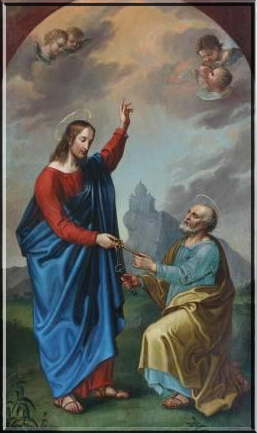
A great historical account exists of the end of Simon's life.  The story recounts events that happened exactly as Jesus said.  The account exists in both Latin and Greek and is called today, The Acts of Peter.  Section 6, labeled Martyrdom of Peter, relates the episode.  Simon is told by Christians close to him in Rome that Agrippa was actively seeking to kill him.  They urged him to leave Rome so that he could continue to teach them from afar.  Peter took their advice, disguised himself, and left Rome.

At the outskirts of the city, Simon saw a man approaching him on the road.  As they passed each other, Simon recognized the other man to be Jesus.  Peter spoke out:


Και ο πετρος ιδων ειπεν αυτω κυριε που ωδε

(Peter noticed him and said, "Lord, where are you going?")

Και ο κυριος ειπεν αυτω εισερχομαι εις την ρωμην σταυρωθηναι

(The Lord said to him, "I am going into Rome to be crucified.")

Και ο πετρος ειπεν αυτω κυριε μου παλιν σταυρουσαι

(Peter replied, "My Lord, are you being crucified again?")

Και ειπεν αυτω ο κυριος ναι πετρε παλιν σταυρουμαι

(The Lord answered, "Yes, Peter, I am being crucified again.")

Και ελθων εις εαυτον ο πετρος και ιδων τον κυριον εις ουρανον ανελθοντα

(Then Peter watched the Lord ascend to Heaven.)

The account went on to say that Jesus' words all those long years ago by the side of the lake flashed through Simon's mind.  It is clear that Simon also remembered Jesus' last instruction to him (John 21.19).

Verse 19b

καὶ τοῦτο εἰπὼν λέγει αὐτῷ· ἀκολούθει μοι

(He then reiterated to Peter, "Follow me.")

Simon could hear again Jesus' voice imprint at the end of his prediction, "Follow me."  That remembered imprint caused Simon to turn to follow Jesus' wish of going back into Rome to suffer crucifixion for his Lord.  All Rome could see the crucifixion of Jesus a second time through his body.

And from his head-downward position on the cross, Simon told the followers of Jesus that had gathered there, the mystery of the cross, namely that everything on Earth is backward to the way of the cross.  Simon quoted Jesus as saying, "Unless you make the things on the right as the things on the left, and the things below as the things above, and the things behind as the things in front, you cannot enter the kingdom of heaven."  Matthew West captures this message from The Martyrdom of Peter wonderfully well in his song, My Finest Hour.


 As time has passed, I have looked on accomplishments that have come my way, what I would consider my finest hours.  They usually led to making life a little better in some way or to giving my children an example.  Only recently have I tried to look on things that have happened and queried Jesus, "Where are you going (with the skills and experiences you have given me?)."  I expect that the answer is the same one Simon received, "I am going into Rome to be crucified again."  I translate that into my own life as "I am visiting your experiences for you to use them for my honor."  So, like Peter, I turn back to take up again what I have done in order to honor God.  

Let it happen.


[Introductory photo of reflection retrieved from http://www.topdesignmag.com/62-impressive-examples-of-reflection-photography.  The second work of art is retrieved from http://catholicharboroffaithandmorals.com/St.%20Peter%20Lives%20of%20the%20Popes.html]
[The first song is Be Not Afraid, I Go Before You Always by Harsh Realm.  The second song is My Finest Hour by Matthew West]
[The Greek text used for the New Testament references is the Nestle Aland 28th edition]
[The Greek text used for the Acts of Peter and the kingdom of heaven quotation of Jesus is taken from The Ancient Martyrdom Accounts of Peter and Paul by David L. Eastman]
[Translations from Greek are my own.]
Thursday, December 22, 2016

Raised voices

Reflections are everywhere - in crystal blue lakes and shining, marble surfaces, in the glass of towering skyscrapers and the concave lenses of ever-present cameras. They capture my thinking and mesmerize me, enticing me to look again because there's more in the picture!


 Nobody really likes for the government to give deadlines and force people to conform.  Not now and not in the Roman Empire of old. The story found in Luke 2.1-20 starts with the oppressive Romans forcing their will once again on their provinces.  It began with a royal decree and with two people in a difficult situation that no one in the world had ever really heard of.  Mary and Joseph were married, yes, but they shared no intimacy until the child was born that Mary was pregnant with.  She was about to deliver that child, so the decree to register at a designated census center was awful timing.  It meant traveling about 3 days on foot, disastrous for a woman ready to deliver a child.  And for what?  Just to register for a census?  The world power Romans were demanding a count of people in its provinces.  Ridiculous!  But the two obeyed the decree.

Joseph and Mary both knew the child would be special.  They had had visitations and dreams that God himself was coming to be with his people through their child.  So far, Joseph and Mary and Mary's cousin Elizabeth had shared this secret.  But, the circle was about to widen.  It would start with this census although Mary and Joseph didn't know that.  Once in Bethlehem, Joseph tried to stay at the local inn, but it had no vacancy.  The innkeeper offered them the stables where the donkeys, sheep, and goats were being kept for his tenants.  Since they didn't have a choice, they took the stable.

It doesn't take much imagination to know what a long journey can do to hasten a pregnant woman's delivery.  Joseph set up an area in the stable for sleeping.  But as he was about to settle in, he heard Mary's cry.

"What is it?" he said, turning to look at Mary as she cried in pain.

"He's coming.  I'm having the baby!"  She could barely draw breath to talk because of the contraction seizing her.

He swung into action.  He ran to get a large bowl of water and a number of cloths for both baby and Mary.  Then he delivered Jesus, their baby boy.  After several trips for water, Joseph had both wife and baby washed and clean.  He wrapped the little baby in a cloth.  Mary and he took turns holding their newborn, gazing lovingly into his face.  After a long while, they all needed rest, so they laid him in the trough filled with hay where usually the animals ate.  He settled down next to Mary to admire the new life that had just come to them and to wonder what might lie in store.  It crossed his mind how much less than ordinary this birth was.  This special child was born away from its home, so no relatives were there celebrating his birth.  He lay in a feed trough in a town not his own where nobody knew of his coming into the world.  After all the messages from God to prepare him and Mary for this birth, surely God from his highest place in the heavens hadn't let this birth slip his notice.

In front of the inn, a group of men were running to its entrance demanding to know if a child had been born to anyone that night.  The innkeeper didn't know, so he said, "No!  Everyone with a room was sleeping."

But, the men were insistent.  "No?" they shouted questioningly.  "The answer cannot be no.  We have just experienced something extraordinary.  There has to be a child here.  The rest of the town is silent.  There would be families together in the houses if one of the women of the town had had a baby.  Someone must be here who has had a baby."


Joseph heard the rising tone of voices in front of the inn.  He roused himself from his and Mary's make-shift bed to see if the excitement was a danger to them.  As he rounded the corner, one of the men ran over to him, "Do you know of anyone who has had a baby tonight?"

"Why?  Who are you?" Joseph asked.

"We are local shepherds.  We were watching a flock just on the other side of this hill."  The man's voice betrayed his uncontained excitement.

"Tell me what you experienced that was so extraordinary?" Joseph asked.

Then Joseph heard the astounding sequence of events that had just occurred outside of town.

Verse 9

καὶ ἄγγελος κυρίου ἐπέστη αὐτοῖς καὶ δόξα κυρίου περιέλαμψεν αὐτούς, καὶ ἐφοβήθησαν φόβον μέγαν

(An angel from the Lord stood beside them and the brilliance of the Lord lit up the countryside around them.  They were seized with terror.)

Verse 10

καὶ εἶπεν αὐτοῖς ὁ ἄγγελος· μὴ φοβεῖσθε, ἰδοὺ γὰρ εὐαγγελίζομαι ὑμῖν χαρὰν μεγάλην ἥτις ἔσται παντὶ τῷ λαῷ

(And the angel said to them.  "Don't be afraid!  I am here to deliver news to you that will bring tremendous happiness to everyone.")

Joseph recognized immediately that  God was now starting to announce the special nature of this child to a broader circle.  Mary lay completely exhausted in the stable trying to sleep, but Joseph knew she would want to hear this story, so he brought the shepherds to her for her to hear.  The shepherds repeated their experience to Mary, then continued telling why the angel said they had appeared to them.

Verse 11

ὅτι ἐτέχθη ὑμῖν σήμερον σωτὴρ ὅς ἐστιν χριστὸς κύριος ἐν πόλει Δαυίδ

(because on this day a savior has been born, who is messiah, Lord, in the city of David )

Verse 12

καὶ τοῦτο ὑμῖν τὸ σημεῖον, εὑρήσετε βρέφος ἐσπαργανωμένον καὶ κείμενον ἐν φάτνῃ

(And here's a sign for you - you will find a baby just born, wrapped and lying in his baby bed)


I would imagine Joseph and Mary were brought to tears recognizing the magnitude of what had happened.  God was starting to make others aware of his plan to be among them in this child.  They had to have been ecstatic.  But, the shepherds were not finished.  "That's not all," they spoke with heightened speech.  "Right after the angel told us about a savior being born..."

Verse 13

καὶ ἐξαίφνης ἐγένετο σὺν τῷ ἀγγέλῳ πλῆθος στρατιᾶς οὐρανίου αἰνούντων τὸν θεὸν καὶ λεγόντων

(Suddenly, with the angel, a crowd of many more angels appeared from the sky with these words: )

Verse 14

δόξα ἐν ὑψίστοις θεῷ 
καὶ ἐπὶ γῆς εἰρήνη
ἐν ἀνθρώποις εὐδοκίας

(Great honor to God in the highest heavens!  
And on Earth, peace.
From its inhabitants, their highest praise!)

"That's why we're here.  We had to come see the new baby boy who deserves our highest praise!"


And people everywhere through all generations since that time continue to come see.  That's because we, as did the shepherds, feel the awe and splendor of someone in the highest heavens announcing to us on Earth - peace.  I, for one, am here with my highest praise to tell the story's beginning again... again... again... again...


[Introductory photo of reflection by David Kingham retrieved from https://www.borrowlenses.com/blog/best-seasons-and-locations-for-night-sky-photography/]
[The first song is Oh, Holy Night by Josh Groban.  The middle song is Let the Heavens Open by Kari Jobe.  The last song is I Heard the Bells on Christmas Day by Casting Crowns]
[The Greek text used is the Nestle Aland 28th edition]
[Translations from Greek are my own.]