Search This Blog

Showing posts with label hermeneutics. Show all posts

Friday, December 29, 2017

When God shows up!

Reflections are everywhere - in crystal blue lakes and shining, marble surfaces, in the glass of towering skyscrapers and the concave lenses of ever-present cameras. They capture my thinking and mesmerize me, enticing me to look again because there's more in the picture!


The Revelation of John
Chapter 16
A Continuation of the Bowls of Wrath

John begins wrapping up his revelation by bringing his last series of 7 to a close.  He pens the sixth and seventh bowls of wrath to set up a catalyst for the culmination of the the book.  He wanted to write about ushering in a new age, the Christian Age, as his assurance to Christians across the empire  by using imagery to depict the crushing of Rome, an evil perpetrator, along with all parties responsible for persecuting Christians.  He tells of a huge battle between the King of kings and the world's leaders in Chapter 19 and a new age to follow.  He begins here with the sixth bowl of wrath.

Verse 12 -

Καὶ ὁ ἕκτος ἐξέχεεν τὴν φιάλην αὐτοῦ ἐπὶ τὸν ποταμὸν τὸν μέγαν τὸν Εὐφράτην, καὶ ἐξηράνθη τὸ ὕδωρ αὐτοῦ, ἵνα ἑτοιμασθῇ ἡ ὁδὸς τῶν βασιλέων τῶν ἀπὸ ἀνατολῆς ἡλίου

(The sixth angel poured out his bowl on the great river Euphrates.  The river became a baked river bed so it could serve as a road for the kings from the lands of the rising sun.)

Isaiah was one of Israel's most revered prophets.  He spoke of doom for Israel in a number of places, one of them being Isaiah 7.  He writes of the hardest times on Earth and a king east of the Euphrates rendering Israel useless as part of the country's punishment for a rebellious spirit.  It's hard to miss the parallel in Revelation 16 since John writes of plagues and disasters striking the Earth and its inhabitants because they persecuted God's people and would not turn from their evil ways.

Another parallel for Revelation 16.12 also exists in a passage in 2 Esdras 15.  That author envisioned a time when God would draw all the nations together, particularly the lands in the east for a large battle.  God would overcome these nations in battle in retribution for the brutalities they had rendered his people.

Verse 13

Καὶ εἶδον ἐκ τοῦ στόματος τοῦ δράκοντος καὶ ἐκ τοῦ στόματος τοῦ θηρίου καὶ ἐκ τοῦ στόματος τοῦ ψευδοπροφήτου πνεύματα τρία ἀκάθαρτα ὡς βάτραχοι

(I saw three, impure spirits appearing as loathesome frogs coming out of the mouths of the dragon, beast, and false prophet.)

John turned next in his writing to the dragon, identified before as Satan in Revelation 12.9 and who had authorized a beast to act and speak on his behalf, presumably Rome's emperor and other leaders, and a second beast as well to aid the first beast, probably the regional governors Rome used to rule the provinces.  The false prophet in verse 13 could be identified as the second beast if John was merely trying to write with variation in terms used.  But, the false prophet could also represent some other power, possibly the Jewish nation since they had resisted turning to the Messiah, Jesus, when he came.  Paul's experiences recorded in Acts and his various letters paint a picture of persecution by Jews across the Roman empire and in the capital city itself.  Finally, John adds a note about the ugliness and loathesomeness of evil leaders who sound a call to arms to battle goodness and honor, that is, a battle against God.

Verse 14

εἰσὶν γὰρ πνεύματα δαιμονίων ποιοῦντα σημεῖα, ἃ ἐκπορεύεται ἐπὶ τοὺς βασιλεῖς τῆς οἰκουμένης ὅλης συναγαγεῖν αὐτοὺς εἰς τὸν πόλεμον τῆς ἡμέρας τῆς μεγάλης τοῦ θεοῦ τοῦ παντοκράτορος

(And even though the three of them are inferior powers, they signaled the kings of all the world's people to gather for battle on the chosen day of God Almighty.)


John interrupts his great battle thoughts for a moment to insert the sudden nature of this battle, or at least the unexpected outcome that will come from this great battle.  Christians had been clamoring for justice for all those responsible for their mistreatment (Revelation 6.10).  John anticipated their next question, "When is this chosen day going to happen?"  So, John answers their question this way.

Verse 15

Ἰδοὺ ἔρχομαι ὡς κλέπτης. μακάριος ὁ γρηγορῶν καὶ τηρῶν τὰ ἱμάτια αὐτοῦ, ἵνα μὴ γυμνὸς περιπατῇ καὶ βλέπωσιν τὴν ἀσχημοσύνην αὐτοῦ

(Watch! I am coming like a thief.  Be sure to keep your clothes close by your bed for a quick escape if you are roused from your sleep so that you won't be seen shamefully walking around naked.)

John then returns to his thought about bringing the kings of the Earth together for battle.  He tells them where the battle will take place.

Verse 16

Καὶ συνήγαγεν αὐτοὺς εἰς τὸν τόπον τὸν καλούμενον Ἑβραϊστὶ Ἁρμαγεδών

(And they gathered in the place called Harmegedon in Hebrew.)
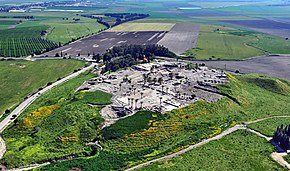

The battle was to be on a hill (הר, har, hill).  But there is more in the use of this word "hill," where the fortress of Megiddo (Megedon) resided, than mere translation offers.  As one can see from the picture at the beginning above, this hill had a walled town on its top.  It commanded a view of the valley.  And, that was important in a time before satellites.  Anyone approaching would be seen miles away. Megiddo lay at a heavily traveled crossroads.  Groups of people constantly traveled this road because it was straight and flat, right across a plain.  Even armies liked to use this road going to and from countries like Egypt enroute to Syria, Assyria, or Babylon. Tracking a group's movements could be done from the hill fortress at Megiddo.  Bringing the kings of the Earth to Megiddo for a fight gave an immediate advantage to God because he could ready himself for battle as he saw the armies approaching.

But, the tactical advantage was not the only reason God was meeting all the kings of the Earth at Megiddo.  Zechariah 12 contains a prophecy of God taking action against all the people of the Earth who have made his people drink from a cup of catastrophe in the same harsh way that they had treated his people all along.  In order for people to understand the depth of the mourning from this devastating blow, John recalled the episode burned into the Jews' memories of the time when all of Judah mourned for the death of one of their own very Godly kings, Josiah.  The peoples of the Earth would experience the same deep mourning that the Jews had experienced for King Josiah who had been fatally wounded at Hadad Rimmon in Megiddo.  John's audience would also understand this reference as a way in which God was avenging his people.  Jeremiah himself had written laments for the king which people had such affection for (2 Chronicles 35.22-25), but for the peoples of the Earth, there would be no such lament, for who would cry out deeply for the desecration and debasement these kings had carried out against God's people over a long period of time.

This passage contains a deeper meaning than merely the place of the battle.  Jews would have had an additional understanding of Hadad Rimmon.  Syria had idols that they worshiped and Hadad and Rimmon were two of them. Hadad, in particular, was the idol's name representing the sun god.  Since John had just written that the 4th angel had poured out his bowl of anger on the sun, and people were burned up by the heat, John presaged his naming of Harmegedon with a bowl of anger poured out on the sun to conjure up the visual of the sun god whose image represented a number of victories made in this plain of Megiddo over a 300-year period against the people of the one true God. This sun god would be vanquished and the victories of old for those who followed this god would be turned into pain for the people who had mistreated God's followers.

Verse 17

Καὶ ὁ ἕβδομος ἐξέχεεν τὴν φιάλην αὐτοῦ ἐπὶ τὸν ἀέρα, καὶ ἐξῆλθεν φωνὴ μεγάλη ἐκ τοῦ ναοῦ ἀπὸ τοῦ θρόνου λέγουσα· γέγονεν

(The seventh angel poured his bowl into the air, and a loud voice could be heard from the throne inside the temple booming out, "It's time to pay up!")

At this point John ends his series of the seven bowls of wrath.  What follows is the culmination of the 7 bowls of wrath.  He had taken care with the first four bowls to represent the plagues of Egypt, the pivotal and seminal event in Jewish history on which everything afterward made sense.  This was followed by the plague of darkness in the fifth bowl.  In Egypt, the plague of darkenss was the precursor to the death blow to the firstborn, the dark hours that led directly to the death of every Egyptian family's firstborn, God's victory against Pharaoh, and the beginning of the era of God's people.

Now for God's new covenant with his people, the Christians, John is making it clear that God is acting in the same seminal and pivotal manner.  Rome's leadership, the new Pharaoh, would experience the same awesome power against them.  God would deliver his new people from their oppression and start them on the path of coming into their own.

Verse 18

καὶ ἐγένοντο ἀστραπαὶ καὶ φωναὶ καὶ βρονταὶ καὶ σεισμὸς ἐγένετο μέγας, οἷος οὐκ ἐγένετο ἀφ’ οὗ ἄνθρωπος ἐγένετο ἐπὶ τῆς γῆς τηλικοῦτος σεισμὸς οὕτως μέγας

(Brilliant bolts of lightning streaked across the sky, noises were everywhere, the rolling of continuous thunder sounded, and such an intensive and extensive earthquake was felt.  One like it had never been seen by humans since they had inhabited the Earth,)

After delivering his people in an astonishing way, supernatural signs and wonders would follow the deliverance as a way of strongly punctuating that the ruler of Heaven and Earth had acted, all people had noticed, and now his people would have their recognition and their revenge.  This had also accompanied the sixth sealed message in Revelation 6.14 and again in Revelation 11.18-19 after the announcement of doom by the seventhth trumpet.  People notice when God shows up.

Verse 19

καὶ ἐγένετο ἡ πόλις ἡ μεγάλη εἰς τρία μέρη καὶ αἱ πόλεις τῶν ἐθνῶν ἔπεσαν. καὶ Βαβυλὼν ἡ μεγάλη ἐμνήσθη ἐνώπιον τοῦ θεοῦ δοῦναι αὐτῇ τὸ ποτήριον τοῦ οἴνου τοῦ θυμοῦ τῆς ὀργῆς αὐτοῦ

(reapportioning the great city into three parts and crumbling the cities of other nations.  The great city of Babylon was brought to God's attention, and he gave them the taste of their own cup of wine, his raging fury)

The last bowl of God's anger is also followed by a reference to Babylon.  This is no mistake and is also a part of the symbolism from Jewish tradition.  The king of Babylon swooped in and sacked Jerusalem in 587/6 BCE and deported many of its people.  He had made quite the entrance onto the stage of Jewish history.  Ever after, the Jews related their great troubles to Babylon's conquering the center of their nation, ridding them of their king, and setting up a puppet government that paid tribute to its king and its pantheon.  However, God had a whole series of pophecies against Babylon for their terrible treatment of the Jews.  Jeremiah 50.28, 29, 45, 46 contain representative verses of what God would do to avenge the treatment of "Babylon." So, to punish "Babylon" in John's time, Rome was "rearranged" by the earthquake that no one had ever seen the intensity of before.

Verse 20

καὶ πᾶσα νῆσος ἔφυγεν καὶ ὄρη οὐχ εὑρέθησαν

(All islands disappeared from view, and mountains were nowhere to be seen.)

Verse 21

καὶ χάλαζα μεγάλη ὡς ταλαντιαία καταβαίνει ἐκ τοῦ οὐρανοῦ ἐπὶ τοὺς ἀνθρώπους, καὶ ἐβλασφήμησαν οἱ ἄνθρωποι τὸν θεὸν ἐκ τῆς πληγῆς τῆς χαλάζης, ὅτι μεγάλη ἐστὶν ἡ πληγὴ αὐτῆς σφόδρα

(Immense, hundred-pound hailstones dropped from the sky on people below, who cursed the god of this plague because it was so brutal and unrelenting. )

The last two verses are clear references to the way the Old Testament viewed an outpouring of God's vengence against men, as found in Micah 1.3, Habakuk 3.6, and Ezekiel 26.15-20.  John had used this imagery as the basis already for Revelation 6.14 and 11.18-19. In addition, he recalls Old Testament prophecies like the ones in Zephaniah, and in particular Zephaniah 3.6-8.  And John uses exact wording matches to Exodus 9.23-24 where God directs a hailstorm to hit Egypt like no one had ever seen before in order to convince Pharaoh to let his people go.  Using all of the catasrophic doom imagery of the Old Testament, John was showing the Christians that the same message God had always used for his people who had been mistreated, he was telling them now.  God would deliver his people so that there would be no mistaking that his enemies had met their day of reckoning and would have no way to escape his anger.

Accompanying the Old Testament allusions in John's writing is the echo of other apocalyptic books written before or contemporary with John's apocalypse.  The apocalypses of 2 Enoch, 2 Baruch, 2 Esdras, and the Sybilline Oracles all talked of an age when a messiah, a son of man, or at least a savior would return and usher in a new age.  Particularly, 2 Esdras 15 is parallel to Revelation 16.  The author writes about countries that oppressed God's people as Egypt had done, and their deliverance followed plagues and disasters like he had brought on Egypt at an earlier time.  He spoke of kings from the east gathering to oppose God in battle.  He wrote of supernatural signs that accompanied God's destruction of nations, a blazing sun to burn up sinners, and terrible storms of hail, and flashing swords.  He also speaks of Rome as Babylon and its provinces as Rome's prostitutes who would also be destroyed.  Perhaps, these beliefs were circulating at the end of the first century and beginning of the second, causing the same material to be used in both books, or perhaps one of the books served as a blueprint for the other.  Whatever the case, John in Revelation assured Christians living at that time that God was acting on his people's behalf for their mistreatment at the hands of Rome and its provincial governments.


The message at the end of the bowls of wrath is not the end of time.  Instead, God was going to show up for his people.  He would usher in a new age, the era of his only son.


Even 2000 years removed from John's writing, I cannot help but read what God did to deliver to his people and be reassured that the same God still shows up time after time - for his people and for me as his follower.  He delivered his people the Jews.  He delivered his people the Christians.  He will fight my oppressors too.  Rome has passed into oblivion, but modern oppressors still fight hard to debase those who follow God's only son.  When I see that oppression, I nod knowingly, believing that God shows up with 100-pound hailstones to pound those who curse his name and never turn from their ways of insulting him and his people.

God still delivers.  It's one of his most resounding messages.  And I give him my heart because he shows up - still - and forever!


[Introductory photo of reflection is found at boredpanda.com]
[The first song is Gracious Tempest by Hillsong Young and Free.  The second song is Do It Again by Elevation Worship.]
[The Greek text used for the New Testament references is the Nestle Aland 28th edition]

[Translations from Greek are my own.]


Saturday, March 18, 2017

Finality? Not on your life!

Reflections are everywhere - in crystal blue lakes and shining, marble surfaces, in the glass of towering skyscrapers and the concave lenses of ever-present cameras. They capture my thinking and mesmerize me, enticing me to look again because there's more in the picture!

When Doing Battle with Gazing Globe
by Lynnette Henderson

Death for four decades of my life was such a note of finality.  Yes, I knew about the resurrection.  Yes, I knew that Jesus provided his followers the promise of life after death.  And, yes, I believed in that I would be "raised" after I die to live in a place called Heaven.

But, death has a different aspect to it now for me.  At the end of four decades my son died an agonizing death from a rare bone cancer.  I went through every agonizing moment of his life between diagnosis and his departure along with my wife and daughter.  His death immediately affected all three of us, and over time we have all three sought God in very different ways.

But this blog is not about my son's death.  It was the starting point to a new aspect about life.  It started with the selection of John 14.2,3 to be read at my son's graveside service.


Verse 2

ἐν τῇ οἰκίᾳ τοῦ πατρός μου μοναὶ πολλαί εἰσιν· εἰ δὲ μή, εἶπον ἂν ὑμῖν ὅτι πορεύομαι ἑτοιμάσαι τόπον ὑμῖν

(In my father's compound are many rooms. If not so, then would I have said, "I go to make a place ready for you?")

Verse 3

καὶ ἐὰν πορευθῶ καὶ ἑτοιμάσω τόπον ὑμῖν, πάλιν ἔρχομαι καὶ παραλήμψομαι ὑμᾶς πρὸς ἐμαυτόν, ἵνα ὅπου εἰμὶ ἐγὼ καὶ ὑμεῖς ἦτε

(And if I have gone away to make a place ready for you, then I am coming back for you to join me so that where I am, you can be too.)

At the beginning of seeing with new eyes, I read this as a place to go.  But, as I have reflected many a time on this passage, I see that Jesus is talking about leaving this place, the Earth, merely going to another place to make some preparations.  Death was merely the break point between the two.  There is no separation at death, no note of finality, nothing to show a time lapse of dying, going through a Judgment Day, then "making it" to Heaven.  There is only mention of Jesus coming again so that we can join him in specially prepared family accommodations.  Jesus said it himself, "I came to give you life and an extraordinary place.  Life here, life there... no death, merely transition, merely exchange of one environment for another.


That was the start of considering again what Jesus offers his followers.  Then I started noticing Jesus' statements about life.  It didn't seem that he was talking about the way we lived our lives on Earth to obtain a position in an afterlife.  His idea of life was what happens at conception and stops when the body wears out or whose heart stops.  But the emphasis was not on what stops, but what is interrupted here on Earth, but continues in a dimension not known or seen by those left behind.  When I read for the thousandth time Jesus' conversation with his Twelve one day about a good shepherd, I thought I might have a grasp on Jesus' idea for life.

John 10.17-18

Verse 17

Διὰ τοῦτό με ὁ πατὴρ ἀγαπᾷ ὅτι ἐγὼ τίθημι τὴν ψυχήν μου, ἵνα πάλιν λάβω αὐτήν

(It's for this reason that my father loves me.  I lay down my life just to take it back again.)

Verse 18

οὐδεὶς αἴρει αὐτὴν ἀπ’ ἐμοῦ, ἀλλ’ ἐγὼ τίθημι αὐτὴν ἀπ’ ἐμαυτοῦ. ἐξουσίαν ἔχω θεῖναι αὐτήν, καὶ ἐξουσίαν ἔχω πάλιν λαβεῖν αὐτήν· ταύτην τὴν ἐντολὴν ἔλαβον παρὰ τοῦ πατρός μου

(No one takes it from me.  I lay it down of my own accord.  I have the authority to lay it down and take it up again.  This charge I have obtained from my father.)

When Jesus was on trial before Pilate, Pilate tried to play the life and death card with Jesus where death is so final (John 19.11).  Pilate thought Jesus was being too coy and complacent with him for Jesus to be in such dire straits.  So, Pilate told Jesus he had the power to stay his execution or command his execution.  Jesus replied,

Verse 11

ἀπεκρίθη [αὐτῷ] Ἰησοῦς· οὐκ εἶχες ἐξουσίαν κατ’ ἐμοῦ οὐδεμίαν εἰ μὴ ἦν δεδομένον σοι ἄνωθεν· διὰ τοῦτο ὁ παραδούς μέ σοι μείζονα ἁμαρτίαν ἔχει

(You have no authority over my life except what is given to you from above.  So, those who delivered me to you have a greater wrong.)

So, my mind finally saw that following Jesus gives me access to life (not a synonym for lifestyle).  The life that comes into us in a mother's womb and that stops at our last heartbeat... unless, of course, we have decided that Jesus is God's son, in which case life does not stop when our heartbeats quit.  We simply have a transition from one place where a certain type of life existed to another place, made ready for us when we join Jesus.  Life is laid down on a planet in a solar system, taken up again in a dimension elsewhere.  Our DNA encodes when our heart will wear out given a certain set of circumstances, much like Pilate's dictate to Jesus.  But, I hear the words Jesus spoke to our DNA by extension of his answer to Pilate, "You have no authority over my life."

That added nuance of insight for me has liberated me from thinking that I would die, my life stopped, my lifestyle evaluated, my soul making the lifestyle cut and spirited away to Heaven at some future point in time.  My new way of thinking allows me to live freely here, honor God, acknowledge his son and his teaching, and transition to live freely again in another dimension.  Death is robbed of its note of finality.

"My soul will dance on the wings of forever."


[Introductory photo of reflection is When Doing Battle with Gazing Globe by Lynnette Henderson and retrieved from https://www.flickr.com/photos/lynnette_henderson/2513227934/.  The second work of art Welcome Home is by Danny Hahlbohm and retrieved from http://www.fulcrumgallery.com/Danny-Hahlbohm/Welcome-Home_663673.htm]
[The first song is Say the Word by Hillsong United.  The second song is Touch the Sky by Hillsong United]
[The Greek text used for the New Testament references is the Nestle Aland 28th edition]
[Translations from Greek are my own.]

Thursday, January 19, 2017

Walking away from Rome

Reflections are everywhere - in crystal blue lakes and shining, marble surfaces, in the glass of towering skyscrapers and the concave lenses of ever-present cameras. They capture my thinking and mesmerize me, enticing me to look again because there's more in the picture!


The words were uttered on the side of a lake.  They would have been easy to miss.  The situation started with Jesus' question, "Do you care about me?" and ended with "Follow me."  Between these phrases, most of the dialog was about Jesus letting Simon know that he would be counting on him to guide his followers.  But all of that dialog was foretelling how Simon would spend his life.  At the tail end of the Q&A part of the conversation in John 21.18-19, Jesus foretells Simon's death.  The remark is easy to miss, especially when reading for gist.

The short remark was to forewarn Simon of a difficult death.  Simon could easily see the metaphor of protection and provision for Jesus' little lambs before Jesus finished speaking to him, which is what Jesus wanted him to do.  But, the statement that followed the Q&A was less metaphorical and more matter of fact.  Jesus knew Peter's last day wouldn't be a soft landing at the end of an illustrious life.  He separated his guidance portion from the death forewarning with the repetition of the word  ἀμὴν (amen or something on the order of "truthfully").  Jesus wanted him to know not to expect to go softly into the dark on his last day.  His reward would be only, but certainly, in the next life.  So Jesus began:

Verse 18a

Ἀμὴν ἀμὴν λέγω σοι, ὅτε ἦς νεώτερος, ἐζώννυες σεαυτὸν καὶ περιεπάτεις ὅπου ἤθελες

(Here's the truth.  When you were younger, you got yourself ready and went wherever you wanted to go.)

Yes, Simon was young in the early days of The Way.  He had the energy and charisma to lead the little lambs to a robust belief in Jesus' Way.  He would lead in Jerusalem in the face of the Jews that wouldn't recognize Jesus as messiah, in Corinth in the face of gnostics who would spiritualize Christianity into simply an inner light for a serene life, and in Rome in the face of the most brutal and indifferent masters of a world empire.


But, Jesus continued speaking:

Verse 18b

ὅταν δὲ γηράσῃς, ἐκτενεῖς τὰς χεῖράς σου, καὶ ἄλλος σε ζώσει καὶ οἴσει ὅπου οὐ θέλεις

(But when you get old, you will raise your hands for someone else to get your ready and take you where you don't want to go.)

Yes, Simon would grow old.  He would cross paths with powerful people and stand for the faith, but eventually one of those powerhouses would be his nemesis, leading him down a path he would not want to travel.  His life would end.

Verse 19a

τοῦτο δὲ εἶπεν σημαίνων ποίῳ θανάτῳ δοξάσει τὸν θεόν

(He said this to signify what kind of death he would honor God with.)

A great historical account exists of the end of Simon's life.  The story recounts events that happened exactly as Jesus said.  The account exists in both Latin and Greek and is called today, The Acts of Peter.  Section 6, labeled Martyrdom of Peter, relates the episode.  Simon is told by Christians close to him in Rome that Agrippa was actively seeking to kill him.  They urged him to leave Rome so that he could continue to teach them from afar.  Peter took their advice, disguised himself, and left Rome.

At the outskirts of the city, Simon saw a man approaching him on the road.  As they passed each other, Simon recognized the other man to be Jesus.  Peter spoke out:


Και ο πετρος ιδων ειπεν αυτω κυριε που ωδε

(Peter noticed him and said, "Lord, where are you going?")

Και ο κυριος ειπεν αυτω εισερχομαι εις την ρωμην σταυρωθηναι

(The Lord said to him, "I am going into Rome to be crucified.")

Και ο πετρος ειπεν αυτω κυριε μου παλιν σταυρουσαι

(Peter replied, "My Lord, are you being crucified again?")

Και ειπεν αυτω ο κυριος ναι πετρε παλιν σταυρουμαι

(The Lord answered, "Yes, Peter, I am being crucified again.")

Και ελθων εις εαυτον ο πετρος και ιδων τον κυριον εις ουρανον ανελθοντα

(Then Peter watched the Lord ascend to Heaven.)

The account went on to say that Jesus' words all those long years ago by the side of the lake flashed through Simon's mind.  It is clear that Simon also remembered Jesus' last instruction to him (John 21.19).

Verse 19b

καὶ τοῦτο εἰπὼν λέγει αὐτῷ· ἀκολούθει μοι

(He then reiterated to Peter, "Follow me.")

Simon could hear again Jesus' voice imprint at the end of his prediction, "Follow me."  That remembered imprint caused Simon to turn to follow Jesus' wish of going back into Rome to suffer crucifixion for his Lord.  All Rome could see the crucifixion of Jesus a second time through his body.

And from his head-downward position on the cross, Simon told the followers of Jesus that had gathered there, the mystery of the cross, namely that everything on Earth is backward to the way of the cross.  Simon quoted Jesus as saying, "Unless you make the things on the right as the things on the left, and the things below as the things above, and the things behind as the things in front, you cannot enter the kingdom of heaven."  Matthew West captures this message from The Martyrdom of Peter wonderfully well in his song, My Finest Hour.


 As time has passed, I have looked on accomplishments that have come my way, what I would consider my finest hours.  They usually led to making life a little better in some way or to giving my children an example.  Only recently have I tried to look on things that have happened and queried Jesus, "Where are you going (with the skills and experiences you have given me?)."  I expect that the answer is the same one Simon received, "I am going into Rome to be crucified again."  I translate that into my own life as "I am visiting your experiences for you to use them for my honor."  So, like Peter, I turn back to take up again what I have done in order to honor God.  

Let it happen.


[Introductory photo of reflection retrieved from http://www.topdesignmag.com/62-impressive-examples-of-reflection-photography.  The second work of art is retrieved from http://catholicharboroffaithandmorals.com/St.%20Peter%20Lives%20of%20the%20Popes.html]
[The first song is Be Not Afraid, I Go Before You Always by Harsh Realm.  The second song is My Finest Hour by Matthew West]
[The Greek text used for the New Testament references is the Nestle Aland 28th edition]
[The Greek text used for the Acts of Peter and the kingdom of heaven quotation of Jesus is taken from The Ancient Martyrdom Accounts of Peter and Paul by David L. Eastman]
[Translations from Greek are my own.]

Tuesday, November 22, 2016

So like me

Reflections are everywhere - in crystal blue lakes and shining, marble surfaces, in the glass of towering skyscrapers and the concave lenses of ever-present cameras. They capture my thinking and mesmerize me, enticing me to look again because there's more in the picture!


It was near Caesarea Philippi that Jesus tested the waters with the question of who he was (Matthew 16.13-20).  Peter reacted as Jesus had hoped, so he knew that Peter was representative of those who had followed his teachings.  His time of teaching and healing was to the point he could leave.  From then on, Jesus pressed to go to Jerusalem.  He had to be face to face with the Jewish leaders, the scholars and groups of Jews who were regarded as the keepers of the Law by the rest of the Jewish nation, to get them to give him due consideration.  Several days later, his meeting and conversation with Moses and Elijah again spurred him to turn his attention to Jerusalem (Matthew 17.1-13).  The stage had been set.

The Twelve followed Jesus into Jerusalem, not realizing that the end was imminent for him.  Matthew presented the public conversation between Jesus and those who represented the only true God on the Earth.  It was clear from the time Jesus entered Jerusalem that the Jewish establishment wasn't going to give him due consideration.  The hours were disappearing.  Jesus was on his collision course with crucifixion.  He knew he had only a moment in time to point out what was happening on Earth here in the heart of the Jewish nation.  He had distinctly different impressions of the Jewish leaders than they did of themselves.  His portrayal of them in Matthew 23 was a clear, unmitigated peeling back the layers of behavior the Jewish leaders had hidden behind for hundreds of years.  He wanted the people to know that they were being misled, misguided, and mistaught.  Jesus began by saying not to imitate the scholars and Pharisaical leaders, and then he exposed their layers one comparison at a time.  His last comparison is recorded in verses 27 and 28.

Verse 27

Οὐαὶ ὑμῖν, γραμματεῖς καὶ Φαρισαῖοι ὑποκριταί, ὅτι παρομοιάζετε τάφοις κεκονιαμένοις, οἵτινες ἔξωθεν μὲν φαίνονται ὡραῖοι, ἔσωθεν δὲ γέμουσιν ὀστέων νεκρῶν καὶ πάσης ἀκαθαρσίας

(Oh-h-h you actors and interpreters - scholars of the Talmud and Pharisees - how disgusting!  You are like tombs that have been whitewashed on the outside, making it clear that dead men's bones and all that is unclean lie behind the rock.)

A tradition had grown up over a couple hundred years with whitewashing tombs.  The stone to the cave of the tomb was painted white as a sign to all that the cave was a tomb so that  people could be warned that this was an unclean place.  The comparison was obvious to Jesus.  The scholars and Pharisees had painted themselves white with all of their demands on those who were giving their best to follow the law.  But everyone could see through their pious facades to the lifeless motions behind.

Jesus was adamant.  The people supposed to be representing God weren't.  Not even a little. They should have been understanding of the human condition.  But no.  They didn't have the desire to accept those who had gone on long journeys with their inheritances, hit bottom in pig sties, and returned to the one who loved them.  They should have helped each other stand against lures that pulled them from the straight and narrow.  But no.  They didn't have the commitment to those succumbing to temptation to stoop and write in the sand to stave off accusers.  They should have turned a listening ear to those who had had life throw them curves.  But no.  They didn't have the compassion for their fellow Jews who had been beat up by life, passing by, instead, with turned heads, leaving someone that they disapproved of to show kindness.

They ignored completely incidents like men getting together to bring a lame friend to Jesus for healing.  And when they found it impossible to get their friend in front of Jesus because of the crowds, they jostled him to the roof, sawed a hole in it, tied ropes to the four corners of his crudely fashioned mat frame, and lowered him to Jesus' feet.  They failed to stand with reckless abandon in the presence of the Almighty, calling out his name, acknowledging that he was all around them in the many and monumental acts of acceptance, kindness, compassion, patience, and mercy of Jesus.  Even dead children and adults were raised to life as they watched.  How could they not look to the skies, then fall to their knees with the name of Yahweh on their lips?!!


Jesus often used puns and he did so here, too, with a metaphor. The words φαίνονται ὡραῖοι, translated "making it clear," has a remote meaning on occasion of "making it beautiful."  Whitewashing was a way to dress up the tombs, making them as attractive as possible, distracting onlookers from knowing the uncleanness inside.  Such were the leaders of the Jewish nation.

Verse 28

οὕτως καὶ ὑμεῖς ἔξωθεν μὲν φαίνεσθε τοῖς ἀνθρώποις δίκαιοι, ἔσωθεν δέ ἐστε μεστοὶ ὑποκρίσεως καὶ ἀνομίας

(This is so like you.  Outwardly you want it to be clear that you are doing all the right things, but inwardly you are actually acting a part, delivering a good speech, and bending rules.)

On the surface, these piercing words against the scholars and Pharisees seem uncharacteristic of Jesus' acceptance of others and his willingness to give people second chances.  On the other hand, the timing of his words make them particularly astute.  In about 48 hours, he would sit around a table to observe the Passover meal, take bread and wine, pass them to each of his Twelve, and announce to them a new covenant that he wanted to make with them.  Very noticeably, Jesus wanted to make this new covenant a time to remember him, his ways, and his teachings - teachings distinctly different from the Jerusalem crowd's "acting, interpreting, and bending rules."  He was replacing the Jewish established leaders as God's representatives on Earth.  He, the Son of Man, the Messiah, the Son of God was offering life and a genuine way of following God to those who would remember him till he came again.  The inner and outward values would be the same genuine article, not arbitrary or merely oratorical.

Something I cannot ignore powerfully draws my attention to these two sayings.  Jesus used the word ὑποκριταί  to refer to the leaders in Jerusalem.  The word was used in a couple of ways.  First, it was used to mean an actor in a play.  Second, it was used of an orator delivering his promises or of an interpreter of what was being said.  Used in Jesus' context, the terms showed how poor an interpreter the leaders had become and how memorized their lines were.  They were lame actors, languid interpreters.  The second, saying uses a different form of the noun, ὑποκρίσεως, meaning the part of an actor, the delivery of the speech, or the manner in which something was translated.  The meanings applied not to the people themselves, but to their actions.  All the Jewish leaders had to do was to look back on their actions... and there were many because their lives were full of them.  On top of that, Jesus framed both sayings in a μὲν ...  δὲ sentence structure.  This structure is perfect for showing absolute contrasts in meaning.  The first statement shows one reality, the second an opposite but equally true reality.  It was one of the Greek ways of showing a particularly poignant paradox.  The leaders themselves could not miss the starkness of how Jesus was portraying them.  Over the next two days they would not rest until they had captured him in the dead of night, accused him of blasphemy against God, and delivered him to the Roman governor who would execute him by morning.

Jesus' words here speak to me deep in my heart.  My tendency to judge others' actions while seeing my own actions without judgment cuts me.  That tendency should have been overridden years ago. All humans are hypocritical in one way or another.  So, who really can cast the first stone?  And Jesus is right.  The judgment I project on others is really just a sign of the rottenness I hide.  My judgment of others boomerangs to judgment on myself, creating a cycle.  The cycle forms a chain, one round link inside another round link, inside another round link, chaining me to acting, pleasing words, and poor translations of God's principles for my life.  But, I hear Jesus' words and realize I need to stop the rattle of those chains because there's a better life, an authentic life.


[Introductory photo of reflection retrieved from http://penniur.upenn.edu/publications, taken by Jason Mirachina]
[The first song is At Your Name by Phil Wickham.  The last song is Chain Breaker by Zach Williams]
[The Greek text used is the Nestle Aland 28th edition]
[Translations from Greek are my own.]
Sunday, September 4, 2016

Break-out

Reflections everywhere capture my thinking - in crystal blue lakes and shining, marble surfaces, in the glass of towering skyscrapers and the concave lenses of ever-present cameras - and mesmerize me, enticing me to look again because there's more in the picture!


It was the end of his life on Earth.  He knew it.  He had deliberately come to Jerusalem in order to encounter the Jewish leaders in the heart of the teaching center of Judaism.  Jesus knew they wouldn't tolerate him any longer, brand him as a heretic, and kill him.  The time in Jerusalem had gone exactly as he had thought it would (or exactly as was planned).

But, his Twelve didn't know this was the end of his life on Earth.  He had to make certain that they understood the unfolding events to the fullest extent possible.  In John 16, Jesus begins by telling the Twelve about events that would happen after he left, such as being ostracized from synagogues, and being martyred.  The purpose was to reveal ahead of time some events so that they would not lose their faith.

He also had a second purpose.  Jesus needed to let them know about someone else - someone who would follow him.  His end was the beginning of the time when another would come to stand beside each of them.  In all their endeavors, they would come to count on this third person to be by their sides.  The Twelve had to be introduced.  And this was the time.

Verse 7

ἀλλ’ ἐγὼ τὴν ἀλήθειαν λέγω ὑμῖν, συμφέρει ὑμῖν ἵνα ἐγὼ ἀπέλθω. ἐὰν γὰρ μὴ ἀπέλθω, ὁ παράκλητος οὐκ ἐλεύσεται πρὸς ὑμᾶς· ἐὰν δὲ πορευθῶ, πέμψω αὐτὸν πρὸς ὑμᾶς

(Truthfully, it is better for you that I leave this world.  If I don't leave, the one who will stand beside you and help you cannot come to you.  If I leave, I can send him to you.)

Jesus answered what the obvious questions would have been if he had stopped talking.  The questions on the table would have been, "When he comes, what exactly will he say or do?  How will he help us?"  But the Twelve didn't have a chance to ask; Jesus knew they needed to know because they lived in a world at large that didn't have a clue what was happening in Judea, nor did they care, and because they lived in a land where people of their own kind would represent God differently than the way Jesus had represented him.  Both groups of people had "worldly notions."

Verse 8

Καὶ ἐλθὼν ἐκεῖνος ἐλέγξει τὸν κόσμον περὶ ἁμαρτίας καὶ περὶ δικαιοσύνης καὶ περὶ κρίσεως

(When he comes, he will refute worldly notions about failure and guilt, about decent living, and about sitting in judgment of others.)


That probably was enough information to answer the obvious question the Twelve would have had.  But, Jesus took it a step farther.  He gave the reasons for his answer.  The Greek word μέν is a word used to show that what followed would be connected to the statement that went before it, usually by way of explanation.  The Greek word δέ following the clause with μέν created a series of parallel phrases that explain.  In this case there were two additional parallel phrases.  This rhetorical formula was perfect for Jesus to succinctly clarify his answer.

Verse 9

περὶ ἁμαρτίας μέν, ὅτι οὐ πιστεύουσιν εἰς ἐμέ

(He will verify what I said about failure and guilt by showing what happens when people don't believe me.)

Verse 10

περὶ δικαιοσύνης δέ, ὅτι πρὸς τὸν πατέρα ὑπάγω καὶ οὐκέτι θεωρεῖτέ με

(He will verify what I said about decent living by showing that I did go back to the father after you didn't see me anymore.)

Verse 11

περὶ δὲ κρίσεως, ὅτι ὁ ἄρχων τοῦ κόσμου τούτου κέκριται

(And he will verify what I have said about sitting in judgment by showing that the ruler of this world has been tried and condemned.)


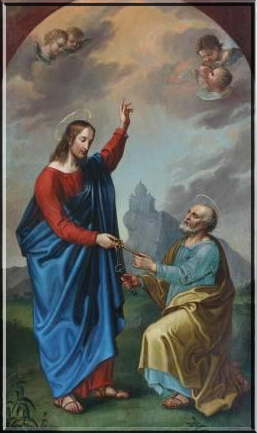
When a person works with an artist, all the artist needs is the idea, then we can appreciate the idea through the artist's representation of this idea.  People can do this for themselves with the website fotosearch.com by typing in a word in the search bar and then scrolling through the 25,000 photos of the idea.  If I type in summer, I am returned thousands of images of summer, all different, all representations of the season.  In such a way, a linguist can take the words on the surface of an utterance and peer into the mind of a person as to the meanings being represented by words.

One can hear some deafening sounds coming from the words being used here.  The three ideas of failure and guilt, decent living, and sitting in judgment are what the Jews specialized in when it came to representing their law.  They had a narrow view of creating their system of justice for not living what they considered to be a decent life, ostracism and negative critique being a part of it.  The world beyond the Jews was no better.  Their idea of justice, might makes right, made for a harsh and brutal society.  I am deafened by the ideas of bound, break out, and freedom.  The Jews seem to have set themselves up for failure since they expected human beings to miraculously perform to the letter of their law, which was layered with traditions and well-intended rabbis' applications.  Honor, too, was in the world at large, but it was a table set for family members and strong men mostly.  Others were just miserable failures.  I can't help but hear the idea that those outside the ring of honor could not be helped and never would amount to much in life.  And, the idea of judgment came in many forms, but one of the most prevalent was the prestige games of trying to be better than or keep up with the Joneses.  Most people couldn't be better, allowing the ones who were, to condescend to them and judge them as worthless.

Jesus had taught about all three of those ideas.  Now he was turning his teaching over to someone else, someone who couldn't come until he departed.  The Twelve had to know so that they could tell others.  There is another person coming after Jesus leaves.  He will refute the deafening noises of the worldly notions about decent living, failure and guilt, and judgment.  He will verify what Jesus had taught.  He will stand beside them to help them break free of ostracism, low self esteem, and low caste in society.


The Twelve were faithful to tell Christians who followed their generation, and they to the generation after them, and they....  Even today, one of the main differences between my world view and many of the acquaintances I have, is my honor, contentment, and guilt-free mode of operation because of the verification of the appropriateness of Jesus' teachings against their belief of ostracism, prestige, and condemnation of others.  I am free of their view, not bound by it in any way.  People, of course, can't see Jesus anymore, but they see me and the reflection of the one that stands beside me helping me break out.  Yes, that's right.


[The beginning song is Does anybody hear her by Casting Crowns, the second song is Broken Girl by Matthew West, the ending song is Grace Wins by Matthew West]
[Introductory artwork retrieved from http://www.fotosearch.com/CSP859/k8597169/]

[The Greek text used is the Nestle Aland 28th edition]
[Translations from Greek are my own.]


Saturday, August 27, 2016

News on developing faith

Morsels of food are delicious because of the little things, the subtle seasonings, the dash of salt, the sprinkle of garlic, the garnish of parsley, the touch of glaze, or the hint of lemon.  Ahhhh - so delicious!


At the beginning of Matthew 18, Jesus is dealing with the idea of "greatness" because his twelve still had the value system of the society around them.  Jesus would change that idea for them over time.  But, on this occasion, he called a child over to the group of men to begin his reconditioning of their thinking.

He began by saying some easy things like become as a little child to enter his kingdom and accept and welcome a little child and in so doing welcome Jesus himself.  He went on to some ideas harder to put into practice such as the verses listed below.  Perhaps Jesus' comments were literal, perhaps metaphorical, but they are hard to achieve.

Verse 6

Ὃς δ’ ἂν σκανδαλίσῃ ἕνα τῶν μικρῶν τούτων τῶν πιστευόντων εἰς ἐμέ, συμφέρει αὐτῷ ἵνα κρεμασθῇ μύλος ὀνικὸς περὶ τὸν τράχηλον αὐτοῦ καὶ καταποντισθῇ ἐν τῷ πελάγει τῆς θαλάσσης

(The ones who would put an obstacle in the way of little ones who trust me, would be better off hanging a grinding stone for grain around their necks and drowning themselves out in the open sea.)

Verse 7

Οὐαὶ τῷ κόσμῳ ἀπὸ τῶν σκανδάλων· ἀνάγκη γὰρ ἐλθεῖν τὰ σκάνδαλα, πλὴν οὐαὶ τῷ ἀνθρώπῳ δι’ οὗ τὸ σκάνδαλον ἔρχεται

(How terribly bad it will be for the world because their obstacles inevitably come, but it will be especially terrible for the person responsible for the obstacle.)

Verse 8

Εἰ δὲ ἡ χείρ σου ἢ ὁ πούς σου σκανδαλίζει σε, ἔκκοψον αὐτὸν καὶ βάλε ἀπὸ σοῦ· καλόν σοί ἐστιν εἰσελθεῖν εἰς τὴν ζωὴν κυλλὸν ἢ χωλὸν ἢ δύο χεῖρας ἢ δύο πόδας ἔχοντα βληθῆναι εἰς τὸ πῦρ τὸ αἰώνιον

(If your hand or foot gets in the way of having a good life, remove it.  It is better for you to participate fully in life crippled than to participate with two hands and feet and wind up being thrown into the eternal fire.)

Verse 9

καὶ εἰ ὁ ὀφθαλμός σου σκανδαλίζει σε, ἔξελε αὐτὸν καὶ βάλε ἀπὸ σοῦ· καλόν σοί ἐστιν μονόφθαλμον εἰς τὴν ζωὴν εἰσελθεῖν ἢ δύο ὀφθαλμοὺς ἔχοντα βληθῆναι εἰς τὴν γέενναν τοῦ πυρός

(And if your eye is an obstacle to good living, take it out and throw it away.  It is better for you to participate fully in life with one eye than to participate with two eyes and wind up being thrown into the despicable fires of the Valley of Hinnom.)

Two ideas stand out in these verses that make Jesus' point.  Each one of the 4 verses uses either the noun form or verb form of σκανδαλίζει (to put an obstacle in the way).  After telling the Twelve that they should become like children, he next had a message for those practicing Judaism.  Don't change the trust factor that little children had in their Heavenly father.  The literal interpretation is daunting.  As children become adults in the world, there are many, many opportunities for them to dump trust in God and direct their trust elsewhere.  That's why he made the statement about "the world's" obstacles that appear for everyone.  The Romans and every other nation under the sun had their own beliefs about gods and lifestyles.  Jesus told them that it would not go well for them ultimately.  


But, he also personalized the statement to responsible parties who make life rough enough on children to make them switch loyalties from God to something else.  As a parent, I know how easy it is to get in the way of a teenager's developing faith.  Intentions to take soft or hard lines can have backlashes on faith that redirect a teen's fragile faith.  Guiding one from child to adult required me to be the responsible party.  In light of Jesus' words that task was daunting because I was not a perfect, responsible party.  At some point the child is responsible for his or her own faith, but parents standing in that gap between childhood and adulthood as a guide know the perilous nature of that decade's journey from 10 to 20.


If the words are more figurative in nature, then the peril doesn't disappear from the situation.  We all go through different stages of faith.  We can look back to a time when our faith was developing.  What kind of voice did we listen to?  Whose choices of what was important for lifestyle habits did we look around to adopt from?  Which books did we read to develop faith.  And when we were more mature, if I was one of the voices someone listened to, then what did that person younger in faith hear me say?  If my lifestyle was under scrutiny from someone who respected me, then what in it was worth adopting?  And, if someone heard my teaching, from a book, class, counsel, or casual conversation, then did it further develop trust in God or deflect that trust to another place or entity?


The other idea in the passage is that of how a person's life ends.  Jesus used his typical reference to a terrible end, the Valley of Hinnom.  The reference is to the days of King Ahaz of Judea.  He built an idol to Ba'al there for people to worship, even sacrificed his own sons there to the God Molech as did others.  The story is carried in 2 Kings 23.10, 2 Chronicles 8.3, and Jeremiah 32.35.  The fires that burned in the valley were kept going for a long period of time.  The Jews eventually had a change of heart.  The fires of Hinnom became the place to burn animal carcasses in order to show their disgust for what previously had happened there.  Eventually, all kinds of garbage was incinerated there, so the fires never went out.  The connotation of the place was one of "despicable" fires in this valley.  Because the Jews kept the fires going over such a long period of time, they were also referred to as the eternal fire.


Some say the first is referring to not misleading literal children and the second is the figurative rendering of Valley of Hinnom's fire as hell's fire.  Others say that the first is meant as a figure of speech not to lead people who have young faith astray and the second is the literal rendering of the image of the despicable fires of Hinnom.

Either way, I know that during the many years of my Christian journey I have violated the principle involved .  I have pushed ideas that others were not ready to accept.  I argued for ideas that worked for me at my various stages of understanding, but that didn't benefit others at their stages of understanding.  For my lack of insight, I depend on God's forgiveness, his grace.  I try much harder these days to understand the principles at work in Jesus' teachings.  This determination is at the heart of the blogs I write.


[The beginning song is Never Too Late by Three Days Grace, the ending song is Handprints on the Wall by Kenny Rogers]
[Introductory artwork retrieved from
http://images.clipartpanda.com/pal-clipart-pal-clipart-of-a-digital-collage-of-couples-of-black-silhouetted-children-playing-together-by-dero-329.jpg]

[The Greek text used is the Nestle Aland 28th edition]
[Translations from Greek are my own.]

Sunday, July 31, 2016

Grainfield innuendos

Morsels of food are delicious because of the little things, the subtle seasonings, the dash of salt, the sprinkle of garlic, the garnish of parsley, the touch of glaze, or the hint of lemon.  Ahhhh - so delicious!


It was an old law.  It dated way back.  Its origins could have dated back to the time when the original group of Hebrews left Egypt.  Since it comes to us from Deuteronomy, which means second law, the date could also be a little less ancient by about 400 years, but either way, the law was very, very old.  It was found among several laws that told the people of Israel how to live as brothers and sisters with each other.  It stated that if you were walking along the road and were hungry, you could pick the heads of grain in the field.  There was the restriction not to bring a container to load up on grain.  That would be theft.  But, to satisfy one's hunger, by all means the field's owner would want to help a brother or sister in time of need.  Deuteronomy 23.25 contains the exact law.

A sister law, also ancient, required bread to be baked for God and put on a table in the Holy Place.  When the priests ate a loaf of this bread, they were to put incense in its place as a place holder offering until the bread could be replaced.  Since the bread was presented to God, then eaten by those serving God directly for the people, it was considered to be sacred.  Priests had kept the tradition alive for a few hundred years.  Leviticus 24.9 contains the instructions for this tradition.

So, one day Jesus was walking down a road with his Twelve.  They were hungry and partook of some heads of grain from a grain field.  That was a perfectly legitimate thing to do.  They must have partaken of the grain close to a village because the group had onlookers who saw them eating.  The whole scene should have come under the category of No Harm Done, EXCEPT that the day Jesus and his Twelve were walking together was the Sabbath.  Matthew 12.1-8 carries the story.

Sabbath rules had been around at least as long as the other two laws above, and Sabbath rules had had a huge oral tradition in the Talmud to accompany the Old Testament reminder to keep the Sabbath holy.  Every Jew was well versed in what the Sabbath meant and how it was to be observed.  Of all the laws, this law and all its accompanying comments by various popular and esteemed rabbis, appears to have been the one most strictly followed.

According to Matthew 12, several villagers from the Pharisaical group saw Jesus and his party picking the grain and eating it from the field, evidently near the village.  They felt compelled to approach Jesus to contest his terrible example in front of his followers.  Jesus had a really surprising answer for them using the episode from David's life in 1 Samuel 21.1-6.

Matthew 12

Verse 3

ὁ δὲ εἶπεν αὐτοῖς· οὐκ ἀνέγνωτε τί ἐποίησεν Δαυὶδ ὅτε ἐπείνασεν καὶ οἱ μετ’ αὐτοῦ

(He asked them, "Haven't you read what David and those with him did when they were hungry?)

Verse 4

πῶς εἰσῆλθεν εἰς τὸν οἶκον τοῦ θεοῦ καὶ τοὺς ἄρτους τῆς προθέσεως ἔφαγον, ὃ οὐκ ἐξὸν ἦν αὐτῷ φαγεῖν οὐδὲ τοῖς μετ’ αὐτοῦ εἰ μὴ τοῖς ἱερεῦσιν μόνοις

(That he went into God's house and ate the bread put out for God.  It was permissible for the priests only to eat, not for David and those with him.)

And Jesus wasn't quite finished.  Priests actually had to offer a meat sacrifice with grain and wine, thus breaking, technically, the prohibitions of working on the Sabbath.  The sacrifice of lamb, grain, and wine can be read in Numbers 28.9-10.

Verse 5

ἢ οὐκ ἀνέγνωτε ἐν τῷ νόμῳ ὅτι τοῖς σάββασιν οἱ ἱερεῖς ἐν τῷ ἱερῷ τὸ σάββατον βεβηλοῦσιν καὶ ἀναίτιοί εἰσιν

(Or haven't you read in the law that on the Sabbath, the priests in the temple desecrate the Sabbath and are not considered at fault for doing so?)

I'm sure that the Pharisees felt like Jesus had just aligned a few of the sacred writings in really creative, but unwarranted ways.  It sounded like rationalization to the max.  A person can tell this by the number of times Pharisees approached Jesus about his Sabbath practices.  His "malpractice" of the Sabbath became a real issue between Jesus' teachings and the Talmud traditions as taught by the Pharisees.

Ironically, the Jews' view of the Sabbath slid into the background given what Jesus said after he had gotten the Pharisees' attention with his application of Old Testament laws to his current activity.  Jesus' next statement was beyond bold because it made a matter of supreme importance, the observance of Sabbath rules, invisible to this conversation.

Verse 6
λέγω δὲ ὑμῖν ὅτι τοῦ ἱεροῦ μεῖζόν ἐστιν ὧδε.
(I tell you that someone greater than the temple is here.)

A person can see the sequence of thought here for the Pharisees keeping up with Jesus' words as they were being spoken.  They were thinking He just justified breaking the law in this modern society by quoting from our scriptures.  Absurd!  He took a really unorthodox view of the priests eating the bread presented to God to justify his own actions.  Unthinkable!  But putting his teachings higher than temple teachings is a level above arrogance!  It had their heads reeling. However, Jesus had one more statement to make that the Pharisees could never acknowledge.

Verse 8

κύριος γάρ ἐστιν τοῦ σαββάτου ὁ υἱὸς τοῦ ἀνθρώπου

(for the Lord of the Sabbath is the Son of Man!")

Jesus didn't have time to spare.  He was on a mission.  He had a message to deliver.  He delivered it quickly, precisely, and succinctly.  Jesus had three years. He had to get the word out that he was the Messiah.  He did so through direct statement occasionally, but through innuendo a lot. And the innuendo part is the delicious morsel in this passage because it is through the innuendo that the Pharisees thought Jesus' teachings were heretical.

Messiah in the Outer Court
Bill Stephens

Verse 8 is many times translated "for the Son of Man is the Lord of the Sabbath."  In this way of thinking Jesus uses the name he has assigned himself, the Son of Man, to refer to himself as being Lord of the Sabbath, and above the rules that deal with the Sabbath.  The words in Greek have a different order, however.  They translate as "The Lord of the Sabbath is the Son of Man."  At first glance this translation merely seems like a reverse version of the first translation used.  Since the copula (is) is used, some say that there is no difference in meaning.  The Lord is the son, the son is the Lord.  One nominative phrase reidentifies the other, and the phrases are of equal importance.  There is no difference in meaning.

A linguist would say that order does matter because the semantics are different.  The subject of the sentence has primary emphasis and the predicate nominative has secondary significance.  If this is true, the second way of translating the order of the Greek means that the Lord of the Sabbath is emphasized and the Son of Man is further identification.  The phrase of primary importance in this case changes the meaning of Jesus' words.  Jesus wasn't saying that he was the Lord of the Sabbath and, therefore, above the rules.  There was only one Lord of the Sabbath, and that was God.  Jesus was saying that God was the Son of Man.  Jesus was claiming that he was God.  The Jews didn't miss the implication.  And that implication began causing a great rift between Jesus' teaching and their own.


Jesus was also the master of the pun.  He made many a statement with double-intended meanings.  This could easily be one of those statements.  He was God.  He was Lord of the Sabbath, above the man-made rules for any day of the week.  He was the Son of Man, the Jews' term for the messiah.  He was and is all of the above.  And even though he created a chasm between him and the Pharisees, he confounded them at the same time.  They didn't exactly know what their next move should be nor could they predict well what Jesus would say.  His teachings were not rote.  They were spontaneous, yet deeply rooted in scripture and history, and sometimes, first-hand sounding knowledge.

I strive harder at times to rid myself of useless traditions of religion than at other times.  But, in the last decade, I have been better able to shake off the dust of the man-made rules of the image that Christians are expected to maintain.  I need to do even more dusting off.  I need to merely be able to see God clearly enough to act immediately and effectively without running the appropriate response through a filter of any expectations other than God's.  I think this episode from Jesus' life is not so much about the relative nature of truth as it is about immediately reacting to situations that face us with what is good, right, and true to God's nature.  Make me that way, please God.


[The beginning song is Yahweh by Elevation Worship, the ending song is Say the Word by Hillsong United]
[Artwork is Messiah in the Outer Court by Bill Stephens retrieved from
http://www.art.com/gallery/id--b12115/Christianity-posters.htm?RFID=054402&domain=com&KWID=892929202&VTP=Start&NetWorkType=g&PAdCopyId=7603601950&ClickPos=1t2&GeolociId=9027304&IntLocId=&AudId=kwd-17171282&Device=c&VTP=End&gclid=CPjYw8z0nM4CFcKGaQod5HYHkA&pe=true]

[The Greek text used is the Nestle 28th edition]
[Translations from Greek are my own.]

Tuesday, July 5, 2016

A joint way of life

Morsels of food are delicious because of the little things, the subtle seasonings, the dash of salt, the sprinkle of garlic, the garnish of parsley, the touch of glaze, or the hint of lemon.  Ahhhh - so delicious!


At the outset of Jesus' public teaching, people probably thought that it was a bit unusual.  But then, people come along from time to time who present the unusual to us.  We recognize it and take it in stride.  Jesus' teaching was unusual, but it very quickly hit a different level.  Changing water to wine was a benevolent thing to do as a first miracle.  But Jesus' response to John the Baptist in the early part of Matthew 11 shows a broader scope.  Jesus had made the lame walk, the deaf hear, the lepers whole, and the blind see.  Those who had had the life seep out of them, had had that life returned to them.  That was far  more than a bit unusual.  It was over the top, extreme, unimaginable, and inimitable.  And his teachings were every bit the same way.  They were distinct, easy to implement, sensible, and irreplicable.

From the beginning of the time Jesus had appeared in public, he had referred to his father.  As the Jews listened, they knew he wasn't speaking of Joseph.  In fact, he claimed not just to be a child of God like everyone else, he claimed to be the personal child of God whose origin was in a different realm.  In the closing part of Matthew 11, the clarity of his words about God cannot be missed.

Verse 25

Ἐν ἐκείνῳ τῷ καιρῷ ἀποκριθεὶς ὁ Ἰησοῦς εἶπεν· ἐξομολογοῦμαί σοι, πάτερ, κύριε τοῦ οὐρανοῦ καὶ τῆς γῆς, ὅτι ἔκρυψας ταῦτα ἀπὸ σοφῶν καὶ συνετῶν καὶ ἀπεκάλυψας αὐτὰ νηπίοις

(At that time Jesus began speaking, "I agree with you, Father, Lord of Heaven and Earth to have hidden these things from the clever and educated and disclosed them to those with childlike understanding.)

Verse 26

ναὶ ὁ πατήρ, ὅτι οὕτως εὐδοκία ἐγένετο ἔμπροσθέν σου

(Yes, Father, it was pleasing in your eyes for it to happen this way.)

Verse 27

Πάντα μοι παρεδόθη ὑπὸ τοῦ πατρός μου, καὶ οὐδεὶς ἐπιγινώσκει τὸν υἱὸν εἰ μὴ ὁ πατήρ, οὐδὲ τὸν πατέρα τις ἐπιγινώσκει εἰ μὴ ὁ υἱὸς καὶ ᾧ ἐὰν βούληται ὁ υἱὸς ἀποκαλύψαι

(Everything has been given to me by my father.  No one understands everything about a son except a father, nor about a father by anyone except a son and others the son wishes to disclose him to.)

This, of course, set the stage for his teachings.  After giving teachings about having God's favor and shouting sounds of pain (Luke 6.20-26), slightly earlier in his public teaching, Jesus wanted to further distance God's way from the teachings so prevalent in the current instruction of the Talmud.  Topics in the Talmud were tedious, long, easy to forget, and applied to selective areas of life.  Although there were many topics in the Talmud, the sabbath topic was a long-standing one, and one surely Jesus heard often as a child.  It serves as an example to illustrate the laborious nature of an expounded topic.  Below is a sampling of this teaching from the Babylonian Talmud.
_______________________________

Mishna II - The principal acts of labor (prohibited on the Sabbath) are forty less one: sowing, plowing, reaping, binding into sheaves, threshing, winnowing, fruit-cleaning, grinding, sifting, kneading, baking, wool-shearing, bleaching, combing, dyeing, spinning, warping, making two-spindle-trees, weaving two threads, separating two threads (in the warp), tying a knot, untying a knot, sewing on with two stitches, tearing in order to sew together with two stitches, hunting deer, slaughtering the same, skinning them, salting them, preparing the hide, scraping the hair off, cutting it, writing two single letter characters, erasing in order to write two letters, building, demolishing (in order to rebuild), kindling, extinguishing (fire), hammering, transferring from one place to another.  These are the principal acts of labor - forty less one.

Gemara - For what purpose is the number (so distinctly) given?  (They are enumerated.)  Said R. Johanan: if one labored through total ignorance of the (laws governing the) Sabbath, he must bring a sin-offering for every act of labor performed...

... Said R. Aha in the name of R. Hyya b. Ashi quoting R. Ami "One who prunes is guilty of planting, and one who plants, transplants, or grafts, is guilty of sowing."  Of sowing and not of planting?  I mean to say of planting also...

... "Binding into sheaves."  Rabha said: One who gathers salt from salt works is guilty of the act of binding into sheaves.  Abayi, however, said that binding into sheaves applies only to produce of the soil.

[For the complete Chapter VII on Acts of Labor on the Sabbath containing the complete Mishnah II and four other Mishnahs concerning the Sabbath, click or press here.]
______________________________________

One of the groups the gospels refer to as trying to trap Jesus in his words is the "scribes" as they have been called for many years.  The word is γραμματεῖς (scholars of the law).  These were the people who studied the Law and Talmud and could cite them by heart. They were scholars and treated Jesus as an upstart who didn't know the depth of God's law as they did.  Thus, it became important to Jesus that he show his connection to God as his son in order to demonstrate that he was every bit as knowledgeable as the γραμματεῖς, and more so.

Guardian Angel
by Danny Hahlbohm

Jesus set his words against such teachings as those above.  His sayings were original.  They may at times have contained echoes of others' teachings to reference his breadth of knowledge, but they would have an original twist.  Matthew 11 illustrates this well.  Jesus echoes The Wisdom of Sirach.  In Sirach 6.21, 23, the author spoke of those to whom Wisdom revealed herself as being the unwise, the unlearned.  Likewise, Jesus thanks God in Matthew 11.25-27 for showing his teaching to the unwise and unlearned as well as God revealing himself to the son and those whom the son reveals himself.  In Sirach 6.24-30, readers were encouraged to put themselves under Wisdom's yoke and in her fetters, and they would find rest and joy.  Sirach 51.26 suggests putting the yoke of Wisdom on one's neck and receiving her instruction.  Changing it from from a personification about wisdom to a metaphor about himself, Jesus takes the idea of finding rest and putting on his yoke and makes it original about following his teachings.  In addition, Jesus hints that he is Wisdom, thus, his hearers should accept his instruction.  But, even though Jesus refers to his teachings as a yoke, showing a knowledge of Sirach, one has to think that Jesus' main purpose was to take full aim at teachings like the sabbath topic above (and representative of all the others found in the Talmud) which turned the ways of God into something laborious and odious.  The Talmud's yoke was tedious, heavy-handed, and hard.  In contrast, Jesus said his yoke was light and easy.

Verses 28

Δεῦτε πρός με πάντες οἱ κοπιῶντες καὶ πεφορτισμένοι, κἀγὼ ἀναπαύσω ὑμᾶς

(Everyone who is tired and carrying a heavy load - come to me.  I will allow you to rest.)

Verse 29

ἄρατε τὸν ζυγόν μου ἐφ’ ὑμᾶς καὶ μάθετε ἀπ’ ἐμοῦ, ὅτι πραΰς εἰμι καὶ ταπεινὸς τῇ καρδίᾳ

(Put on my yoke and learn from me because I am gentle and unpretentious.)

Verse 30

ὁ γὰρ ζυγός μου χρηστὸς καὶ τὸ φορτίον μου ἐλαφρόν ἐστιν

(My yoke fits you exactly and my load is light. )

A couple of the subtle seasonings used in these last two verses are the puns that Jesus uses.  Since people translate this verse one way, that is, using the yoke and the heavy load, the value of the pun is lost in the translation.  By using the other meanings of the double entendre, the yoke becomes a symbol for shouldering a load together and light burden becomes a contrasting idea to the extensive rules of the Talmud about certain topics.  The following translation can be made.

Put on the bar that joins us together and acquire my habits because I am easy to work with and don't mind joining you.  The bar that joins us benefits you, my load isn't tedious, long, and odious.

The word ζυγός (yoke) can at times refer to a balance beam or just a balance.  So, really, yoke is a triple entendre.  The scholars of the law would not have missed this intended meaning.   It meant,

Take on my teachings because they are balanced.  My teachings are not rigid and don't make you high and mighty.  The balance makes you good and keeps you steady.


That's my goal - to put on Jesus' yoke and learn from him.  It's a beneficial way of life.  It's a fluid way of life because his teachings apply to every situation, at least that I have ever encountered.  It's a steady way of life that people learn to count on you for.  It's a joint way of life.


[The beginning and ending songs are different versions of Prince of Peace by Hillsong United]
[Artwork is Guardian Angel by Danny Hohlbohm retrieved from
http://www.fulcrumgallery.com/Danny-Hahlbohm/Guardian-Angel_69658.htm]
[For a suggested text of the Wisdom of Sirach click here.]
[For a suggested text for the Babylonian Talmud of the Mishnah used above click here.]

[The Greek text used is the Nestle 28th edition]
[Translations from Greek are my own.]