Search This Blog

Showing posts with label New Testament exegesis. Show all posts

Tuesday, November 22, 2016

So like me

Reflections are everywhere - in crystal blue lakes and shining, marble surfaces, in the glass of towering skyscrapers and the concave lenses of ever-present cameras. They capture my thinking and mesmerize me, enticing me to look again because there's more in the picture!


It was near Caesarea Philippi that Jesus tested the waters with the question of who he was (Matthew 16.13-20).  Peter reacted as Jesus had hoped, so he knew that Peter was representative of those who had followed his teachings.  His time of teaching and healing was to the point he could leave.  From then on, Jesus pressed to go to Jerusalem.  He had to be face to face with the Jewish leaders, the scholars and groups of Jews who were regarded as the keepers of the Law by the rest of the Jewish nation, to get them to give him due consideration.  Several days later, his meeting and conversation with Moses and Elijah again spurred him to turn his attention to Jerusalem (Matthew 17.1-13).  The stage had been set.

The Twelve followed Jesus into Jerusalem, not realizing that the end was imminent for him.  Matthew presented the public conversation between Jesus and those who represented the only true God on the Earth.  It was clear from the time Jesus entered Jerusalem that the Jewish establishment wasn't going to give him due consideration.  The hours were disappearing.  Jesus was on his collision course with crucifixion.  He knew he had only a moment in time to point out what was happening on Earth here in the heart of the Jewish nation.  He had distinctly different impressions of the Jewish leaders than they did of themselves.  His portrayal of them in Matthew 23 was a clear, unmitigated peeling back the layers of behavior the Jewish leaders had hidden behind for hundreds of years.  He wanted the people to know that they were being misled, misguided, and mistaught.  Jesus began by saying not to imitate the scholars and Pharisaical leaders, and then he exposed their layers one comparison at a time.  His last comparison is recorded in verses 27 and 28.

Verse 27

Οὐαὶ ὑμῖν, γραμματεῖς καὶ Φαρισαῖοι ὑποκριταί, ὅτι παρομοιάζετε τάφοις κεκονιαμένοις, οἵτινες ἔξωθεν μὲν φαίνονται ὡραῖοι, ἔσωθεν δὲ γέμουσιν ὀστέων νεκρῶν καὶ πάσης ἀκαθαρσίας

(Oh-h-h you actors and interpreters - scholars of the Talmud and Pharisees - how disgusting!  You are like tombs that have been whitewashed on the outside, making it clear that dead men's bones and all that is unclean lie behind the rock.)

A tradition had grown up over a couple hundred years with whitewashing tombs.  The stone to the cave of the tomb was painted white as a sign to all that the cave was a tomb so that  people could be warned that this was an unclean place.  The comparison was obvious to Jesus.  The scholars and Pharisees had painted themselves white with all of their demands on those who were giving their best to follow the law.  But everyone could see through their pious facades to the lifeless motions behind.

Jesus was adamant.  The people supposed to be representing God weren't.  Not even a little. They should have been understanding of the human condition.  But no.  They didn't have the desire to accept those who had gone on long journeys with their inheritances, hit bottom in pig sties, and returned to the one who loved them.  They should have helped each other stand against lures that pulled them from the straight and narrow.  But no.  They didn't have the commitment to those succumbing to temptation to stoop and write in the sand to stave off accusers.  They should have turned a listening ear to those who had had life throw them curves.  But no.  They didn't have the compassion for their fellow Jews who had been beat up by life, passing by, instead, with turned heads, leaving someone that they disapproved of to show kindness.

They ignored completely incidents like men getting together to bring a lame friend to Jesus for healing.  And when they found it impossible to get their friend in front of Jesus because of the crowds, they jostled him to the roof, sawed a hole in it, tied ropes to the four corners of his crudely fashioned mat frame, and lowered him to Jesus' feet.  They failed to stand with reckless abandon in the presence of the Almighty, calling out his name, acknowledging that he was all around them in the many and monumental acts of acceptance, kindness, compassion, patience, and mercy of Jesus.  Even dead children and adults were raised to life as they watched.  How could they not look to the skies, then fall to their knees with the name of Yahweh on their lips?!!


Jesus often used puns and he did so here, too, with a metaphor. The words φαίνονται ὡραῖοι, translated "making it clear," has a remote meaning on occasion of "making it beautiful."  Whitewashing was a way to dress up the tombs, making them as attractive as possible, distracting onlookers from knowing the uncleanness inside.  Such were the leaders of the Jewish nation.

Verse 28

οὕτως καὶ ὑμεῖς ἔξωθεν μὲν φαίνεσθε τοῖς ἀνθρώποις δίκαιοι, ἔσωθεν δέ ἐστε μεστοὶ ὑποκρίσεως καὶ ἀνομίας

(This is so like you.  Outwardly you want it to be clear that you are doing all the right things, but inwardly you are actually acting a part, delivering a good speech, and bending rules.)

On the surface, these piercing words against the scholars and Pharisees seem uncharacteristic of Jesus' acceptance of others and his willingness to give people second chances.  On the other hand, the timing of his words make them particularly astute.  In about 48 hours, he would sit around a table to observe the Passover meal, take bread and wine, pass them to each of his Twelve, and announce to them a new covenant that he wanted to make with them.  Very noticeably, Jesus wanted to make this new covenant a time to remember him, his ways, and his teachings - teachings distinctly different from the Jerusalem crowd's "acting, interpreting, and bending rules."  He was replacing the Jewish established leaders as God's representatives on Earth.  He, the Son of Man, the Messiah, the Son of God was offering life and a genuine way of following God to those who would remember him till he came again.  The inner and outward values would be the same genuine article, not arbitrary or merely oratorical.

Something I cannot ignore powerfully draws my attention to these two sayings.  Jesus used the word ὑποκριταί  to refer to the leaders in Jerusalem.  The word was used in a couple of ways.  First, it was used to mean an actor in a play.  Second, it was used of an orator delivering his promises or of an interpreter of what was being said.  Used in Jesus' context, the terms showed how poor an interpreter the leaders had become and how memorized their lines were.  They were lame actors, languid interpreters.  The second, saying uses a different form of the noun, ὑποκρίσεως, meaning the part of an actor, the delivery of the speech, or the manner in which something was translated.  The meanings applied not to the people themselves, but to their actions.  All the Jewish leaders had to do was to look back on their actions... and there were many because their lives were full of them.  On top of that, Jesus framed both sayings in a μὲν ...  δὲ sentence structure.  This structure is perfect for showing absolute contrasts in meaning.  The first statement shows one reality, the second an opposite but equally true reality.  It was one of the Greek ways of showing a particularly poignant paradox.  The leaders themselves could not miss the starkness of how Jesus was portraying them.  Over the next two days they would not rest until they had captured him in the dead of night, accused him of blasphemy against God, and delivered him to the Roman governor who would execute him by morning.

Jesus' words here speak to me deep in my heart.  My tendency to judge others' actions while seeing my own actions without judgment cuts me.  That tendency should have been overridden years ago. All humans are hypocritical in one way or another.  So, who really can cast the first stone?  And Jesus is right.  The judgment I project on others is really just a sign of the rottenness I hide.  My judgment of others boomerangs to judgment on myself, creating a cycle.  The cycle forms a chain, one round link inside another round link, inside another round link, chaining me to acting, pleasing words, and poor translations of God's principles for my life.  But, I hear Jesus' words and realize I need to stop the rattle of those chains because there's a better life, an authentic life.


[Introductory photo of reflection retrieved from http://penniur.upenn.edu/publications, taken by Jason Mirachina]
[The first song is At Your Name by Phil Wickham.  The last song is Chain Breaker by Zach Williams]
[The Greek text used is the Nestle Aland 28th edition]
[Translations from Greek are my own.]

Sunday, March 20, 2016

By our side

Morsels of food are delicious because of the little things, the subtle seasonings, the dash of salt, the sprinkle of garlic, the garnish of parsley, the touch of glaze, or the hint of lemon.  Ahhhh - so delicious!


The people of old didn't have the advantage of the historical position Christians sit in today.  They didn't have hindsight as we do, so they saw blurred pictures and failed to understand the clarity of the situation.  But even if modern Christians sit in a better vantage point, I understand perfectly the feeling a person has when a concept is nebulous, blurred, or otherwise hard to grasp because of shifting life experiences yielding seemingly conflicted semantics for an idea.  It has happened to me over time because my experiences with certain ideas shift over time.

The song below presents very incredibly the conflicting ideas the Jews in Jesus' time were piecing together for God, his promised messiah, and the future presence of God on Earth after hearing Jesus' teaching.  Listening to what Elevation Worship offers in the song Yahweh, below, very exactly helps one digest the idea of what Jesus was saying in John 14.  I hope you will let this worshipful song enhance your experience of John's record of Jesus' words of the one who was to come.


God made his name known to Moses in the event of the burning bush when Moses asked God, "Who do I say has sent me?" (Exodus 3.14; 6.2-3)

"יהוה"  was the answer.

Translating this word is in some ways not hard.  The Jews always have understood it.  They revered it.  They went through a period of time when they wouldn't pronounce it.  Their scribes who transmitted the text of the Old Testament went through a period of time when they washed themselves and their writing utensil after writing the name because it was so holy.  In that tradition, many translations of the Bible have used a euphemism for the word, such as Lord,  rather than translating it directly since it was so sacred.  But, the Jews have always known what יהוה (Yahweh)   has meant.

But translating the word is in some ways really, really difficult.  To Moses it meant something on the order of The one who was and is and is to come, The one who is always present, The one who lives always - past, present, and future, The one who is - no matter the age, The one who exists in all the Earth, The one fills all time, The one who is always beside you.

When Moses went to tell Israel and Pharaoh who sent him, he did just that.  He told them יהוה (YHWH) has sent me.  Can you imagine what they must've said besides, "Who is that?"  Over the next 1300 years, the Jews learned who יהוה (YHWH) was but boiled the name down to the two words, I AM.  Jesus used I AM as his reference point, saying it was his father's name, and his own, which is why the Jews could not tolerate the thought of him extending the meaning of the I AM of their understanding, and of their fathers, to apply to Jesus.

Less than a week before Jesus departed the Earth, he spoke to his Twelve selected men.  He had told them about his impending death, his timing for waking again , and his departure for his father's realm where he would prepare many places for his followers to live.  He lacked telling them one more thing before he left.

Verse 1

Μὴ ταρασσέσθω ὑμῶν ἡ καρδία· πιστεύετε εἰς τὸν θεὸν καὶ εἰς ἐμὲ πιστεύετε

(Don't allow your heart to be disturbed.  You trust God, so trust me too.)

The discourse that followed was a beautiful rendition of the name יהוה (YHWH - I AM).  Then Jesus ended his words of presence, his YHWH dialog, in the same fashion he began:

Verse 27

Εἰρήνην ἀφίημι ὑμῖν, εἰρήνην τὴν ἐμὴν δίδωμι ὑμῖν· οὐ καθὼς ὁ κόσμος δίδωσιν ἐγὼ δίδωμι ὑμῖν. μὴ ταρασσέσθω ὑμῶν ἡ καρδία μηδὲ δειλιάτω

(I am leaving peace with you.  I'm not giving you peace as the world gives it.  Don't allow your heart to be disturbed or afraid.)

The morsel to savor for its awesome, robust flavor are two verses in the middle of the dialog telling of I AM, not in Heaven, not in the flesh, but the I AM inside us, beside us every step of our trusting way.

Verse 15

Ἐὰν ἀγαπᾶτέ με, τὰς ἐντολὰς τὰς ἐμὰς τηρήσετε

(If you care for me, you will observe the things I have told you to be doing.)

Verse 16

κἀγὼ ἐρωτήσω τὸν πατέρα καὶ ἄλλον παράκλητον δώσει ὑμῖν, ἵνα μεθ’ ὑμῶν εἰς τὸν αἰῶνα ᾖ

(And I will ask Father to give you someone else to stand beside you so that forever he can be with you,)

Verse 17

τὸ πνεῦμα τῆς ἀληθείας, ὃ ὁ κόσμος οὐ δύναται λαβεῖν, ὅτι οὐ θεωρεῖ αὐτὸ οὐδὲ γινώσκει· ὑμεῖς γινώσκετε αὐτό, ὅτι παρ’ ὑμῖν μένει καὶ ἐν ὑμῖν ἔσται

(the spirit of truth that the world cannot receive because they have no frame of reference to know, but you do.  He stands with you and is in you.)

And if the Twelve thought they were being given too big a responsibility after Jesus' departure, he promised them them his presence, his I AM nature, but not in the flesh.

Verse 25

Ταῦτα λελάληκα ὑμῖν παρ’ ὑμῖν μένων

(I have said these things while being with you.)

Verse 26

ὁ δὲ παράκλητος, τὸ πνεῦμα τὸ ἅγιον, ὃ πέμψει ὁ πατὴρ ἐν τῷ ὀνόματί μου, ἐκεῖνος ὑμᾶς διδάξει πάντα καὶ ὑπομνήσει ὑμᾶς πάντα ἃ εἶπον ὑμῖν

(Father will send the Holy Spirit, the one who stands beside you, in my name.  He will teach you everything and remind you of everything I told you. )

Jesus spoke of his/God's Spirit both to those who follow his words and to the Twelve who needed his personal strength as παράκλητος (the one who stands beside me).  I can read the setting to know that the Twelve felt fearful of being followers in a world without Jesus.  They knew that people would have questions about a recently departed messiah.  I know they had the same question that Moses had.  "Who do we say has sent us?"

παράκλητος (the one who stands beside us, the one who is with us in our moments of need) is the answer.

The one who stands beside us, The one who represents us, The one who helps us remember the relevant past, and The one who fills the present, The one who is... the not-in-flesh, not-in-Heaven, God/Jesus-in-us.

I AM - in spirit.

My heart is not disturbed!


[The Greek text used is the Nestle-Alland 28th edition.]
[Songs are sung by the groups Elevation Worship and Jesus Culture.]
[Introductory art, Peace Be With You, by Susie Boyer from
http://www.fulcrumgallery.com/c7594/christian-art.htm?page=2]
[Translations from Greek and Hebrew are my own.]

Monday, February 1, 2016

Lord status

Morsels of food are delicious because of the little things, the subtle seasonings, the dash of salt, the sprinkle of garlic, the garnish of parsley, the touch of glaze, or the hint of lemon.  Ahhhh - so delicious!


David wrote a psalm about doing the right thing (Psalm 37).  He recognized the world around him was full of people who didn't treat people right.  So, he wrote lyrically contrasting the two types of people.  His words inspired Jewish readers to do the right thing for many years afterward.  One of the most inspiring verses comes in verse 25.

"In my journey from youth to old man, I have never seen those who live decently left destitute or their children begging for food."

Matthew 6.24-34 doesn't record Jesus' thoughts in order to know if these psalm lines were on his mind, but the words he used echoed in his sentiments.  Early in his public teaching, Jesus seemed to have been struck by people always thinking about making enough money - whether just to live on or to impress others. Apparently it seemed to Jesus that accumulation of money and the things that accumulation would bring permeated people's thinking.  He felt the need to say a few words about that permeation of thought (verse 24).

Οὐδεὶς δύναται δυσὶ κυρίοις δουλεύειν· ἢ γὰρ τὸν ἕνα μισήσει καὶ τὸν ἕτερον ἀγαπήσει, ἢ ἑνὸς ἀνθέξεται καὶ τοῦ ἑτέρου καταφρονήσει. οὐ δύνασθε θεῷ δουλεύειν καὶ μαμωνᾷ

(Nobody can serve two masters.  Either he will despise one and show a lot of care for the other or he will be loyal to one and have little regard for the other.  You cannot serve God and the accumulation of money.)


Jesus had just made a bold statement.  He had elevated the status of wealth.  Everyone knew that money was important.  People have to have it to live on.  So, yes, money was important.  Why would Jesus make it a big deal?   I think the answer is in the breakdown of how money comes to people.  To Jesus it evidently was in showing care and loyalty.  People spend a lot of time caring about whatever accumulates money for them.  And, when they spend that much time accumulating something, they inevitably are loyal to taking the time to bring in more.

To Jesus the two ingredients of serving a master were showing care and being loyal.  That was a problem for him when he looked at people and saw them showing those two characteristics for accumulation of money instead of for God, his father.  Jesus elevated the status of pursuing wealth from something people do for a living to a consuming pursuit being master of people's lives, a God pursuit.

The secret to understanding this elevation of status is found in the word κυρίος (lord)The word poses a fairly significant problem for Americans.  When the constitution was passed in 1787, it contained provisions against elected officials accepting titles related to a monarchy, such as LordLord, of course, has been one of the main translations for κυρίος since the King James Version was published during the days of the British monarchy, and its influence on subsequent translations has been enormous.  The constitution had no diminishing effect on the use of lord as a translation for κυρίος even though an elected official couldn't accept the title.  But it did diminish the use of lord in Americans' everyday speech, so much so that Americans only use the word now when referring to the royal line of succession or  the upper class of people living in a monarchy in a historical era.  Master, used above, is not really a suitable substitution, but given the American proclivity against all words monarchical, it was almost the only word left that still contains most of the semantic domains of κυρίος.

One of the great problems with the word master is that it implies the idea of slavery, an idea that is more repugnant to Americans than lord.  Both lord and master leave bad tastes in Americans' mouths because of such a raw, mistrusting experience with the rulers and owners who embodied the ideas meant with these words.  People don't usually consider the implication of benevolent with either word.  κυρίος, on the other hand, did imply that a person in charge of others' lives in some way was worthy of the title because he could be trusted to take care of the people he was over.  Usually it was for protection, but in many areas of the Mediterranean Sea, it was also for organizing society in a way that allowed people not to worry about how they should go about daily living and fulfilling their basic needs. 

Thus, when Jesus used the word κυρίος, he was implying a benevolent protector/provider.  This would explain Jesus' consternation with the Jews' idea of accumulating money.  The effect of wealth allowed a person to depend on it to provide and protect, God's place.  But for Jesus, his father, God, was κυρίος, not the accumulation of money.  There was no substitute for his father's provisions.

Verses 28-30 have a morsel of flavor in them as Jesus continued to illustrate his point.  He illustrated first that people could trust his father to give them food and drink.  Then, he addressed provision for clothes by asking a rhetorical question.

Verse 28

Καὶ περὶ ἐνδύματος τί μεριμνᾶτε; καταμάθετε τὰ κρίνα τοῦ ἀγροῦ πῶς αὐξάνουσιν· οὐ κοπιῶσιν οὐδὲ νήθουσιν

(Why are you stressed about clothing?  Learn from the lilies dotting the countryside.  How do they become so beautiful? They don't work hard or make their own clothes.)

Verse 29

λέγω δὲ ὑμῖν ὅτι οὐδὲ Σολομὼν ἐν πάσῃ τῇ δόξῃ αὐτοῦ περιεβάλετο ὡς ἓν τούτων.

(I tell you that Solomon in all his splendor was never dressed as finely as they are.)

Verse 30

εἰ δὲ τὸν χόρτον τοῦ ἀγροῦ σήμερον ὄντα καὶ αὔριον εἰς κλίβανον βαλλόμενον ὁ θεὸς οὕτως ἀμφιέννυσιν, οὐ πολλῷ μᾶλλον ὑμᾶς, ὀλιγόπιστοι

(If God dresses up the meadows with wild lilies today and and people throw them in their little bread ovens tomorrow, don't you think he would do much, much more for you, smallfaiths?

This last illustration shows how much Jesus was dismayed with the way that people didn't trust in their father and his for the necessities of life.  Instead, they depended on money accumulation.  It wasn't enough for him to raise the status of people's dependence on their own ability to eat and dress, and do so nicely, to κυρίος (lord) status, he also coined a term for the people exhibiting this attitude.  No secular records exist using the word Jesus called such people.  He combined the words for small and faith and used it as a term of address.  He was probably just stating facts by using this word, but it would be easy to see how the people who heard him might take the term as sarcasm.


These three verses (28-30) also have a little sting to them.  Where it might be slightly veiled whether or not Jesus had Psalm 37.25 on his mind when he started talking about people's trust in God for their basic provisions, it isn't veiled at all that Psalms 37.20 is used.

"But the wicked will die,
The Lord's enemies are like flowers in a field - 
They will disappear like smoke."
(New Living Translation)

The apparent innuendo of Jesus' words definitely show the connection of "the Lord's enemies" in Psalms 37 to those in his own crowd of listeners not trusting his father for the basics of life.  Jesus' reference to the flowers of the field disappearing in smoke is a dead give away of the connection.  And in case there was any misunderstanding of who κυρίος was in either Psalms or his own words, the Old Testament reference uses יהוה Yahweh), translated as Lord in verse 20 above, the most sacred of the names for God,   Yes, that stung a bit.

But the words sting a bit for me too, I who live in this great modern era.  I  see myself working hard and priding myself on the type of clothing I can buy and the type of restaurants I can eat in when not cooking at home.  I fully understand the God replacement idea Jesus spoke about.  While I am not wealthy by my own country's standards, my country's standards for "working class" are still head and shoulders above most of the rest of the world's standards for the same designation.  I find myself in need of a picture of lilies dotting the countryside being better made and more attractive than the clothes on my own body.  I need an understanding of how temporary those lilies-more-beautiful-than-my-clothes are since they are thrown in a fire and burned, yet my clothes remain because my father thinks that much more of me.  I need a good reminder of Jesus' sentiments echoed in Psalms 37 of living decently, doing the right things, showing a lot of care for my creator, and being loyal to him for any accumulation of things that come my way.

Saturday, October 24, 2015

Flocking to the valley

Morsels of food are delicious because of the little things, the subtle seasonings, the dash of salt, the sprinkle of garlic, the garnish of parsley, the touch of glaze, or the hint of lemon.  Ahhhh - so delicious!


Jesus was never one to mince words.  He told his message in a most straightforward manner, which was one of the reasons he was so popular to those outside of the power structure.  The everyday person loved hearing their friends tell of the time that they heard Jesus teach about the kind of people God favored, or the time they saw Jesus healing bonafide lepers and crippled people, or the time they sat in the crowd while Jesus went head to head with the influential people.

Of all the gospels, Luke seems to have wanted to highlight the teachings that Jesus gave that raised the importance of the everyday person.  Perhaps because Luke was had medical training and tended to hurting people, he also had a heart for those whose spirits were hurt.  The story of the prodigal son in Luke 15, unique to Luke, is a grand example of Luke's sentiments for the hurting.  It also appears that Mary's stories were a source for Luke because of the genealogy at the beginning of the book and the fact that he mentions Mary double the number of times of the other gospels.  If so, this might have also contributed to the "feeling" language of the stories found in Luke favoring the average person and criticizing the prestigious and influential groups.

With this in mind, Luke gives another take on the μακαριοι sayings found at the opening of the Sermon on the Mount of Matthew 5.  If Luke is recording the same occasion that Matthew records, the teachings in Luke are more skeletal in nature, briefer, so his source(s) had retained the information somewhat differently.  But, there is nothing to preclude Jesus from using his sayings and comparisons multiple times on many hillsides around Galilee and Judea.  So, truly these words might not have been a different memory of the same occasion, but a different occasion altogether.


Jesus began speaking in similar fashion to the event Matthew recorded.  Jesus had come from a hilltop to a lower level place or to one of the valleys among the hills that range across the area (Luke 6.17-26).  Again he had eight sayings.  μακαριοι introduced his first four.

How favored are the poor.  The realm of God is for you.
How favored are the ones who are hungry now.  You will be full.
How favored are the ones crying now.  You will be laughing.
How favored you are when people hate, ostracize, and brand you as a bad influence because of the  Son of Man.  Be crazy happy because you have a great reward in heaven.  Your ancestors treated  their prophets the same exact way.

The source for Luke after these first four sayings is very different from what Matthew recorded.  It's also the point where Jesus (perhaps Mary as Luke's source) shows a bit of a sting toward those in the power structure of Judea.  Jesus used πλην (in addition) before starting the next four sayings.  That would be the equivalent of someone saying something, then adding "And get this... " to show the importance of what is going to be added to what was just said.  The word following πλην is ουαι, the beginning word for the next four sayings.  This word is the opposite of μακαριοι.  The first of the ουαι sayings shows the structure and semantics of this group of four.

πλην ουαι υμιν τοις πλουσιοις οτι απεχετε την παρακλησιν υμων.
(And get this.  It won't go well for you who are rich.  You are receiving your plush life now.)

The next four sayings are the mirror opposites of the first four sayings.  Another way to put it is that Jesus gave one set of conditions for God's favor and a second set of conditions for his disfavor.  The two sayings were in direct juxtapostion.  I don't know that Jesus spoke one group of sayings and then a second group of sayings as it is recorded.  It's possible that the way it was remembered was merely an organizing method for oral transmission.  Ancient literature elsewhere in the world, such as Homer's Iliad and Odyssey, had an organizational structure for transmission such as rhyme, repetition of nominative participles, and a melodic number of syllables (number of feet in a line).  Ancient Hebrew poetry also used literary features such as parallelism and chiasm for easy remembrance. So, people were used to hearing orally transmitted material through the use of particular organizational patterns.  Below is a little different organizational structure for the modern reader in order to show the offsetting meanings of the two types of sayings.  A modern translation might use this method to report the sayings for the semantic effect they might have had on the listeners that day in valley.

How favored are the poor.  The realm of God is for you.
It won't go well for you who are rich.  You are receiving your plush life now.

How favored are the ones who are hungry now.  You will be full.
It won't go well for you who are full.  You will be hungry.

How favored are the ones crying now.  You will be laughing.
It won't go well for you who are laughing.  You will be grieving and crying.

How favored you are when people hate, ostracize, and brand you as a bad influence because of the  Son of Man.  Be crazy happy because you have a great reward in heaven.  Your ancestors treated  their prophets the same exact way.
It won't go well for you when everyone accepts you everywhere.  Your ancestors treated their false  prophets the same exact way.

There's a tasty morsel in setting up the sayings.  Before Jesus opened his mouth, he surveyed all the people who had gathered in the valley. He noticed there were two groups of people.  When I was a young adult and reading less critically, I didn't notice at all the two groups of people, and I thought Jesus usually drew "crowds" from local villages which were small, hardly a crowd by modern standards.  But, I'm not so sure these days.  People had been hearing about Jesus, so by the time he decided to select his twelve closest followers, thousands of people had decided to come to the hills where Jesus taught in order to sit and listen to him.  And one can bet that since healings were happening there in the hills, people were showing up for that too.

One group of people were his followers.  Specifically, οχλος πολυς μαθητων αυτου (a tremendous number of his followers) had gathered to hear more about him.  μαθητων was used for the word followers.  It was used in Greece to speak of students and derived from the verb to study.  So what did go through Jesus's mind, really, when he surveyed the crowd and saw a tremendous number of μαθητων.  Students? Probably not.  Jesus knew that people came to hear him speak because he called himself the Son of Man, one of the identifications Jews had given to the Messiah.  Both the popular book of Enoch, the writing called Second Esdras, and the Old Testament book of Daniel speak of this identification.  People came to check out the teachings of the messiah.  Thousands of people were flocking to the hills because they were attracted by the audacity of Jesus to claim this in the first place and by his message of contemporaneous application of God's realm to people of this time and place, not something spoken long ago and laboriously applied to each successive generation like the rabbis had done for centuries.

The Dierks Bentley song below makes me feel like I think Jesus's followers felt.  They were just holding on.  Jesus let them know who they were holding on to and what they were holding on for.


The second group Jesus noticed were πληθος πολυ του λαου (a tremendous number of people) from various places - Judea, its capital, Jerusalem, and the Roman cities of Tyre and Sidon.  Basically, they were people from a hundred miles or more away in a time when people walked everywhere.  They seemed to be easy to spot.  Perhaps they were the rich, educated, or haughty types, not from the same class of people as the ones who were listening to Jesus as learners.  Perhaps, they were wearing regional garb, and so were distinct in their dress or nationality.  

For whatever reasons, Jesus noticed two groups of people - his and not his.  And certainly, this division in his mind surfaced in his speech.  He began by rewarding his μαθητων (followers) with μακαριοι (how favored) sayings.  Then he turned his attention to the second group he saw, λαου (the people) from other regions, with ουαι sayings.

I find myself split-minded about which group I would have been in had I lived during that day.  I probably would have gone out to hear this Son of Man teach about God's realm.  I can see myself listening intently and soaking up what Jesus was telling me, that I was favored by God.  Unfortunately, I can see myself on the fringe, sizing up Jesus's teaching to see if it was worthy of the messiah.  In that case, I hear Jesus tell me that it won't go well for me.

The speech in Luke helps me see the two sides of myself.  It keeps me honest.  It tells me where I stand.

Saturday, October 10, 2015

Campfire chat

Morsels of food are delicious because of the little things, the subtle seasonings, the dash of salt, the sprinkle of garlic, the garnish of parsley, the touch of glaze, or the hint of lemon.  Ahhhh - so delicious!


In his last encounter with the apostles in John 21, Jesus appeared to 7 of his 12 for a final conversation, especially with Simon, the Rock.  He impressed them by providing one last miracle.  He told them where to catch fish, then sat with them around a campfire for a breakfast that included the fish they caught.  But, he had one more item on his agenda, a very personal one for Simon.

Jesus knew Simon would not see him again as a living human (except by way of vision),  so he wanted to put in a last word to shake him from any indifference to, any doubt of, or any illusions about Jesus as authentically God's son, the last three years as real, and the events from those years as strong memories, not figments of his imagination.  Jesus wanted him to know that new followers would be looking to him for guidance, so Simon had to be certain.

Of course, Simon figured this out, but not until after this encounter.  Jesus punned with him about the exact nature of their relationship and about the nature of his role from this point forward.  He used the idea of sheep and shepherds with Simon to get him to understand how people would view him in the coming age.  Jesus had given him a name that had stuck - the Rock.  Everybody was calling him that.  Now, Jesus would give him a role, not a status necessarily, but a role.

So, Jesus asked Simon, "Do you care about me?"  Simon answered, "Of course, Lord, you know that we're friends."  Jesus responds to Simon's answer with, "βόσκε τὰ ἀρνία μου" (provide food for my little lambs).  


If I had been Simon, I would have wondered about about what Jesus was up to by asking about caring about him, but this second part would have been a mystery.  Who are the little lambs?  Is Jesus asking for him to perform a miracle of food for little children?  One one occasion Jesus had talked about sheep not in his fold.  Were those the sheep he meant (John 10.16)?  Who were these little lambs, and what kind of food was Jesus expecting?
  
He didn't know he would very soon stand with 120 others to choose a replacement for Judas, someone who also was a witness to the resurrection (Acts 1).  He also didn't realize that right around the corner, the spirit of God would fall on him and the other 11 apostles and that he would stand in front of a crowd and tell them that the Messiah had come, that he had been crucified on their watch, and that it wasn't too late to believe that he had died, risen, and ascended to Heaven to be with God.  God provided a very large crowd to hear Simon's bold proclamation (Acts 2).  Surely events were happening in a way that he could remember the words of Jesus encouraging him to provide food for this young group of believers (Jesus's little lambs).  The description in Acts 5.17-42 shows Simon providing Jesus's little lambs with great examples of healing and standing up for the Messiah in the face of persecution.  That was the greenest pasture they could have eaten from.

On that occasion of breakfast in John 21, Jesus had asked Simon a second time if Simon cared about him.  Simon had answered the same way, "Sure, Lord, you know that we're friends."  But Jesus's response was not the same this second time.  Jesus had responded with, "ποίμαινε τὰ πρόβατά μου" (protect my sheep and take them to good pastures).  The Greek word ποίμαινε means (you) shepherd (a verb).  And although there is the verb form to shepherd in English, people don't use it because no one really shepherds anymore.  What did Jesus mean?  Simon understood the words perfectly clearly.  He understood all the word entailed and noticed Jesus had separated the idea of feeding from the word for to shepherd.  The main two remaining duties left for a shepherd, as everyone knew at that time, was to constantly move  sheep around, taking them to pastures where they could have enough to eat and to keep a watchful eye for predators, warding them away.

Jesus also switched  the word after his second question from ἀρνία (little lambs) to πρόβατά (sheep).  The obvious difference was the maturity of the lambs.  Jesus knew that his followers would need initial nurturing as lambs do, but that they would mature and need guidance.  Sure enough, Simon was asked to do some of this shepherding.  God chose him to introduce the idea to the Jewish followers that the Messiah's message was for Gentiles as well as Jews by giving him a vision of animals, clean and unclean.  Simon was faithful to the vision's meaning by baptizing and welcoming Cornelius, the first Gentile convert (Acts 10).  A little later, Simon also presided over the council of Jerusalem when conflict arose between Jewish and Gentile churches (Acts 15).

Simon knew Jesus had a point to make when Jesus asked him a third time, "Are we friends?"  The tone of the question had changed.  So had the statement after the question.  When Simon assured Jesus that they were friends, Jesus told him, "βόσκε τὰ πρόβατά μου" (provide food for my sheep).  What was Jesus trying to tell him?  His request had now changed from "provide food for lambs" to "protect my sheep and take them to good pasture" back to "provide food" but this time for "my sheep."

At the time, Simon may not have known the point Jesus was making, but as time passed, Simon's life showed that he understood Jesus's meaning.  After many years, Simon wrote a letter to mature Christians (Jesus's sheep).  He gave them lasting food since he put his thoughts to words, words of wisdom lasting into perpetuity.  His letter (1st Peter) offered encouragement and advice (a pasture full of food) to women, slaves, men, young men, and elders on how to live a good life as travelers through this temporary life.

A really tasty morsel is found at the very end of this encounter.  Jesus tells Simon, "when you are old, someone else will take you where you don't want to go... and they will stretch out your hands."  John followed that statement with the comment that Jesus was foretelling the manner in which Peter would die.  In a Christian writing of the 2nd century, The Acts of Peter, Simon disguised himself and was on his way out of Rome in order to avoid a direct threat on his life by Agrippa.  On the road out, Simon passed Jesus, who was walking into Rome.  Simon recognized Jesus as they passed each other and asked Jesus where he was going.  Jesus told him that he was going into Rome to be crucified.  Peter asked, "Crucified a second time?"  Jesus answered, "Yes, again,"  then ascended into heaven.  Simon realized Jesus was asking him to return and be crucified.


From the time of Jesus's ascension after his resurrection until his own crucifixion in Rome, Simon proved what a rock he was, providing food for the early followers, protecting and guiding those followers as Gentiles began accepting the message of Jesus, and providing food through teaching and example in Jerusalem and Rome for followers who had to persevere through Roman persecution of the faith.  Simon inspires all of us to do what Jesus told him to do as Jesus ended his encounter with Simon that day on the lakeside, "ἀκολούθει μοι."  It means "Follow me!"

Saturday, October 3, 2015

You know we're friends

Morsels of food are delicious because of the little things, the subtle seasonings, the dash of salt, the sprinkle of garlic, the garnish of parsley, the touch of glaze, or the hint of lemon.  Ahhhh - so delicious!


The story comes from John 21.  The voice on the bank of the lake came loud and clear to the ears of 7 men who were busy positioning nets, tugging at them to see if enough fish had filled them, getting a second net ready to replace the first one when it was pulled, and otherwise watching the water and communicating what needed to happen with casting for fish.

John recognized the voice which he had heard slightly above all the men's boisterous and noisy small talk and motion.  He yelled to Simon, the Rock, "It's the Lord."

Simon was so eager to see the Lord.  He hurriedly put on his clothes since he was working in his shorts, dove into the lake, and swam to the shore.  The two talked while they fixed breakfast, waiting for the other 6 to join them, provide the fish, and enjoy a meal together.  It was during the after-meal chatting that Jesus shot a question to Simon. "σιμων ιωαννων αγαπας με πλεον τουτων," (Do you care about me more than all of this?).  Jesus waved his arm around their surroundings to indicate the fish in his plate, the boat with all its gear, and the other men fishing with him."

Simon's response is interesting.  I am thinking that Simon was wondering why Jesus wanted to be so formal.  Jesus had said, "Simon, son of John" (like in our culture when someone calls you by your first and last name).  And the question?  What kind of question was that?  Couldn't Jesus see from 3 years together that he cared?  So he answered quickly, ναι κυριε συ οιδας οτι φιλω σε" (Yes, Lord, you know that we're friends.  Simon's response is interesting for another reason also.   Jesus uses αγαπας (do you care about) in his question.  And, Simon answered with φιλω (we're friends).  Simon might have thought the words meant the same thing.  Or he might have thought that with the formality of the tone Jesus was using, he needed to lighten the tone.  Simon might have simply thought that Jesus was ignoring the fact that for 3 years they had traveled around the countryside together, so he merely wanted to state the obvious.

Jesus wasn't finished after his first question.  Perhaps he didn't receive the answer he wanted.  Perhaps he wanted to drive home a point.  Maybe he was giving Simon an open opportunity in a similar situation (around a fire with others listening to his answers about his association with Jesus, and now around this early morning fire) to change the three denials he had given at Jesus's trial.  For whatever reason, Jesus asks again the same question, σιμων ιωαννων αγαπας με," (Do you care about me?) but without the comparison to "more than all of this."  Jesus reduced the question so that Simon could be clear that it was his heart and fortitude that Jesus needed not his camaraderie.  Simon, however, missed the point.  He answered, ναι κυριε συ οιδας οτι φιλω σε" (Yes, Lord, you know that we're friends.).

Jesus was not one to leave his lessons unfinished.  Some believe that Simon was given a chance to redeem himself from the three denials during Jesus's trial, and that he did redeem himself on this occasion.  But, Jesus's response to Simon's two answers showed that yet again Simon was weak and was not responding in the way Jesus needed or wanted.  Jesus changed his wording to that of Simon's in order to penetrate the facade Simon had put up and to assure him that he needed his service, his heart, and his fortitude.

The tasty morsel comes in the next exchange of this episode.  Jesus asked a third question, but switched his wording, "σιμων ιωαννων φιλεις με," (Are you my friend?).  John records that Simon got the point this third time.  John mentioned Simon's look of consternation to Jesus for switching words, for making Jesus ask three times, and for the formality that Jesus's tone had.  But, Simon being Simon, he didn't change his answer.  He had a stubborn mind.  He answered Jesus, "Κυριε παντα συ οιδας συ γινωκεις οτι φιλω σε," (Lord, you have seen everything. You know that we're friends.).


I think the main lesson here is about facades.  Jesus doesn't buy them.  He sees right through them.  He pursues me until my stubborn mind finally gets the point.  The moment Jesus "gets on my level" with whatever my nature wants to hide from his eyes, he switches to my language until I say, "I get it!"  And he does this to assure me that he needs my service, my heart, and my fortitude.

Sunday, September 27, 2015

Keys to the kingdom

Morsels of food are delicious because of the little things, the subtle seasonings, the dash of salt, the sprinkle of garlic, the garnish of parsley, the touch of glaze, or the hint of lemon.  Ahhhh - so delicious!


Jesus traveled to the countryside right outside of Caesarea Philippi (Matthew 16.17-19).  There is no telling where he and his band of 12 were standing, but it must have been in view of the cliffs behind the beautiful springs that fed the town's water reservoir.  The contrast of the white and marble temples of Zeus and Pan to the brown bluffs above them was a scenic feast.


As Jesus watched the comings and goings of the townspeople and visitors walking the steps of temples to other gods, he posed a question to his band of 12.  "Who do people say that I am?" (we still have this rhetoric ploy to get others' reactions).  Jesus wanted to know.  There were no temples to him, only one temple in Jerusalem to his father.  So in this town where people visited temples to the Romans' important gods, he might have wanted to gauge how much more work he had left to do in order for his closest followers to believe with unwavering confidence that he was the son of the true God .  And it would be a good opportunity for his 12 to hear themselves compare others' assessments of him to that of their own.

Peter makes a statement that all believers make when they realize who Jesus is.  "You are the one God promised, the son of the living God."

The other apostles' reactions are not given in the story, so there is no way to know how much agreement or silence they exhibited to this declaration.  But Jesus' reaction is very clear.  "Flesh and blood hasn't revealed this realization to you, but my father in heaven."  The next words are punned, so Jesus' wit is apparent.  Ει πετρος και επι ταυτη τη πετρα οικοδομησω μου την εκκλησιαν (You are a rock and on this rock I will establish my band of followers).   Peter's name πετρος is also the word for rock or stone.  Perhaps Simon is being named here by Jesus, or perhaps Simon is simply being called a rock.  After all, the twelve were standing on a rock bluff or looking at it.  The name stuck with Simon.  Even Paul in his later writings refers to Simon as the rock (Peter).  The second time rock is used, πετρα, rock is what Jesus was going to establish his band of followers on.  If Jesus was standing or looking at the bluffs overlooking the temples of Zeus and Pan, then he was going to build something like what they were looking at built into the side of the rock cliffs.  He said he would build something on a rock which would invite followers to come and admire.  The Twelve could see the temples of Zeus and Pan and the people flocking to see them.  So, you know they were wondering what would Jesus build?  But, Jesus was talking of establishing a realization, that he was the promised one, the son of the living God. That would be the rock base, the basis, for his εκκλησια (band of followers), not a building.

At the back of the temple of Zeus, naturally carved into the side of the mountain, was a cave leading down into the Earth.  The cave was known as the Gates of Hades.  There were several of these gates around the ancient Grecian world.  This was one.   After entering the temple, one would have seen the elaborate doors that had been built in front of this entrance.  When opened, they would allow someone to enter the underworld.  The underworld was usually considered the place for dead souls. (It was not the equivalent of modern hell.)  Pluto was its guardian.  He was aware of everyone who entered and once in, he would not allow anyone to leave.  Jesus addressed this aspect of the temples and the cliffs while the twelve were peering at it.  He said that the Gates of Hades would not stand against his establishing people's awareness of him as Son of God.  Easily the reference is to Jesus' eventual resurrection.  The gates of the underworld would not be able to keep him locked behind them in the place of the dead, even as powerful as Pluto was reported to have been.  

This trip to the cliffs and temples was a powerful image for the moment Jesus had hoped for.

The tasty morsel for me appears after Peter's words of realization.  Jesus told Peter he would give Peter the keys to the kingdom.  But, Jesus wanted to assure him that he would be with Peter every step of the way.  In verse 19, Jesus said, "ο εαν δησης επι τη γης εσται δεδεμενον εν τοις ουρανοις και ο εαν λυσης επι τη γης εσται λευμενον εν τοις ουρανοις."  The best way to describe the meaning of these words is with the title of a recent movie, As Above, So Below.  Jesus illustrated this idea in his model prayer, "Our father in heaven, we honor your name.  Let your kingdom come.  Let your will be done on Earth as it is in Heaven."  So, Jesus's words of assurance came in two parts.  The first part, "Whatever you find that you need on Earth is what has already been needed in Heaven," referred to the rock base, the awareness that Jesus is the son of the living God.  And, the second part was another pun.  First, "Whatever you will overthrow on Earth is what has already been overthrown in Heaven," namely the temples acknowledging other Gods.  Second, "Whatever you will conquer on Earth is what has already been conquered in Heaven," namely the power of Pluto to hold Jesus (or anyone in his band of followers) in the world of the dead.  These words surely gave Peter confidence that he would not have to be bulldozing a new way.  What he would be asking of others had already been overcome or overthrown in Heaven.


Yes, absolutely, the trip to the cliffs and temples was a powerful image for the moment Jesus had hoped for with the Twelve... and with me too.

Saturday, September 12, 2015

This thing we have

Morsels of food are delicious because of the little things, the subtle seasonings, the dash of salt, the sprinkle of garlic, the garnish of parsley, the touch of glaze, or the hint of lemon.  Ahhhh - so delicious!


It's such a beautiful flower and special too.  The flower was harvested for a spice to add to wine and foods in wealthy Roman households.  But, the plant also had an extractable oil that smelled much like lavender.  This oil in the ancient Egyptian days was used as incense to honor the dead (in India as well).  It had the same use in ancient Greece, too, because the hero of Homer's Iliad, Achilles, honored one of his dead friend's body after a battle by pouring Nard on it.

In ancient Israel the Jews also had a tradition of using the oil of this plant called Nard.  They would mix it with other ingredients such as myrrh and frankencense as an incense offering on Sabbath days in rememberance to God for what he had done for his people.  In the Song of Songs (4:13-14), the groom describes his beautiful bride-to-be as a garden containing fruits, spices, and sweet smelling scents - Nard in particular.

In Exodus (34.34-38, 37.29), Nard oil was dedicated to God when it was burned as an incense offering.

And you shall make it a perfume, a confection after the art of the apothecary, tempered together [salted], pure and holy... And as for the perfume which you shall make, you shall not make to yourselves according to the composition thereof: it shall be unto you holy for the LORD. Whosoever shall make like unto it, to enjoy the smell thereof, shall even be cut off from his people.   (NASV)

The oral Talmud of the above verses allowed pure Nard as a part of the incense sacred to God.


So, when we read in Mark 14.1-8 of a supper Jesus was invited to, the context, which is not included in the translation of the words, adds marvelously to words used.  The context brings a realization of what the woman is really doing and of the reason Jesus is touched enough to memorialize the woman's actions. Jesus is sitting, visiting with Simon and others when Lazarus' sister Mary, comes to him, kneels at his feet, takes her alabaster (stone like marble) jar of pure Nard oil, breaks its wax seal, and pours the oil on Jesus's feet.  Everyone recognizes instantly the smell of lavender from the marble-like container that kept the Nard pure, because it was an oil dedicated for God only.

The Nard wasn't cheap - it cost a year's earnings ($52,000 median salary in U.S. at this writing). But, Mary was a woman of means.  The Nard was expensive in another way,too.  It was kept for burials of friends and family and for dedications of one's soul to God.  To use it meant that she was pouring out  not only her highly prized material possession, but also her heart and soul because where a person's money goes, the heart goes also.

The spiritual significance of pouring this pure Nard on Jesus's feet cannot be understated.  Mary was pouring sacred oil, the oil that dedicates one's actions to acknowledge the Most High, the perfume that is freely used for only one person, for a supreme reason.


Jesus was not about to pass up an opportunity to illustrate that he was God's son just shy of a week from his upcoming ordeal ending his life on Earth.  Mary's actions with all their significance moved Jesus. So he interjected himself into the criticism that Simon, his friends, and Judas were making about breaking open an expensive jar of Nard.  He tells them that they would have ample opportunity to give to the poor if that was the object of their criticism.  But his objective was very different for this expensive show of tribute to him, reserved normally for the Most High .  He accepted this tribute and announced his burial.  Their reaction is not recorded so it's unknown whether they understood his prediction.  But readers after this event understood it.

The tasty morsel for me in this story comes in Jesus's ensuing words to the group about Mary. He said,  ὃ ἔσχεν ἐποίησεν (the thing she had, she did).  If I wasn't touched by the context of the scene, I am certainly moved by the words from Jesus.  Everyone has something that cost a great deal to obtain.  It might have cost money, time, tremendous effort, a great deal of experience, great loss, or any combination of the above things.  But we all have a thing.  Jesus memorialized this thing of Mary's, this pure Nard, because she actually broke open the wax seal around the jar's mouth and poured the oil on his feet.  It was her action that was honored.  She did something.  She didn't just give something and go her way.  She did something that left behind something of tremendous value, her oil of dedication, and her heart and soul.


I think that as God looks at us as we are among our friends, our coworkers, and the people in whatever sphere we travel.  He is moved and touched by how we follow Jesus ος διηλθεν ευεργετων (who went about doing good) [Acts 10:38].  That was his comment about Mary.  "Why do you criticize her?" he asked.  "καλὸν ἔργον ἠργάσατο ἐν ἐμοί," (she has done something good for me).  Mary did something with the thing she had.  It touched Jesus, and he memorialized it.  I also am moved to want to do something with the thing I have that would leave behind my dedication, heart, and soul.


[An explanatory note is in order for the events used in the above commentary.  The story of a woman annointing Jesus is in all four gospels: Matthew 26.6-13, Mark 14.3-11, Luke 7.36-50, and John 12.1-8.  The details differ in several ways, but I have taken a composite of the 4 accounts.  I have followed John rather than Luke in the identification of Mary although there is nothing to preclude Lazarus's sister from being the Mary of Luke.  Also I have followed John's timing of the event as close to the time of Jesus's death.  I also acknowledge that some would allow for two different annointings, one in Bethany and another in a different village as in Luke.]

Thursday, September 3, 2015

Preparing permanent accommodations

Morsels of food are delicious because of the little things, the subtle seasonings, the dash of salt, the sprinkle of garlic, the garnish of parsley, the touch of glaze, or the hint of lemon.  Ahhhh - so delicious!


Jesus seems to have grasped the attitude that so many of the Jews had that he was not the Son of God despite overtly telling them and dropping hints everywhere.  But many remained unconvinced.  So, when it came time to depart the world, Jesus told his twelve something that he followed with "If it weren't so, I wouldn't have told you."  He had told many people including the Twelve, "Believe in me."  But on this occasion of departure (John 14.1-2) what he told them began with urgency and emphasis, πισευετε εις τον θεον και εις εμε πιστευετε (You trust God, trust me as well) and ended with ει μη ειπον αν υμιν (I wouldn't have told you this if it weren't so).

These words of Jesus mark a very important passage to me for two reasons.  First, with the passing of my son at age 19, what I had believed before that time was severely tested and the last shred of hope was to take Jesus's words for their absolute truth.  Second, the particular idea about which Jesus was speaking became the most important truth of the entire New Testament because it is the only place where Jesus said, "I wouldn't have told you this if it weren't so."

Jesus was about to face death, so he felt an urgency.  And he wanted them to be where he would be going after his death, so he spoke emphatically about this place where the Twelve would catch up to him a little later. So, after saying, "Trust me too," he told them in very plain terms - no parable - εν τη οικια του πατρος μου μοναι πολλαι εισιν (In my father's house are many rooms) and πορευομαι ετοιμσαι τοπον... οπου ειμι εγω και υμεις ητε (I am leaving to prepare that place for you... so that where I am you can join me).

Those words seemed to have guided the Twelve after Jesus left them since they all steadfastly taught his teachings, especially the part about a life after this one.  Thomas in particular left a legacy in India in which he highlighted the next life.  And here's the tasty morsel. The words for house and rooms let us know a little more what Jesus impressed upon the Twelve.  The first three minutes of the video below tells the story of the "palace in heaven."


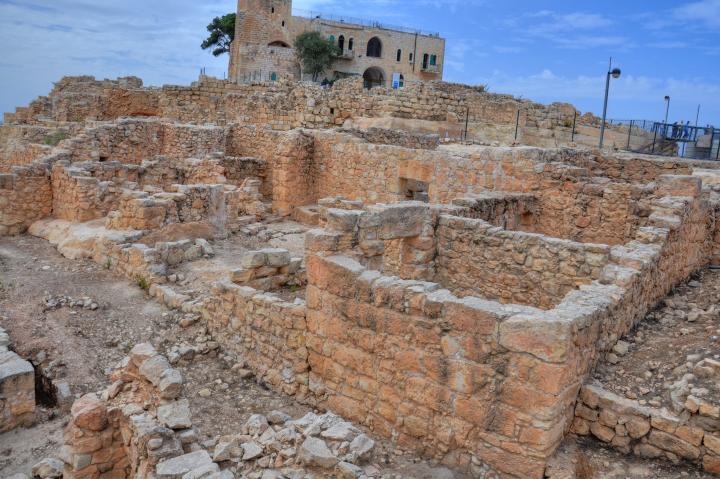
οικος is the usual word translated house. But in the dialect of Greek John was using, a second word had come into use, οικια. This second word took over the meaning for the structure of the house. οικος was aggrandized in meaning to mean the entire household, family and servants, and in Homer's Odyssey and other places, an estate including property with the house.  The structures of the houses then showed that they were built in the manner of the modern idea of compound, much like apartments or condominiums.  Communities were generally small by our standards, but the compound housed 50 to 100 people with each house or apartment having four rooms. That is a stereotype for οικια, and there were some variations, but archaeology has uncovered many four-room-house compounds.


μοναι is a word that is translated rooms.  Truly they are.  They're small compartments designated for different activities like cooking and sleeping.  A compound of οικια with συν, συνοικια is the word for people who would travel and need a room to spend the night or spend a few days refreshing themselves before resuming travel.  So, οικια is distinguished from that word by being a permanent place for the residents.

I think the essence of the passage is that Jesus is going to prepare permanent accommodations for us to live a second life.  We don't have to worry about running out of room in this place because the Father's compound has many rooms, enough for everyone who trusts him to be his father's son.