Search This Blog

Showing posts with label Revelation. Show all posts

Friday, December 29, 2017

When God shows up!

Reflections are everywhere - in crystal blue lakes and shining, marble surfaces, in the glass of towering skyscrapers and the concave lenses of ever-present cameras. They capture my thinking and mesmerize me, enticing me to look again because there's more in the picture!


The Revelation of John
Chapter 16
A Continuation of the Bowls of Wrath

John begins wrapping up his revelation by bringing his last series of 7 to a close.  He pens the sixth and seventh bowls of wrath to set up a catalyst for the culmination of the the book.  He wanted to write about ushering in a new age, the Christian Age, as his assurance to Christians across the empire  by using imagery to depict the crushing of Rome, an evil perpetrator, along with all parties responsible for persecuting Christians.  He tells of a huge battle between the King of kings and the world's leaders in Chapter 19 and a new age to follow.  He begins here with the sixth bowl of wrath.

Verse 12 -

Καὶ ὁ ἕκτος ἐξέχεεν τὴν φιάλην αὐτοῦ ἐπὶ τὸν ποταμὸν τὸν μέγαν τὸν Εὐφράτην, καὶ ἐξηράνθη τὸ ὕδωρ αὐτοῦ, ἵνα ἑτοιμασθῇ ἡ ὁδὸς τῶν βασιλέων τῶν ἀπὸ ἀνατολῆς ἡλίου

(The sixth angel poured out his bowl on the great river Euphrates.  The river became a baked river bed so it could serve as a road for the kings from the lands of the rising sun.)

Isaiah was one of Israel's most revered prophets.  He spoke of doom for Israel in a number of places, one of them being Isaiah 7.  He writes of the hardest times on Earth and a king east of the Euphrates rendering Israel useless as part of the country's punishment for a rebellious spirit.  It's hard to miss the parallel in Revelation 16 since John writes of plagues and disasters striking the Earth and its inhabitants because they persecuted God's people and would not turn from their evil ways.

Another parallel for Revelation 16.12 also exists in a passage in 2 Esdras 15.  That author envisioned a time when God would draw all the nations together, particularly the lands in the east for a large battle.  God would overcome these nations in battle in retribution for the brutalities they had rendered his people.

Verse 13

Καὶ εἶδον ἐκ τοῦ στόματος τοῦ δράκοντος καὶ ἐκ τοῦ στόματος τοῦ θηρίου καὶ ἐκ τοῦ στόματος τοῦ ψευδοπροφήτου πνεύματα τρία ἀκάθαρτα ὡς βάτραχοι

(I saw three, impure spirits appearing as loathesome frogs coming out of the mouths of the dragon, beast, and false prophet.)

John turned next in his writing to the dragon, identified before as Satan in Revelation 12.9 and who had authorized a beast to act and speak on his behalf, presumably Rome's emperor and other leaders, and a second beast as well to aid the first beast, probably the regional governors Rome used to rule the provinces.  The false prophet in verse 13 could be identified as the second beast if John was merely trying to write with variation in terms used.  But, the false prophet could also represent some other power, possibly the Jewish nation since they had resisted turning to the Messiah, Jesus, when he came.  Paul's experiences recorded in Acts and his various letters paint a picture of persecution by Jews across the Roman empire and in the capital city itself.  Finally, John adds a note about the ugliness and loathesomeness of evil leaders who sound a call to arms to battle goodness and honor, that is, a battle against God.

Verse 14

εἰσὶν γὰρ πνεύματα δαιμονίων ποιοῦντα σημεῖα, ἃ ἐκπορεύεται ἐπὶ τοὺς βασιλεῖς τῆς οἰκουμένης ὅλης συναγαγεῖν αὐτοὺς εἰς τὸν πόλεμον τῆς ἡμέρας τῆς μεγάλης τοῦ θεοῦ τοῦ παντοκράτορος

(And even though the three of them are inferior powers, they signaled the kings of all the world's people to gather for battle on the chosen day of God Almighty.)


John interrupts his great battle thoughts for a moment to insert the sudden nature of this battle, or at least the unexpected outcome that will come from this great battle.  Christians had been clamoring for justice for all those responsible for their mistreatment (Revelation 6.10).  John anticipated their next question, "When is this chosen day going to happen?"  So, John answers their question this way.

Verse 15

Ἰδοὺ ἔρχομαι ὡς κλέπτης. μακάριος ὁ γρηγορῶν καὶ τηρῶν τὰ ἱμάτια αὐτοῦ, ἵνα μὴ γυμνὸς περιπατῇ καὶ βλέπωσιν τὴν ἀσχημοσύνην αὐτοῦ

(Watch! I am coming like a thief.  Be sure to keep your clothes close by your bed for a quick escape if you are roused from your sleep so that you won't be seen shamefully walking around naked.)

John then returns to his thought about bringing the kings of the Earth together for battle.  He tells them where the battle will take place.

Verse 16

Καὶ συνήγαγεν αὐτοὺς εἰς τὸν τόπον τὸν καλούμενον Ἑβραϊστὶ Ἁρμαγεδών

(And they gathered in the place called Harmegedon in Hebrew.)
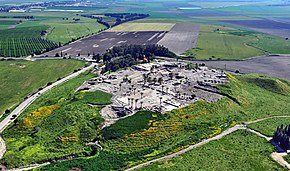

The battle was to be on a hill (הר, har, hill).  But there is more in the use of this word "hill," where the fortress of Megiddo (Megedon) resided, than mere translation offers.  As one can see from the picture at the beginning above, this hill had a walled town on its top.  It commanded a view of the valley.  And, that was important in a time before satellites.  Anyone approaching would be seen miles away. Megiddo lay at a heavily traveled crossroads.  Groups of people constantly traveled this road because it was straight and flat, right across a plain.  Even armies liked to use this road going to and from countries like Egypt enroute to Syria, Assyria, or Babylon. Tracking a group's movements could be done from the hill fortress at Megiddo.  Bringing the kings of the Earth to Megiddo for a fight gave an immediate advantage to God because he could ready himself for battle as he saw the armies approaching.

But, the tactical advantage was not the only reason God was meeting all the kings of the Earth at Megiddo.  Zechariah 12 contains a prophecy of God taking action against all the people of the Earth who have made his people drink from a cup of catastrophe in the same harsh way that they had treated his people all along.  In order for people to understand the depth of the mourning from this devastating blow, John recalled the episode burned into the Jews' memories of the time when all of Judah mourned for the death of one of their own very Godly kings, Josiah.  The peoples of the Earth would experience the same deep mourning that the Jews had experienced for King Josiah who had been fatally wounded at Hadad Rimmon in Megiddo.  John's audience would also understand this reference as a way in which God was avenging his people.  Jeremiah himself had written laments for the king which people had such affection for (2 Chronicles 35.22-25), but for the peoples of the Earth, there would be no such lament, for who would cry out deeply for the desecration and debasement these kings had carried out against God's people over a long period of time.

This passage contains a deeper meaning than merely the place of the battle.  Jews would have had an additional understanding of Hadad Rimmon.  Syria had idols that they worshiped and Hadad and Rimmon were two of them. Hadad, in particular, was the idol's name representing the sun god.  Since John had just written that the 4th angel had poured out his bowl of anger on the sun, and people were burned up by the heat, John presaged his naming of Harmegedon with a bowl of anger poured out on the sun to conjure up the visual of the sun god whose image represented a number of victories made in this plain of Megiddo over a 300-year period against the people of the one true God. This sun god would be vanquished and the victories of old for those who followed this god would be turned into pain for the people who had mistreated God's followers.

Verse 17

Καὶ ὁ ἕβδομος ἐξέχεεν τὴν φιάλην αὐτοῦ ἐπὶ τὸν ἀέρα, καὶ ἐξῆλθεν φωνὴ μεγάλη ἐκ τοῦ ναοῦ ἀπὸ τοῦ θρόνου λέγουσα· γέγονεν

(The seventh angel poured his bowl into the air, and a loud voice could be heard from the throne inside the temple booming out, "It's time to pay up!")

At this point John ends his series of the seven bowls of wrath.  What follows is the culmination of the 7 bowls of wrath.  He had taken care with the first four bowls to represent the plagues of Egypt, the pivotal and seminal event in Jewish history on which everything afterward made sense.  This was followed by the plague of darkness in the fifth bowl.  In Egypt, the plague of darkenss was the precursor to the death blow to the firstborn, the dark hours that led directly to the death of every Egyptian family's firstborn, God's victory against Pharaoh, and the beginning of the era of God's people.

Now for God's new covenant with his people, the Christians, John is making it clear that God is acting in the same seminal and pivotal manner.  Rome's leadership, the new Pharaoh, would experience the same awesome power against them.  God would deliver his new people from their oppression and start them on the path of coming into their own.

Verse 18

καὶ ἐγένοντο ἀστραπαὶ καὶ φωναὶ καὶ βρονταὶ καὶ σεισμὸς ἐγένετο μέγας, οἷος οὐκ ἐγένετο ἀφ’ οὗ ἄνθρωπος ἐγένετο ἐπὶ τῆς γῆς τηλικοῦτος σεισμὸς οὕτως μέγας

(Brilliant bolts of lightning streaked across the sky, noises were everywhere, the rolling of continuous thunder sounded, and such an intensive and extensive earthquake was felt.  One like it had never been seen by humans since they had inhabited the Earth,)

After delivering his people in an astonishing way, supernatural signs and wonders would follow the deliverance as a way of strongly punctuating that the ruler of Heaven and Earth had acted, all people had noticed, and now his people would have their recognition and their revenge.  This had also accompanied the sixth sealed message in Revelation 6.14 and again in Revelation 11.18-19 after the announcement of doom by the seventhth trumpet.  People notice when God shows up.

Verse 19

καὶ ἐγένετο ἡ πόλις ἡ μεγάλη εἰς τρία μέρη καὶ αἱ πόλεις τῶν ἐθνῶν ἔπεσαν. καὶ Βαβυλὼν ἡ μεγάλη ἐμνήσθη ἐνώπιον τοῦ θεοῦ δοῦναι αὐτῇ τὸ ποτήριον τοῦ οἴνου τοῦ θυμοῦ τῆς ὀργῆς αὐτοῦ

(reapportioning the great city into three parts and crumbling the cities of other nations.  The great city of Babylon was brought to God's attention, and he gave them the taste of their own cup of wine, his raging fury)

The last bowl of God's anger is also followed by a reference to Babylon.  This is no mistake and is also a part of the symbolism from Jewish tradition.  The king of Babylon swooped in and sacked Jerusalem in 587/6 BCE and deported many of its people.  He had made quite the entrance onto the stage of Jewish history.  Ever after, the Jews related their great troubles to Babylon's conquering the center of their nation, ridding them of their king, and setting up a puppet government that paid tribute to its king and its pantheon.  However, God had a whole series of pophecies against Babylon for their terrible treatment of the Jews.  Jeremiah 50.28, 29, 45, 46 contain representative verses of what God would do to avenge the treatment of "Babylon." So, to punish "Babylon" in John's time, Rome was "rearranged" by the earthquake that no one had ever seen the intensity of before.

Verse 20

καὶ πᾶσα νῆσος ἔφυγεν καὶ ὄρη οὐχ εὑρέθησαν

(All islands disappeared from view, and mountains were nowhere to be seen.)

Verse 21

καὶ χάλαζα μεγάλη ὡς ταλαντιαία καταβαίνει ἐκ τοῦ οὐρανοῦ ἐπὶ τοὺς ἀνθρώπους, καὶ ἐβλασφήμησαν οἱ ἄνθρωποι τὸν θεὸν ἐκ τῆς πληγῆς τῆς χαλάζης, ὅτι μεγάλη ἐστὶν ἡ πληγὴ αὐτῆς σφόδρα

(Immense, hundred-pound hailstones dropped from the sky on people below, who cursed the god of this plague because it was so brutal and unrelenting. )

The last two verses are clear references to the way the Old Testament viewed an outpouring of God's vengence against men, as found in Micah 1.3, Habakuk 3.6, and Ezekiel 26.15-20.  John had used this imagery as the basis already for Revelation 6.14 and 11.18-19. In addition, he recalls Old Testament prophecies like the ones in Zephaniah, and in particular Zephaniah 3.6-8.  And John uses exact wording matches to Exodus 9.23-24 where God directs a hailstorm to hit Egypt like no one had ever seen before in order to convince Pharaoh to let his people go.  Using all of the catasrophic doom imagery of the Old Testament, John was showing the Christians that the same message God had always used for his people who had been mistreated, he was telling them now.  God would deliver his people so that there would be no mistaking that his enemies had met their day of reckoning and would have no way to escape his anger.

Accompanying the Old Testament allusions in John's writing is the echo of other apocalyptic books written before or contemporary with John's apocalypse.  The apocalypses of 2 Enoch, 2 Baruch, 2 Esdras, and the Sybilline Oracles all talked of an age when a messiah, a son of man, or at least a savior would return and usher in a new age.  Particularly, 2 Esdras 15 is parallel to Revelation 16.  The author writes about countries that oppressed God's people as Egypt had done, and their deliverance followed plagues and disasters like he had brought on Egypt at an earlier time.  He spoke of kings from the east gathering to oppose God in battle.  He wrote of supernatural signs that accompanied God's destruction of nations, a blazing sun to burn up sinners, and terrible storms of hail, and flashing swords.  He also speaks of Rome as Babylon and its provinces as Rome's prostitutes who would also be destroyed.  Perhaps, these beliefs were circulating at the end of the first century and beginning of the second, causing the same material to be used in both books, or perhaps one of the books served as a blueprint for the other.  Whatever the case, John in Revelation assured Christians living at that time that God was acting on his people's behalf for their mistreatment at the hands of Rome and its provincial governments.


The message at the end of the bowls of wrath is not the end of time.  Instead, God was going to show up for his people.  He would usher in a new age, the era of his only son.


Even 2000 years removed from John's writing, I cannot help but read what God did to deliver to his people and be reassured that the same God still shows up time after time - for his people and for me as his follower.  He delivered his people the Jews.  He delivered his people the Christians.  He will fight my oppressors too.  Rome has passed into oblivion, but modern oppressors still fight hard to debase those who follow God's only son.  When I see that oppression, I nod knowingly, believing that God shows up with 100-pound hailstones to pound those who curse his name and never turn from their ways of insulting him and his people.

God still delivers.  It's one of his most resounding messages.  And I give him my heart because he shows up - still - and forever!


[Introductory photo of reflection is found at boredpanda.com]
[The first song is Gracious Tempest by Hillsong Young and Free.  The second song is Do It Again by Elevation Worship.]
[The Greek text used for the New Testament references is the Nestle Aland 28th edition]

[Translations from Greek are my own.]


Saturday, November 25, 2017

Apocalyptic moments with God

Reflections are everywhere - in crystal blue lakes and shining, marble surfaces, in the glass of towering skyscrapers and the concave lenses of ever-present cameras. They capture my thinking and mesmerize me, enticing me to look again because there's more in the picture!


Literature differs from one era to the next.  The myths of really ancient literature, such as the ones told by the Egyptians differ in length and style and a few other ways from the myths told up the timeline by a couple thousand years in Greece.  The tales of the gods of the Norse people differ in style and content from the myths down the timeline a thousand years from the Greeks' tales.  So it goes.  Different eras produce different literature.

One would expect Hebrew literature not to be an exception.  One can see short narratives, for instance, in the earliest tales of the Hebrew people, but by the time of David, the narratives have lengthened and have a different purpose and style than the earlier narratives.  Poems of the Israelites can also be seen as early as the Exodus story (Exodus 15, which many call the Song of Moses), but its form, style, and type are certainly different from the forms exhibited in the book of poetry called Psalms.  A person can see the robust style and technique of a poem like Psalm 119 as very different from the straightforward and focused praise poem of Exodus 15.

So, it really should not surprise anyone at all that the New Testament, too, contains different forms of writing.  Even though it was a much more tightly constrained time period than any of the comparisons in the above paragraphs, its literature still shows variation because of place, time, purpose, and author.  An exercise in accounting for the differences between the synoptic gospels and the Gospel of John illustrates the affect of different circumstances for different audiences in different settings.  And as a person reads the New Testament as a whole, it would not take a genius to notice that the book of Revelation is very different from the other books of the New Testament.  It stands alone.  In fact, it has a greater similarity to a couple of Old Testament books (Daniel and Zechariah) than it does to any of the New Testament books.

But, literature exists in genres.  It would be the rarest of books that stand alone with no connection to other books of its type.  That should be a great indication to any reader that one might want to look for a genre of literature that Revelation fits even if he or she has to look outside the New Testament for comparisons.  At the same time that Revelation was being written, in fact, the books of Second Baruch and Second Esdras were penned.  They contain the same fanciful imagery, visions, and guidance of a human by heavenly beings that Revelation does.  First Enoch one of the first to be written, is somewhat older by a couple or three centuries, but it still contained the features that Revelation adopted of heavenly beings explaining the scheme of things to come to Enoch.  Second Enoch as well might be slightly older than Revelation, but its contents were very similar.  And the Apocalypse of Peter, written around the same time as Revelation, was actually given canonical status by Christan groups in Egypt and Ethiopia, but it never achieved that status by Roman Christians, who had a great deal of influence in canon formation.  Other apocalyptic material existed, but the mention of the above books helps one to see that apocalyptic writing was a genre and a style of writing over about a 400 year period that Revelation fits into.  Understanding the style and genre gives great insight into the interpretation of the New Testament's last book.

Revelation 16 is representative of the help one can receive in interpreting its symbols by knowing the genre of apocalyptic literature.  A series of angels are pouring bowls of wrath onto the Earth.  Immediately one notices that a literal understanding doesn't give insight.  Instead, one knows from other apocalyptic books that angels deliver God's messages to chosen humans.  These angels do things like ride in different directions around the Earth and report to God what they saw (as in Zechariah) or open scrolls and explain its contents (as in Daniel).  They measure things (as in Second Enoch and Ezekiel).  Or they interpret great battles' consequences for all who live on the Earth (as in Second Esdras).

The bowls of Revelation 16, then, are actions of angels with a message for the inhabitants of Earth.  They are symbols belonging to the story of Christians who have cried out for God to avenge their oppression and suffering that has been unfolding in previous chapters.  The seven seals, for instance, show that God has received reports from his angels of his people's suffering, then reveals that he is going to act on their behalf to avenge their suffering.  Seven trumpets follow to publicly announce to his people that God knows who exactly is responsible for the persecution against his son's followers and that their end is new.  After the trumpets, John sees a vision in the sky of an evil force (Satan), who tries to eliminate Christianity as it was being born from Judaism and that Roman leaders (the first beast) and Jewish leaders (the second beast) had been in cahoots with the Romans and on their own oppressing his sacred people, now those who follow the slain lamb.


In auspicious manner (because Revelation 15.1 says these seven angels' actions are God's πληγὰς ἑπτὰ τὰς ἐσχάτας... ἐτελέσθη ὁ θυμὸς τοῦ θεοῦ  ["seven last plagues... that finish his anger"]), seven angels start pouring out bowls of anger onto the Earth.  The first four recall God's dealings with the king of Egypt 1500 years prior to John's time in a Great Deliverance that alleviated his people's pain of suffering. The first four bowls of anger conjured up the accompanying signs of that Great Devliverance in foreshadowing what God was about to do for his people in John's time because the emperors of Rome, their governors, and Jews everywhere around the empire had been persistently persecuting them.

Verse 8

Καὶ ὁ τέταρτος ἐξέχεεν τὴν φιάλην αὐτοῦ ἐπὶ τὸν ἥλιον, καὶ ἐδόθη αὐτῷ καυματίσαι τοὺς ἀνθρώπους ἐν πυρί

(The fourth one poured his bowl out onto the sun causing people to suffer from extreme heat.)

Verse 9

καὶ ἐκαυματίσθησαν οἱ ἄνθρωποι καῦμα μέγα καὶ ἐβλασφήμησαν τὸ ὄνομα τοῦ θεοῦ τοῦ ἔχοντος τὴν ἐξουσίαν ἐπὶ τὰς πληγὰς ταύτας καὶ οὐ μετενόησαν δοῦναι αὐτῷ δόξαν

(When people felt the tremendous heat, they spoke profanities against the name of God, the one having the power over these plagues, and refused to give him due honor.)

Verse 10

Καὶ ὁ πέμπτος ἐξέχεεν τὴν φιάλην αὐτοῦ ἐπὶ τὸν θρόνον τοῦ θηρίου, καὶ ἐγένετο ἡ βασιλεία αὐτοῦ ἐσκοτωμένη, καὶ ἐμασῶντο τὰς γλώσσας αὐτῶν ἐκ τοῦ πόνου

(The fifth poured his bowl onto the beast's throne, and its kingdom became dark.  People bit their tongues to endure their suffering.)

Verse 11

καὶ ἐβλασφήμησαν τὸν θεὸν τοῦ οὐρανοῦ ἐκ τῶν πόνων αὐτῶν καὶ ἐκ τῶν ἑλκῶν αὐτῶν καὶ οὐ μετενόησαν ἐκ τῶν ἔργων αὐτῶν

(They spoke profanities against the God of Heaven since they had to endure suffering and had been covered in festering sores.  But they did not say they wanted to change the behavior that caused their pain.)

There are some very close parallels with Second Esdras at this point.  The first 4 bowls of anger speak to God's anger about the treatment of his people.  That also is a theme using the same kind of symbolic language of leading his people from torment out of Egypt in Second Esdras 15.5-12.  The fourth bowl of anger uses imagery with the sun and extreme heat.  The same kind of imagery of destruction of the abusers of God's people is used in Second Esdras 13.8-11.  The sun isn't mentioned in that context, but fire, flames, and sparks spewing from the Messiah's mouth to burn people and to show humanity that God is in control and through his anger he brings accountability  to a group of people mistreating those who live by his name is the same.  Rejection of God and refusal to change behavior by those who act profanely against him in the bowls poured out by angels 4 and 5 of John's vision parallels Second Esdras 9.7-13.  And although there is the same kind of imagery in Day of the Lord passages in the Old Testament, such as Isaiah 13.6-18, the details of apocalyptic imagery represent the denoument an age and a beginning of a new era, not just a cleansing.

The above parallels with Second Esdras make the point that God's people have called out to him, that he has heard them and will act against the ones subjecting them to mistreatment.  Both books were written about the same time with the same message.  They corroborate the treatment of God's people at the hands of the Romans, and both show that God is acting with superlative means and with supernatural, unmistakable, inimicable justice against this invincible empire.  Both make the comparison to the Egyptian deliverance, which was Judaism's pivotal, seminal event.  Both have overtones that this time God is acting on behalf of his people the Christians, including those Jews who believed and accepted Jesus for who he was, but excluding those Jews who believed Jesus to be a prophet, not the son of God or the messiah.

One of the reasons John's Apocalypse resonates with me is that, at times, I have found myself on the opposite side of Christianity.  I have been in situations when no one knew that I was a Christian, and so I saw others rail against it as an evil in the world.  I have heard people say God doesn't exist and Christianity is a mere superstition.  I have heard and been in the presence of scientists speaking about the impossibility of God's existence, that we as sentient beings have created a god out of necessity for controling the masses of people.

Admittedly, ashamedly, my silence against such terrible profanity against the Maker of Heaven and Earth fits into the category of these Romans and Jews who persecuted Christians for their beliefs in a superstition that God's son rose from the dead and will return for his followers.  Deservedly, I should accept my judgment of festering sores or death from not getting to drink Earth's lifesources of water.  My early years as an adult were characteristic of idealism and relentless pursuit of knowing more about God.  But my middle years were filled with silence as the scientific pursuits of knowledge encroached on my faith rather than supplementing it.


But, with knowledge, there is a tipping point.  It must decide to continue to supplant one's spiritual beliefs or decide to make it subsidiary to faith because knowledge seeks arrogance and self aggrandizement and doesn't coexist with the humble nature of faith well.  It was evident that supplanting my belief would place me in a kingdom that would become dark.  So I thank the God of the Great Deliverance from Egypt and the God of the Great Deliverance from Rome for allowing time for the profanity of silence to change  into a voice for the sake the kingdom of light.  I am grateful to have changed discomfort from the extreme heat of the sun into letting others see that God stands with his people and acts in their lives.  John's apocalypse, his disclosure of the One who stands with his people, even me, brings me to an unclouded moment with "the one who has the power over the plagues," who deserves my due honor!


[Introductory photo of reflection is found at https://i.pinimg.com/736x/8d/82/3a/8d823a0a3cc358656c1e2c48f6eb19a1--stunning-photography-photography-ideas.jpg]
[The first song is There Is A Cloud by Elevation Worship.  The second song is So Will I by Hillsong.]
[The Greek text used for the New Testament references is the Nestle Aland 28th edition]

[Translations from Greek are my own.]

Sunday, November 5, 2017

Lord, act again

Reflections are everywhere - in crystal blue lakes and shining, marble surfaces, in the glass of towering skyscrapers and the concave lenses of ever-present cameras. They capture my thinking and mesmerize me, enticing me to look again because there's more in the picture!


Image result for reflectionsJohn had a case against the Romans, for sure.  They had tried to kill him.  He had survived, so they allowed him to live out his life in banishment on an island, away from his beloved Ephesus with his Christian community.  It was also well known around christendom that Nero had had Paul killed and Agrippa had had Peter executed.  Even closer to the time of John's writing of Revelation, Antipas had been martyred.

Now the most ruthless ruler yet to govern the Roman Empire, Domitian, was in power.  He was the first to actually have the gall to claim full deity and had made his subjects call him "Lord", as if he ruled the whole universe.  The Romans had spiraled out of control.  They brutally killed to hold their power and they relentlessly exterminated those who believed superstitions, like that insidious belief that someone named Christ had been resurrected from the dead and would return for those who followed him one day, which to them was absolutely absurd!

On top of dealing with the Romans, he had had to tell the Jews that their God had warned them about their failure as his people.  He had even taken the time to write about all the acts of Jesus that showed the heart of God.  But he had moved on. Titus had leveled Jerusalem just 15 years before this writing. Masada with its mass suicides had fallen.  Qumran lay in ruins.  The Dead Sea Scrolls had vanished.  Judaism had given birth to followers of Christ. John had just finished writing that the beast, Satan, had tried to devour Christ and his movement at its inception, but had failed.  About all that was left was for God to eradicate that pestilence on the Earth called the Roman Empire.

John had to reassure the Christians he had led for half a century.  God was on the cusp of dealing with these barbaric Romans in a convincing manner.  Like he had done with the Egyptians for his people 1400 years prior to his time, God was about to demonstrate his power against these invincible- thinking, merciless, arrogant, and uncouth Romans to once again deliver his people from oppression.
_________________________________________________________________________

John sat, staring into the waves beating against the ragged rocks dividing the sea from this small island of Patmos in deep contemplation, ready to continue writing on his papyrus tablet.  Sixty years ago...

He didn't know why God had looked down in favor on him to choose him to walk alongside his son, his people's long awaited messiah, the one sent to show his father's nature to his people and to offer them life and an extraordinary place.  And because God had shown him this favor, he had felt compelled to remind his own people once more of God's offer - for all those that would accept him and believe who his son was, he would give them the power to become the children of God. He had written those two ideas a decade before in his memoirs of Jesus' actions as he presented his father's heart (John 1.12, John 14.10).

As he felt the spray of the waves hitting the rocks and boulders, John reviewed what he had written thus far in a new message to his beloved Jewish people and to the Christian community he had been a part of.  He had chosen the apocalyptic form as the vehicle for his message in the tradition of the books of Enoch and Esdras.  He had used the apocalyptic beginning of Zechariah to start the visions of his own book.  He had used Zechariah's four horses in a series of seals being broken to show how God was still being reported to about the condition of the world and that God was not complacent toward his children of this generation.  He had infused ideas from other times of great trouble like the time of the exodus of Egypt, some of the struggles referred to in the prophets against the nations around them, and a few of the captivity Psalms to depict that Christians had endured great hardship at the hands of the brutal Romans who ruled John's world.

He briefly contemplated the sixty years that had passed since the Romans had put down a Jewish rebellion by crucifying its "king." But that king had not vanished.  His tomb had actually been empty and he had followers.  The Romans had had to deal with that continuing movement.  It seemed like each decade the Romans had become a little more brutal with Jesus' followers than the last decade.  John remembered fondly over the last week or so all those he had written about on the previous pages of his tablet when he was summarizing the state of the world as the horsemen had reported it.  He had depicted his courageous friends as souls crying out from beneath an altar to God, clamoring for justice.

Revelation 6.10

καὶ ἔκραξαν φωνῇ μεγάλῃ λέγοντες· ἕως πότε, ὁ δεσπότης ὁ ἅγιος καὶ ἀληθινός, οὐ κρίνεις καὶ ἐκδικεῖς τὸ αἷμα ἡμῶν ἐκ τῶν κατοικούντων ἐπὶ τῆς γῆς

(And they called with a loud voice, "How long, sacred Lord, the one we trust, are you going to hold out on judging the ones who govern the Earth and not punish them for our blood?")


John continued his thoughts of the judgment of God against "the ones who govern the Earth," the feared and hated Roman government.  He wanted to reassure the Christian community around him that the Romans could not and would not win in their battle against God's people.  What came to his mind to write (Revelation 16) was imagery of the total devastation of the Romans, a time when God would crush them for their brutalities.

He could not think of imagery any better than that from a very similar situation - the time the Jews had spent under a terrible Pharaoh in Egypt.  God had sent ten plagues to crush the pharaoh and to kill him under the waves of a sea.  So, John placed a vision in his writing of seven angels pouring out bowls of God's anger on the Earth that were filled with 4 of the most impacting of those plagues. 

John continued writing the images in his mind's eye. A loud voice was coming from the temple in his vision.  The voice told seven angels to pour out bowls of anger on the Earth.

Verse 2

Καὶ ἀπῆλθεν ὁ πρῶτος καὶ ἐξέχεεν τὴν φιάλην αὐτοῦ εἰς τὴν γῆν, καὶ ἐγένετο ἕλκος κακὸν καὶ πονηρὸν ἐπὶ τοὺς ἀνθρώπους τοὺς ἔχοντας τὸ χάραγμα τοῦ θηρίου καὶ τοὺς προσκυνοῦντας τῇ εἰκόνι αὐτοῦ

(The first angel came and poured out his bowl on the Earth.  Festering and ugly sores appeared on those having the imprint of the beast and worshiping its image.)

In Pharaoh's Egypt, the magicians that represented the king had duplicated the first two plagues, failed in their attempt to duplicate the third, and were impotent in the fourth and fifth plagues.  But on the sixth plague, they were so covered in boils they couldn't even appear when Moses came calling at the palace.  God let Pharaoh see the condition of utter helplessness with the sixth plague.  John wanted to show this same helpless condition with the Romans.  So, he had started with the sixth plague.


The next two angels poured out God's anger on the seas, rivers, and springs of the Earth.

Verse 3

Καὶ ὁ δεύτερος ἐξέχεεν τὴν φιάλην αὐτοῦ εἰς τὴν θάλασσαν, καὶ ἐγένετο αἷμα ὡς νεκροῦ, καὶ πᾶσα ψυχὴ ζωῆς ἀπέθανεν τὰ ἐν τῇ θαλάσσῃ

(The second poured out his bowl on the sea.  It changed to the blood of someone who had died, because every living creature of the sea had died.)

Verse 4

Καὶ ὁ τρίτος ἐξέχεεν τὴν φιάλην αὐτοῦ εἰς τοὺς ποταμοὺς καὶ τὰς πηγὰς τῶν ὑδάτων, καὶ ἐγένετο αἷμα

(The third poured out his bowl on the rivers and water sources, and they too turned to blood.)

The second two angels poured anger onto the Earth's reservoirs of water.  John went back to the first plague of God against pharaoh.  For seven days, the River Nile and its tributaries ran red.  The Egyptians were desperate for water, digging in the mud on the banks of the river to see if they could uncover any non-bloody water.  God could alter their world in a way that demonstrated he was in complete control, not them.  It was God's way of saying, "I could exterminate all of you if I wanted to."  John saw that God would treat the Romans in the same way. 

But the Romans weren't the only group standing vehemently against Christians.  The Jews had stood firmly against Christians and even collaborated with the Romans in ridding the Earth of their presence.  The prophets had experience the Jews' wrath over a 400 year period of time because they tried to tell them what God had really wanted of them.  Jesus did the same with the same result.  And the followers of Jesus met with shame, ostracism, and death at the hands of the Jews.  John had just finished writing about two beasts who served a dragon who had tried to devour God's son.  But God's patience had been completely spent with these two beasts (Revleation 13.1, 6, 14, 15; Revelation 14.15, 16; Revelation 15.1, 7).  He was sending seven last plagues on the Earth, expressions of anger against two groups of people who had relentlessly tried to rid the Earth of his people the Christians.  Seven bowls of his anger would be poured out on the Earth and through them his anger would complete his judgment (Revelation 15.1) against these two "beasts" who had killed his prophets and his sacred children.


Verse 5

Καὶ ἤκουσα τοῦ ἀγγέλου τῶν ὑδάτων λέγοντος· 
      δίκαιος εἶ, ὁ ὢν καὶ ὁ ἦν, ὁ ὅσιος, 
      ὅτι ταῦτα ἔκρινας

(I heard the angel of the waters speaking.
      You are the one who stands for right, the one who is and was, the one who is sacred,                      because you have judged their actions )

Verse 6

ὅτι αἷμα ἁγίων καὶ προφητῶν ἐξέχεαν 
      καὶ αἷμα αὐτοῖς δέδωκας πιεῖν, 
      ἄξιοί εἰσιν

(because they poured out the blood of the prophets and those who set themselves apart,
     And you have given them blood to drink.
     And they deserve it.)

Verse 7

Καὶ ἤκουσα τοῦ θυσιαστηρίου λέγοντος· 
     ναὶ κύριε ὁ  θεὸς ὁ παντοκράτωρ, 
     ἀληθιναὶ καὶ δίκαιαι αἱ κρίσεις σου

(I heard a voice from the altar speaking.
         "Yes, Lord God Almighty,
          your judgments we can trust to be right.")


My heart has ached for God's relief before.  I understand the utter devastation caused by a force completely out of my control and the resulting helpless feeling in the wake of the onslaught of such a terrible force..  And when God sent his relief, I spoke out like the angel here in complete trust of his handling of the situation, "Your judgments I can trust to be right!"

Help me, Daddy, to cry out in chorus with others when life's treatment is so utterly out of control so that you can replace it with your morality and decency!


[Introductory photo of reflection is found at blog.enterpriseengagement.com]
[The first song is Like Incense by Hillsong.  The second song is Find Me by Jenn Johnson.]
[The Greek text used for the New Testament references is the Nestle Aland 28th edition]

[Translations from Greek are my own.]

Monday, June 20, 2016

Take the reins

Morsels of food are delicious because of the little things, the subtle seasonings, the dash of salt, the sprinkle of garlic, the garnish of parsley, the touch of glaze, or the hint of lemon.  Ahhhh - so delicious!


There was a time in Jewish history when things were worse than they ever had been since leaving the province of Goshen centuries before.  Jerusalem was sacked by Nebuchanezzar's army and many Jews were deported to his capital city of Babylon.  That was a terrible, terrible part of the Jew's story.  The prophets had given oracles from God that this would happen if the Jews didn't change from their outrageous habits of indecently representing God on the Earth.  The prophets warned and warned, still nothing changed.  So, God visited their nation with captivity.

Its scars filled their literature for hundreds of years thereafter.  Stories, memoirs, and songs contained the people's hopes of returning to Judah and reestablishing Jerusalem as their capital and rebuilding their temple to God.  The literature contained oracles from more prophets not to fall into the same pitfalls that the people before the captivity had fallen into.  It contained historical accounts of the Law of God being reinstituted in Jerusalem when a number of captives were allowed to return there almost a century after they had been deported.  And, it contained stories of Jewish people who still served God in the empires where the Jews had been scattered after deportation.

The prophets that still actively delivered their oracles from God after the Jews' return to Jerusalem seemed to say the same thing.  The oracles of God's prophets before the captivity had talked about restoration after captivity in very glowing terms.  Isaiah 9. 2-17 shows some of the first seeds of this thinking.  After the return, Joel 2 is representative of the developed line of reasoning from the post-exilic prophets as the Jews contemplated their captivity experience.  And added to the oracle is the hope of Israel for God to chastise the nations for enslaving his people again.  Joel 3. 1-3 portrays this condemnation of non-Jewish nations.  Malachi, one of the last prophets, if not the last, represents a well developed philosophy of the Jews' rationale about 435 BCE.  Its four small chapters contain a cohesive, sequential unit of thought of the reason for the captivity, the aftermath of judgment against those who opposed God and his people, and the promise of  bringing all his people back together.  This became the blueprint for the literature that followed during the first, second, and third centuries BCE.

Although different types of literature came out of the post-exilic centuries, such as the story of Esther, a really different form of expression developed in order to propagate the blueprint found in Malachi.  It was called apocalyptic literature.  The form became very popular and had predictable features.  The principal traits were to have a main character, a human messenger to relay heavenly secrets to through visions, and an angel from Heaven to reveal the meanings of the visions.  God's people would be reminded to live a clean life and to repent if they hadn't.  Then, God would promise destruction in order to save his people from a relentless empire making them suffer.  They nearly all talked about God's people being brought together for a last age with God in a restored blissful state with him.  A good number of these apocalypses were produced by Jewish authors, but some by Christian writers.  The tradition using the apocalypse lasted about 400 years, 200 years before and after Jesus' life.  Some of the most common revelations were The Book of Enoch, 2 Esdras, Daniel, a portion of the War Scroll from Qumran, Testament of Levi, Apocalypse of John, Apocalypse of Peter, and a portion of the Shepherd of Hermas.

The Apocalypse, or Revelation, of John is squarely in the center of this tradition and contains the features mentioned above.  The seventh trumpet of Revelation 11 serves as a good example of the last feature, that of God bringing his people into a kingdom just for them at the end of the age.  It is very reminiscent of Second Esdras chapter 6. 11-34 and chapter 13.25-38, and Daniel 7, all three of which were written in the two hundred years before Jesus.  They dealt with interpretations of a vision that introduced the beginning of a dominion or realm in which God took over from the powers of the Earth.  All three deal with God judging a terrible empire who had oppressed his people and whose power he is taking from them and establishing his own realm.  In Revelation 11, the last 5 verses containing the 7th trumpet, the trumpet signals a time people have been waiting for and comes after warning all of the Christians' enemies that their oppression and persecution would be repaid.

Doomsday Earth on Fire

Verse 13

Καὶ ἐν ἐκείνῃ τῇ ὥρᾳ ἐγένετο σεισμὸς μέγας καὶ τὸ δέκατον τῆς πόλεως ἔπεσεν καὶ ἀπεκτάνθησαν ἐν τῷ σεισμῷ ὀνόματα ἀνθρώπων χιλιάδες ἑπτὰ καὶ οἱ λοιποὶ ἔμφοβοι ἐγένοντο καὶ ἔδωκαν δόξαν τῷ θεῷ τοῦ οὐρανοῦ

(And in that hour, a great earthquake caused a tenth of the city to crumble.  7000 names of men were extinguished in the earthquake.  Fear gripped the rest of the city and they honored the God of Heaven. )

Verse 15

Καὶ ὁ ἕβδομος ἄγγελος ἐσάλπισεν· καὶ ἐγένοντο φωναὶ μεγάλαι ἐν τῷ οὐρανῷ λέγοντες· 
ἐγένετο ἡ βασιλεία τοῦ κόσμου τοῦ κυρίου ἡμῶν 
καὶ τοῦ χριστοῦ αὐτοῦ,
καὶ βασιλεύσει εἰς τοὺς αἰῶνας τῶν αἰώνων

(The seventh angel sounded his trumpet.  Loud voices in Heaven shouted, "The realm of the world has become the realm of our Lord and his Chosen One, and he will be its ruler forever.")

Second Esdras 6.23 and 13.25-38 in particular contain the exact idea of Revelation 11.13b, 15 in a vision given to Ezra about judgment on those who have humiliated Jerusalem's inhabitants.  Daniel 7.13-14 also express the idea of the Son of Man joining the Ancient of Days and establish his rule.

Second Esdras 6.23

Then the trumpet will sound, and sudden terror will grip the heart of everyone when they hear it. 
Second Esdras 13. 25, 26
The man you saw coming out of the sea, represents the one whom God Most High has kept ready for many ages. He will free the world he created and establish the new order for those who survive.
[Good News Translation] 

Daniel 7

Verse 13

חָזֵ֤ה הֲוֵית֙ בְּחֶזְוֵ֣י לֵֽילְיָ֔א וַאֲרוּ֙ עִם־עֲנָנֵ֣י שְׁמַיָּ֔א כְּבַ֥ר אֱנָ֖שׁ אָתֵ֣ה הֲוָ֑ה וְעַד־עַתִּ֤יק יֹֽומַיָּא֙מְטָ֔ה וּקְדָמֹ֖והִי הַקְרְבֽוּהִי׃

(In night visions, I saw the Son of Man in the sky meeting the one who is without time, the Ancient of Days.  As he approached,)

Verse 14

לֵ֨הּ יְהִ֤יב שָׁלְטָן֙ וִיקָ֣ר וּמַלְכ֔וּ וְכֹ֣ל עַֽמְמַיָּ֗א אֻמַיָּ֛א וְלִשָּׁנַיָּ֖א לֵ֣הּ יִפְלְח֑וּן שָׁלְטָנֵ֞הּ שָׁלְטָ֤ן עָלַם֙דִּֽי־לָ֣א יֶעְדֵּ֔ה וּמַלְכוּתֵ֖הּ דִּי־לָ֥א תִתְחַבַּֽל׃ פ

(he was given the power to rule, and all the honor that comes with it.  Many people, nations, and languages would worship him.  His realm would not end and could not be destroyed.)


There are a lot of things I cannot imagine - hiking the mountains in winter without a coat, visiting other countries without reading about their cultures first, and diving into the ocean without knowing how to swim.   Likewise, I cannot imagine anyone taking on the task of interpreting Revelation without knowledge of the literature of the apocalyptic movement among the Jews.  Each work individually would trigger a hope for the end of the world and the saints of God joining him in his realm.  But, taken all together, it is easy to see that the hope of Israel was given an expression for what they thought God had promised.  Shortly before the time of Jesus, the Qumran sect of Jews, in their War Scroll, definitely had linked the Messiah to the last age when God would come and set up a kingdom for the Messiah to reign with God's saints.  Second Esdras as well mentions the Son of Man.  So, as Christianity began to take hold in Asia Minor, it is no wonder that John would turn to the apocalypse to express to Christians to hold on through persecution and oppression because God would stand up for his people, come for them, and embarrass the nations that had treated them harshly.

The visions of Revelation that began with the seven seals show clearly the blueprint used in nearly all apocalypses.  The visions built on each other.  One led to another, so that seals number 5 and 6 set up the vision of the trumpets.  The Christian martyrs asked God how long their suffering would last and received an answer through the imagery of a Day of the Lord happening.  As each trumpet sounded, the events that took place showed more in detail the cause for the Day of the Lord and the events that drove God to cleanse the Earth as he had done in the past.  This time Roman leaders and military forces were persecuting his people.  God told his people in symbols that the root of the problem was that the the Romans had taken on God’s role, thinking they were the controllers of destiny on Earth.  They weren't, so they would be eradicated along with the other main source of their suffering, the Parthians.  The Jews, also, would see that God's saints were those following Christ, God's chosen, the Messiah.  Seal 7 (Revelation 11.15) opened to the announcement that the realm of God with Christ, the Messiah, was starting - the last age when God would restore his people and establish his realm.

The response in Heaven to this news was acknowledgment of by the twenty-four elders around the throne.  They appeared before the seals (Revelation 5) with praise for God before knowing what was going to happen.  Here they appeared again, doing the same thing at the end of the trumpets after knowing what was going to happen.

Verse 16

Καὶ οἱ εἴκοσι τέσσαρες πρεσβύτεροι [οἱ] ἐνώπιον τοῦ θεοῦ καθήμενοι ἐπὶ τοὺς θρόνους αὐτῶν ἔπεσαν ἐπὶ τὰ πρόσωπα αὐτῶν καὶ προσεκύνησαν τῷ θεῷ


(The twenty-four elders sitting on their thrones in God's presence fell on their faces and worshiped God)

Verse 17

λέγοντες· 
εὐχαριστοῦμέν σοι, κύριε ὁ θεὸς ὁ παντοκράτωρ, 
ὁ ὢν καὶ ὁ ἦν, 
ὅτι εἴληφας τὴν δύναμίν σου τὴν μεγάλην
καὶ ἐβασίλευσας

(saying, 
We thank you Lord God Almighty
The one who is and who was,
Because you have taken the reins of your great power,
And started your rule.)

Very predictably, and according to the apocalyptic blueprint, after announcing the end of the age, God was next going to destroy the nations and reward his people (verse 18).  Then, the scene introducing the trumpets, the temple in Heaven, opens again.  This time it is not the altar that is seen, but the ark, or chest, containing the covenant .  God would keep his promise.  The scene that had started with God hearing the prayers of his people ended with a sign that he would powerfully show his glory for those who had reverenced him!

Verse 19

Καὶ ἠνοίγη ὁ ναὸς τοῦ θεοῦ ὁ ἐν τῷ οὐρανῷ καὶ ὤφθη ἡ κιβωτὸς τῆς διαθήκης αὐτοῦ ἐν τῷ ναῷ αὐτοῦ, καὶ ἐγένοντο ἀστραπαὶ καὶ φωναὶ καὶ βρονταὶ καὶ σεισμὸς καὶ χάλαζα μεγάλη


(God's temple in Heaven opened up and the chest containing his covenant could be seen it.  This was accompanied by lightning and thunder, an earthquake and rumbles.)

There is this bit of garnish around the morsel as the chapter closes.  It's God's trademark, his signature.  All of the apocalypses didn't fail to use God's signature move in showing his glory.  The signature started with his people at Mt. Sinai, it was used with every Day of the Lord oracle through his servants the prophets, and it continued into the expressions of hope of restoration in the apocalypses.  John uses it here in Revelation as God promises to visit the nations with destruction on behalf of the ones who sing his hallelujah in the name of his son.  When God moves, the earth and sky quake and rumble and flash.


[Songs used are I Am by David Crowder Band, Majesty and Our God Reigns by Delirious, and Forever by Kari Jobe]
[Artwork Doomsday Earth on Fire, retrieved from http://www.fotosearch.com/CSP953/k9531862/]

[The Greek text used is the Nestle-Aland 28th edition]
[The Hebrew text used is the Biblia Hebraica Stuttgartensia, 1967/77.]
[Second Esdras 6:23 and 13.25, 26 used The Good News Translation (US Version), American Bible Society, 1976]
[Translations from Greek and Hebrew are my own.]