Morsels of food are delicious because of the little things, the subtle seasonings, the dash of salt, the sprinkle of garlic, the garnish of parsley, the touch of glaze, or the hint of lemon. Ahhhh - so delicious!
It was an old law. It dated way back. Its origins could have dated back to the time when the original group of Hebrews left Egypt. Since it comes to us from Deuteronomy, which means second law, the date could also be a little less ancient by about 400 years, but either way, the law was very, very old. It was found among several laws that told the people of Israel how to live as brothers and sisters with each other. It stated that if you were walking along the road and were hungry, you could pick the heads of grain in the field. There was the restriction not to bring a container to load up on grain. That would be theft. But, to satisfy one's hunger, by all means the field's owner would want to help a brother or sister in time of need. Deuteronomy 23.25 contains the exact law.
A sister law, also ancient, required bread to be baked for God and put on a table in the Holy Place. When the priests ate a loaf of this bread, they were to put incense in its place as a place holder offering until the bread could be replaced. Since the bread was presented to God, then eaten by those serving God directly for the people, it was considered to be sacred. Priests had kept the tradition alive for a few hundred years. Leviticus 24.9 contains the instructions for this tradition.
So, one day Jesus was walking down a road with his Twelve. They were hungry and partook of some heads of grain from a grain field. That was a perfectly legitimate thing to do. They must have partaken of the grain close to a village because the group had onlookers who saw them eating. The whole scene should have come under the category of No Harm Done, EXCEPT that the day Jesus and his Twelve were walking together was the Sabbath. Matthew 12.1-8 carries the story.
Sabbath rules had been around at least as long as the other two laws above, and Sabbath rules had had a huge oral tradition in the Talmud to accompany the Old Testament reminder to keep the Sabbath holy. Every Jew was well versed in what the Sabbath meant and how it was to be observed. Of all the laws, this law and all its accompanying comments by various popular and esteemed rabbis, appears to have been the one most strictly followed.
According to Matthew 12, several villagers from the Pharisaical group saw Jesus and his party picking the grain and eating it from the field, evidently near the village. They felt compelled to approach Jesus to contest his terrible example in front of his followers. Jesus had a really surprising answer for them using the episode from David's life in 1 Samuel 21.1-6.
(That he went into God's house and ate the bread put out for God. It was permissible for the priests only to eat, not for David and those with him.)
And Jesus wasn't quite finished. Priests actually had to offer a meat sacrifice with grain and wine, thus breaking, technically, the prohibitions of working on the Sabbath. The sacrifice of lamb, grain, and wine can be read in Numbers 28.9-10.
(Or haven't you read in the law that on the Sabbath, the priests in the temple desecrate the Sabbath and are not considered at fault for doing so?)
I'm sure that the Pharisees felt like Jesus had just aligned a few of the sacred writings in really creative, but unwarranted ways. It sounded like rationalization to the max. A person can tell this by the number of times Pharisees approached Jesus about his Sabbath practices. His "malpractice" of the Sabbath became a real issue between Jesus' teachings and the Talmud traditions as taught by the Pharisees.
Ironically, the Jews' view of the Sabbath slid into the background given what Jesus said after he had gotten the Pharisees' attention with his application of Old Testament laws to his current activity. Jesus' next statement was beyond bold because it made a matter of supreme importance, the observance of Sabbath rules, invisible to this conversation.
Verse 6
λέγω δὲ ὑμῖν ὅτι τοῦ ἱεροῦ μεῖζόν ἐστιν ὧδε.
(I tell you that someone greater than the temple is here.)
A person can see the sequence of thought here for the Pharisees keeping up with Jesus' words as they were being spoken. They were thinking He just justified breaking the law in this modern society by quoting from our scriptures. Absurd! He took a really unorthodox view of the priests eating the bread presented to God to justify his own actions. Unthinkable!But putting his teachings higher than temple teachings is a level above arrogance! It had their heads reeling. However, Jesus had one more statement to make that the Pharisees could never acknowledge.
Verse 8
κύριος γάρ ἐστιν τοῦ σαββάτου ὁ υἱὸς τοῦ ἀνθρώπου
(for the Lord of the Sabbath is the Son of Man!")
Jesus didn't have time to spare. He was on a mission. He had a message to deliver. He delivered it quickly, precisely, and succinctly. Jesus had three years. He had to get the word out that he was the Messiah. He did so through direct statement occasionally, but through innuendo a lot. And the innuendo part is the delicious morsel in this passage because it is through the innuendo that the Pharisees thought Jesus' teachings were heretical.
Messiah in the Outer Court
Bill Stephens
Verse 8 is many times translated "for the Son of Man is the Lord of the Sabbath." In this way of thinking Jesus uses the name he has assigned himself, the Son of Man, to refer to himself as being Lord of the Sabbath, and above the rules that deal with the Sabbath. The words in Greek have a different order, however. They translate as "The Lord of the Sabbath is the Son of Man." At first glance this translation merely seems like a reverse version of the first translation used. Since the copula (is) is used, some say that there is no difference in meaning. The Lord is the son, the son is the Lord. One nominative phrase reidentifies the other, and the phrases are of equal importance. There is no difference in meaning.
A linguist would say that order does matter because the semantics are different. The subject of the sentence has primary emphasis and the predicate nominative has secondary significance. If this is true, the second way of translating the order of the Greek means that the Lord of the Sabbath is emphasized and the Son of Man is further identification. The phrase of primary importance in this case changes the meaning of Jesus' words. Jesus wasn't saying that he was the Lord of the Sabbath and, therefore, above the rules. There was only one Lord of the Sabbath, and that was God. Jesus was saying that God was the Son of Man. Jesus was claiming that he was God. The Jews didn't miss the implication. And that implication began causing a great rift between Jesus' teaching and their own.
Jesus was also the master of the pun. He made many a statement with double-intended meanings. This could easily be one of those statements. He was God. He was Lord of the Sabbath, above the man-made rules for any day of the week. He was the Son of Man, the Jews' term for the messiah. He was and is all of the above. And even though he created a chasm between him and the Pharisees, he confounded them at the same time. They didn't exactly know what their next move should be nor could they predict well what Jesus would say. His teachings were not rote. They were spontaneous, yet deeply rooted in scripture and history, and sometimes, first-hand sounding knowledge.
I strive harder at times to rid myself of useless traditions of religion than at other times. But, in the last decade, I have been better able to shake off the dust of the man-made rules of the image that Christians are expected to maintain. I need to do even more dusting off. I need to merely be able to see God clearly enough to act immediately and effectively without running the appropriate response through a filter of any expectations other than God's. I think this episode from Jesus' life is not so much about the relative nature of truth as it is about immediately reacting to situations that face us with what is good, right, and true to God's nature. Make me that way, please God.
[The beginning song is Yahweh by Elevation Worship, the ending song is Say the Word by Hillsong United] [Artwork is Messiah in the Outer Court by Bill Stephens retrieved from http://www.art.com/gallery/id--b12115/Christianity-posters.htm?RFID=054402&domain=com&KWID=892929202&VTP=Start&NetWorkType=g&PAdCopyId=7603601950&ClickPos=1t2&GeolociId=9027304&IntLocId=&AudId=kwd-17171282&Device=c&VTP=End&gclid=CPjYw8z0nM4CFcKGaQod5HYHkA&pe=true]
[The Greek text used is the Nestle 28th edition] [Translations from Greek are my own.]
Morsels of food are delicious because of the little things, the subtle seasonings, the dash of salt, the sprinkle of garlic, the garnish of parsley, the touch of glaze, or the hint of lemon. Ahhhh - so delicious!
At the outset of Jesus' public teaching, people probably thought that it was a bit unusual. But then, people come along from time to time who present the unusual to us. We recognize it and take it in stride. Jesus' teaching was unusual, but it very quickly hit a different level. Changing water to wine was a benevolent thing to do as a first miracle. But Jesus' response to John the Baptist in the early part of Matthew 11 shows a broader scope. Jesus had made the lame walk, the deaf hear, the lepers whole, and the blind see. Those who had had the life seep out of them, had had that life returned to them. That was far more than a bit unusual. It was over the top, extreme, unimaginable, and inimitable. And his teachings were every bit the same way. They were distinct, easy to implement, sensible, and irreplicable.
From the beginning of the time Jesus had appeared in public, he had referred to his father. As the Jews listened, they knew he wasn't speaking of Joseph. In fact, he claimed not just to be a child of God like everyone else, he claimed to be the personal child of God whose origin was in a different realm. In the closing part of Matthew 11, the clarity of his words about God cannot be missed.
(At that time Jesus began speaking, "I agree with you, Father, Lord of Heaven and Earth to have hidden these things from the clever and educated and disclosed them to those with childlike understanding.)
(Everything has been given to me by my father. No one understands everything about a son except a father, nor about a father by anyone except a son and others the son wishes to disclose him to.)
This, of course, set the stage for his teachings. After giving teachings about having God's favor and shouting sounds of pain (Luke 6.20-26), slightly earlier in his public teaching, Jesus wanted to further distance God's way from the teachings so prevalent in the current instruction of the Talmud. Topics in the Talmud were tedious, long, easy to forget, and applied to selective areas of life. Although there were many topics in the Talmud, the sabbath topic was a long-standing one, and one surely Jesus heard often as a child. It serves as an example to illustrate the laborious nature of an expounded topic. Below is a sampling of this teaching from the Babylonian Talmud.
_______________________________
Mishna II - The principal acts of labor (prohibited on the Sabbath) are forty less one: sowing, plowing, reaping, binding into sheaves, threshing, winnowing, fruit-cleaning, grinding, sifting, kneading, baking, wool-shearing, bleaching, combing, dyeing, spinning, warping, making two-spindle-trees, weaving two threads, separating two threads (in the warp), tying a knot, untying a knot, sewing on with two stitches, tearing in order to sew together with two stitches, hunting deer, slaughtering the same, skinning them, salting them, preparing the hide, scraping the hair off, cutting it, writing two single letter characters, erasing in order to write two letters, building, demolishing (in order to rebuild), kindling, extinguishing (fire), hammering, transferring from one place to another. These are the principal acts of labor - forty less one.
Gemara - For what purpose is the number (so distinctly) given? (They are enumerated.) Said R. Johanan: if one labored through total ignorance of the (laws governing the) Sabbath, he must bring a sin-offering for every act of labor performed...
... Said R. Aha in the name of R. Hyya b. Ashi quoting R. Ami "One who prunes is guilty of planting, and one who plants, transplants, or grafts, is guilty of sowing." Of sowing and not of planting? I mean to say of planting also...
... "Binding into sheaves." Rabha said: One who gathers salt from salt works is guilty of the act of binding into sheaves. Abayi, however, said that binding into sheaves applies only to produce of the soil.
[For the complete Chapter VII on Acts of Labor on the Sabbath containing the complete Mishnah II and four other Mishnahs concerning the Sabbath, click or press here.]
______________________________________
One of the groups the gospels refer to as trying to trap Jesus in his words is the "scribes" as they have been called for many years. The word is γραμματεῖς (scholars of the law). These were the people who studied the Law and Talmud and could cite them by heart. They were scholars and treated Jesus as an upstart who didn't know the depth of God's law as they did. Thus, it became important to Jesus that he show his connection to God as his son in order to demonstrate that he was every bit as knowledgeable as the γραμματεῖς, and more so.
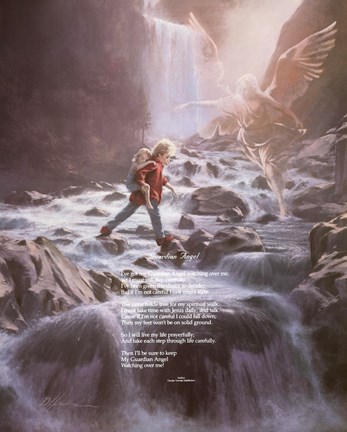
Guardian Angel
by Danny Hahlbohm
Jesus set his words against such teachings as those above. His sayings were original. They may at times have contained echoes of others' teachings to reference his breadth of knowledge, but they would have an original twist. Matthew 11 illustrates this well. Jesus echoes The Wisdom of Sirach. In Sirach 6.21, 23, the author spoke of those to whom Wisdom revealed herself as being the unwise, the unlearned. Likewise, Jesus thanks God in Matthew 11.25-27 for showing his teaching to the unwise and unlearned as well as God revealing himself to the son and those whom the son reveals himself. In Sirach 6.24-30, readers were encouraged to put themselves under Wisdom's yoke and in her fetters, and they would find rest and joy. Sirach 51.26 suggests putting the yoke of Wisdom on one's neck and receiving her instruction. Changing it from from a personification about wisdom to a metaphor about himself, Jesus takes the idea of finding rest and putting on his yoke and makes it original about following his teachings. In addition, Jesus hints that he is Wisdom, thus, his hearers should accept his instruction. But, even though Jesus refers to his teachings as a yoke, showing a knowledge of Sirach, one has to think that Jesus' main purpose was to take full aim at teachings like the sabbath topic above (and representative of all the others found in the Talmud) which turned the ways of God into something laborious and odious. The Talmud's yoke was tedious, heavy-handed, and hard. In contrast, Jesus said his yoke was light and easy.
A couple of the subtle seasonings used in these last two verses are the puns that Jesus uses. Since people translate this verse one way, that is, using the yoke and the heavy load, the value of the pun is lost in the translation. By using the other meanings of the double entendre, the yoke becomes a symbol for shouldering a load together and light burden becomes a contrasting idea to the extensive rules of the Talmud about certain topics. The following translation can be made.
Put on the bar that joins us together and acquire my habits because I am easy to work with and don't mind joining you. The bar that joins us benefits you, my load isn't tedious, long, and odious.
The word ζυγός (yoke) can at times refer to a balance beam or just a balance. So, really, yoke is a triple entendre. The scholars of the law would not have missed this intended meaning. It meant, Take on my teachings because they are balanced. My teachings are not rigid and don't make you high and mighty. The balance makes you good and keeps you steady.
That's my goal - to put on Jesus' yoke and learn from him. It's a beneficial way of life. It's a fluid way of life because his teachings apply to every situation, at least that I have ever encountered. It's a steady way of life that people learn to count on you for. It's a joint way of life.
[The beginning and ending songs are different versions of Prince of Peace by Hillsong United] [Artwork is Guardian Angel by Danny Hohlbohm retrieved from http://www.fulcrumgallery.com/Danny-Hahlbohm/Guardian-Angel_69658.htm] [For a suggested text of the Wisdom of Sirach click here.] [For a suggested text for the Babylonian Talmud of the Mishnah used above click here.] [The Greek text used is the Nestle 28th edition] [Translations from Greek are my own.]
Morsels of food are delicious because of the little things, the subtle seasonings, the dash of salt, the sprinkle of garlic, the garnish of parsley, the touch of glaze, or the hint of lemon. Ahhhh - so delicious!
There was a time in Jewish history when things were worse than they ever had been since leaving the province of Goshen centuries before. Jerusalem was sacked by Nebuchanezzar's army and many Jews were deported to his capital city of Babylon. That was a terrible, terrible part of the Jew's story. The prophets had given oracles from God that this would happen if the Jews didn't change from their outrageous habits of indecently representing God on the Earth. The prophets warned and warned, still nothing changed. So, God visited their nation with captivity.
Its scars filled their literature for hundreds of years thereafter. Stories, memoirs, and songs contained the people's hopes of returning to Judah and reestablishing Jerusalem as their capital and rebuilding their temple to God. The literature contained oracles from more prophets not to fall into the same pitfalls that the people before the captivity had fallen into. It contained historical accounts of the Law of God being reinstituted in Jerusalem when a number of captives were allowed to return there almost a century after they had been deported. And, it contained stories of Jewish people who still served God in the empires where the Jews had been scattered after deportation.
The prophets that still actively delivered their oracles from God after the Jews' return to Jerusalem seemed to say the same thing. The oracles of God's prophets before the captivity had talked about restoration after captivity in very glowing terms. Isaiah 9. 2-17 shows some of the first seeds of this thinking. After the return, Joel 2 is representative of the developed line of reasoning from the post-exilic prophets as the Jews contemplated their captivity experience. And added to the oracle is the hope of Israel for God to chastise the nations for enslaving his people again. Joel 3. 1-3 portrays this condemnation of non-Jewish nations. Malachi, one of the last prophets, if not the last, represents a well developed philosophy of the Jews' rationale about 435 BCE. Its four small chapters contain a cohesive, sequential unit of thought of the reason for the captivity, the aftermath of judgment against those who opposed God and his people, and the promise of bringing all his people back together. This became the blueprint for the literature that followed during the first, second, and third centuries BCE.
Although different types of literature came out of the post-exilic centuries, such as the story of Esther, a really different form of expression developed in order to propagate the blueprint found in Malachi. It was called apocalyptic literature. The form became very popular and had predictable features. The principal traits were to have a main character, a human messenger to relay heavenly secrets to through visions, and an angel from Heaven to reveal the meanings of the visions. God's people would be reminded to live a clean life and to repent if they hadn't. Then, God would promise destruction in order to save his people from a relentless empire making them suffer. They nearly all talked about God's people being brought together for a last age with God in a restored blissful state with him. A good number of these apocalypses were produced by Jewish authors, but some by Christian writers. The tradition using the apocalypse lasted about 400 years, 200 years before and after Jesus' life. Some of the most common revelations were The Book of Enoch, 2 Esdras, Daniel, a portion of the War Scroll from Qumran, Testament of Levi, Apocalypse of John, Apocalypse of Peter, and a portion of the Shepherd of Hermas.
The Apocalypse, or Revelation, of John is squarely in the center of this tradition and contains the features mentioned above. The seventh trumpet of Revelation 11 serves as a good example of the last feature, that of God bringing his people into a kingdom just for them at the end of the age. It is very reminiscent of Second Esdras chapter 6. 11-34 and chapter 13.25-38, and Daniel 7, all three of which were written in the two hundred years before Jesus. They dealt with interpretations of a vision that introduced the beginning of a dominion or realm in which God took over from the powers of the Earth. All three deal with God judging a terrible empire who had oppressed his people and whose power he is taking from them and establishing his own realm. In Revelation 11, the last 5 verses containing the 7th trumpet, the trumpet signals a time people have been waiting for and comes after warning all of the Christians' enemies that their oppression and persecution would be repaid.
(And in that hour, a great earthquake caused a tenth of the city to crumble. 7000 names of men were extinguished in the earthquake. Fear gripped the rest of the city and they honored the God of Heaven. )
(The seventh angel sounded his trumpet. Loud voices in Heaven shouted, "The realm of the world has become the realm of our Lord and his Chosen One, and he will be its ruler forever.")
Second Esdras 6.23 and 13.25-38 in particular contain the exact idea of Revelation 11.13b, 15 in a vision given to Ezra about judgment on those who have humiliated Jerusalem's inhabitants. Daniel 7.13-14 also express the idea of the Son of Man joining the Ancient of Days and establish his rule.
Then the trumpet will sound, and sudden terror will grip the heart of everyone when they hear it. Second Esdras 13. 25, 26 The man you saw coming out of the sea, represents the one whom God Most High has kept ready for many ages. He will free the world he created and establish the new order for those who survive. [Good News Translation]
(he was given the power to rule, and all the honor that comes with it. Many people, nations, and languages would worship him. His realm would not end and could not be destroyed.)
There are a lot of things I cannot imagine - hiking the mountains in winter without a coat, visiting other countries without reading about their cultures first, and diving into the ocean without knowing how to swim. Likewise, I cannot imagine anyone taking on the task of interpreting Revelation without knowledge of the literature of the apocalyptic movement among the Jews. Each work individually would trigger a hope for the end of the world and the saints of God joining him in his realm. But, taken all together, it is easy to see that the hope of Israel was given an expression for what they thought God had promised. Shortly before the time of Jesus, the Qumran sect of Jews, in their War Scroll, definitely had linked the Messiah to the last age when God would come and set up a kingdom for the Messiah to reign with God's saints. Second Esdras as well mentions the Son of Man. So, as Christianity began to take hold in Asia Minor, it is no wonder that John would turn to the apocalypse to express to Christians to hold on through persecution and oppression because God would stand up for his people, come for them, and embarrass the nations that had treated them harshly.
The visions of Revelation that began with the seven seals show clearly the blueprint used in nearly all apocalypses. The visions built on each other.One led to
another, so that seals number 5 and
6 set up the vision of the trumpets. The Christian martyrs asked God how
long their suffering would last and received an answer through the imagery of a Day of the Lord happening.As each trumpet sounded, the events that took place showed more in detail the cause
for the Day of the Lord and the events that drove God to cleanse the Earth as he
had done in the past. This time Roman
leaders and military forces were persecuting his people.God told his people in symbols that the root of the problem was that the the Romans had taken on God’s role,thinking they were the controllers of destiny on Earth. They weren't, so they would be eradicated along with the other main source of their suffering, the Parthians. The Jews, also, would see that God's saints were those following Christ, God's chosen, the Messiah. Seal 7 (Revelation 11.15) opened to the announcement that the realm of God with Christ, the Messiah, was starting - the last age when God would restore his people and establish his realm. The response in Heaven to this news was acknowledgment of by the twenty-four elders around the throne. They appeared before the seals (Revelation 5) with praise for God before knowing what was going to happen. Here they appeared again, doing the same thing at the end of the trumpets after knowing what was going to happen. Verse 16 Καὶ οἱ εἴκοσι τέσσαρες πρεσβύτεροι [οἱ] ἐνώπιον τοῦ θεοῦ καθήμενοι ἐπὶ τοὺς θρόνους αὐτῶν ἔπεσαν ἐπὶ τὰ πρόσωπα αὐτῶν καὶ προσεκύνησαν τῷ θεῷ
(The twenty-four elders sitting on their thrones in God's presence fell on their faces and worshiped God) Verse 17 λέγοντες· εὐχαριστοῦμέν σοι, κύριε ὁ θεὸς ὁ παντοκράτωρ, ὁ ὢν καὶ ὁ ἦν, ὅτι εἴληφας τὴν δύναμίν σου τὴν μεγάλην καὶ ἐβασίλευσας (saying, We thank you Lord God Almighty The one who is and who was, Because you have taken the reins of your great power, And started your rule.) Very predictably, and according to the apocalyptic blueprint, after announcing the end of the age, God was next going to destroy the nations and reward his people (verse 18). Then, the scene introducing the trumpets, the temple in Heaven, opens again. This time it is not the altar that is seen, but the ark, or chest, containing the covenant . God would keep his promise. The scene that had started with God hearing the prayers of his people ended with a sign that he would powerfully show his glory for those who had reverenced him! Verse 19 Καὶ ἠνοίγη ὁ ναὸς τοῦ θεοῦ ὁ ἐν τῷ οὐρανῷ καὶ ὤφθη ἡ κιβωτὸς τῆς διαθήκης αὐτοῦ ἐν τῷ ναῷ αὐτοῦ, καὶ ἐγένοντο ἀστραπαὶ καὶ φωναὶ καὶ βρονταὶ καὶ σεισμὸς καὶ χάλαζα μεγάλη
(God's temple in Heaven opened up and the chest containing his covenant could be seen it. This was accompanied by lightning and thunder, an earthquake and rumbles.) There is this bit of garnish around the morsel as the chapter closes. It's God's trademark, his signature. All of the apocalypses didn't fail to use God's signature move in showing his glory. The signature started with his people at Mt. Sinai, it was used with every Day of the Lord oracle through his servants the prophets, and it continued into the expressions of hope of restoration in the apocalypses. John uses it here in Revelation as God promises to visit the nations with destruction on behalf of the ones who sing his hallelujah in the name of his son. When God moves, the earth and sky quake and rumble and flash.
,
[Songs used are I Am by David Crowder Band, Majesty and Our God Reigns by Delirious, and Forever by Kari Jobe] [Artwork Doomsday Earth on Fire, retrieved from http://www.fotosearch.com/CSP953/k9531862/] [The Greek text used is the Nestle-Aland 28th edition] [The Hebrew text used is the Biblia Hebraica Stuttgartensia, 1967/77.] [Second Esdras 6:23 and 13.25, 26 used The Good News Translation (US Version), American Bible Society, 1976] [Translations from Greek and Hebrew are my own.]
Morsels of food are delicious because of the little things, the subtle seasonings, the dash of salt, the sprinkle of garlic, the garnish of parsley, the touch of glaze, or the hint of lemon. Ahhhh - so delicious!
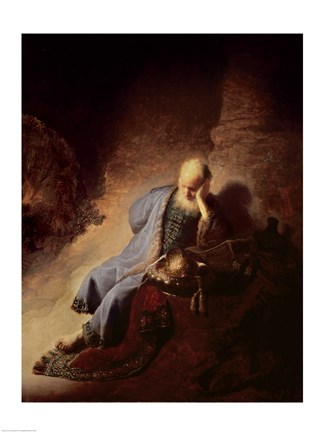
Jeremiah Mourning Over the Destruction of Jerusalem
by Rembrandt van Rijn
John addressed the need for God to rescue his people from the Roman leaders and their provincial governors in trumpets 1-4 and from the Roman army in trumpet 5. He included the Persian army and their disdain for anyone not Persian in the 6th trumpet. John referred to the plagues used against Pharaoh to remind Christians that the Romans had the same arrogance and would face the same end since the same God was going to deliver them. He used analogies of Roman and Parthian armies to locusts and scorpions to show how powerful, and yet how limited these two forces were in the face of God's power and control. But there was one more group of people that the Christians suffered at the hands of.
John turned his attention to the Jews. A little historical information helps one to see that the Jews had been at work actively distinguishing themselves from Christians since Jesus had ascended to God's realm. Although Jesus was a Jew, the Jews would not accept that he was God's son. So, Jews distanced themselves. Especially after the 50s ACE, after Paul's considerable work in taking the gospel to the non-Jewish groups of the Roman Empire, the Jews felt that they should make themselves distinct in the Roman leadership's eyes.
Seutonius' Lives of the Twelve Caesars, written in 119 ACE, bears out this determination on the part of the Jews. Rome was a bustling city in the year 50 ACE. Claudius was emperor of this huge and very powerful empire with legions and legions of military force at his disposal. He could have easily quelled the unrest. But, instead, Claudius decided to expel the Jews, or at least a portion of the Jews, because of the disturbances they were causing over "Chrestus," thought to have been the Latin name for Christ. Acts 18.1-18 also refers to the expulsion. Some think that Claudius didn't distinguish between Christians and Jews, since Christ was a Jew, and expelled "Jews" (both orthodox and Christian) that were causing the disturbance.
Seutonius also mentions that Jews in Tiberius' time, 19 ACE, were punished, some expelled, because of a scandal concerning converting an important woman in Rome, then taking funds allocated to her for a Roman building to send to the Jerusalem temple. This incident was well before Jesus, but Jews had certainly built a reputation for being a devious and rebellious group in the empire.
The Jews' actions in the provinces of Rome were not any different than what Seutonius recorded about Jews in Rome. Acts 18.1-18 also records the uprising in the Grecian province, in Corinth. It, too, was about Christ, and Gallio, the proconsul, dealt with it in keeping with Roman tradition, that is by not showing concern about provincial religions unless they threatened the security of Roman peace. Acts also includes uprisings in other cities in the provinces, such as the one in Ephesus in Asia Minor and Thessalonica in Macedonia.
It is no wonder, then that by the time Revelation was written, probably in the last year of Domitian's reign in 96 ACE, that the Jews were still at it. They had continued to actively persecute Christians. In Revelation 2.8-11and 3.7-13, in the letters to the churches of Asia Minor, John mentions the Jews in a very derogatory manner, calling them the "synagogue of Satan," and contrasting the Christians to them. John commends the Christians at Sardis for standing up under the slander of the Jews and the Christians from Philadelphia for holding on against Jewish ostracism.
It was important to John to reassure Christians that not only was God hearing their cries of suffering at the hands of the Romans mainly, but that he also heard their cries of the things they had suffered at the hands of the Jews. John created an interlude in the presentation of the seven trumpets to show Christians that God had seen the works of the Jews and wanted to reinforce the idea that Christians were God's designated people. In the seals, John had created a similar interlude in Chapter 7 between the first 6 seals and the 7th seal to show that God was acknowledging them specially, by sealing them. He created an interlude in Chapters 10 and two-thirds of Chapter 11 between the first 6 trumpets and the 7th trumpet for the same reason - to reassure them that they were God's people, distinct from the Jews. And what better way to indicate this than to use a couple of Old Testament, twin sister passages to his own apocalypse - apocalyptic sections from Ezekiel and Daniel.
Daniel 12.7-13 depicted two angels, both standing with feet planted on opposite sides of a river, one a little further downstream than the other. One angel asked the other how long it would be until the things that Daniel was asked to seal in a book would take place. The other angel took an oath in God's name, exclaimed that God's people would be persecuted for 3 1/2 years, then told Daniel to keep secret the words of how the end will happen.
(But that, in the days when the seventh angel would intentionally play his trumpet loudly, God's mystery would be competed, just like he announced to his servants, the prophets. )
The second half of Revelation 10 uses Ezekiel 2.8-10 and 3.1-15 to portray a message. Perhaps John was building on the previous idea from Daniel, so he was explaining that the following action from Ezekiel contained the mystery of God. Or, perhaps Ezekiel was just an additional voice in reminding his audience that God needed to explain a mystery that he had created many years ago. God's oracle to Ezekiel was to speak specifically to his people the Jews and tell them how defiant God considered them to be. God strengthened Ezekiel against the Jews' very chilly reception by giving him a scroll to eat containing the griefs of the people. Ezekiel did, and it tasted sweet in his mouth and filled his stomach. It made him stubborn and tough, like the Jews were, and gave him the strength to stand up to them even though they never listened to him.
The comparison to Ezekiel's experience is unmistakable in Revelation 10.
(I went to the angel to tell him to give me the little scroll, but he said to me, "Take it and eat it until it is completely gone. It will cause pain in your stomach, but will be as sweet as honey in your mouth.)
(I took the little scroll from the angel's hand and ate it. It was as sweet as honey in my mouth and caused indigestion in my stomach.)
What follows in Chapter 11 makes it very clear that God gave John the message that God's people of the Old Testament didn't accept Jesus. Because of this, his people of the New Testament shouldn't be confused. God did send his son. All of their suffering at the hand of the Jews would be vindicated.
The first two verses of Revelation 11 depicted an angel asking John to measure the temple. The precedent for this was found in two places, Ezekiel 40-43 and Zechariah 2.1-2. In Ezekiel, God asked the prophet to measure all the gates and all the courtyards so that they people could be given the exact plan. With the exact plan, they would hopefully not sin anymore, but repent and change their ways, as indicated in Ezekiel 43.10. With the exact plan, they also would hopefully quit worshiping idols from surrounding nations and stop following their kings' morality rather than God's laws, as in Ezekiel 43.7. They had been disgracing God's name, but hopefully they would change. The 1260 days referred to symbolize a shortened time or a Godless time, or both. 1260 = 42 months = 3 1/2 years, which is half of 7, the number representing a perfect time or a Godly time since 7 was the number of Heaven (3, the trinity) and Earth (4, the four corners of the Earth).
Verses 3-6 of Revelation addressed two witnesses. They were identified in verse 3 with two olive trees and a lampstand, a reference to Zechariah 4.11-14 where two witnesses were chosen by God to serve him. Although the two witnesses were not further identified in Zechariah, there were two witnesses that people in Jesus' day referenced when speaking of Jesus, Moses, referenced in John 1.21 and Elijah, referenced in Matthew 11.14. The reference from John is based on Deuteronomy 18.18, the Matthew reference was based on Malachi 4.5. Revelation 11.6 tells who the two witnesses were in case Revelation 11.3-4 left any doubt.
(In the days when they were representing God, they had the power to prevent the sky from a drop of rain making anything wet and the power to turn rivers and lakes into blood and strike the land with plagues whenever they desired.)
These two witnesses were powerful. They could stop rain and inflict plagues. Very clearly, these were the two actions of Elijah ( 1 Kings 17.1) and Moses (Exodus 9-11). These two men as witnesses had to have been representative of the Jewish nation and how they should have represented God to the nations of the Earth.
Revelation 11.7-14 shows what happens to the two witnesses. In this case the two witnesses were not the focus of the passage. They symbolized the Jews as a group during the days of Jesus. He came to give a new covenant, or at least a new understanding of the Old Covenant, before the Jews killed him. The lifeless bodies of the witnesses were paraded in the streets of Jerusalem for all to view. Everyone should have taken note that when Jesus was killed, the Jewish nation's life was gone, not because Jesus represented the Jews, but because he represented a new beginning for God with the Jews, a new understanding of the kind of people God expected his own to be.
Three more references from the Apocalyptic sections of the Old Testament were echoed in Revelation 11.7-14 and applied to the Jews. The first echo is from Daniel 7.7, 19-28. The fourth beast of Daniel's vision comes to mind.
(And when they had completed their testimony, the beast who had risen from the Earth's depths went to war against them, subduing and killing them.)
Interestingly, the Roman army, which is many times correlated to the fourth beast in Daniel, closed in on the group of people who had been a thorn in their sides in this region of the world. They sacked Jerusalem in 70 ACE and 3 years later finished off the last of the dissenters on the top of a bluff called Masada. One might say the Jewish nation had been subdued and killed.
As a result, when people wanted to talk about what might come after this in the grand scheme of things, Daniel was brought up. It talked about the times of the end. Other apocalypses, such as the book of 2 Esdras written shortly before the time of Jesus, also dealt with the end through a series of visions delivered by angels. And, extant in Jesus' day were the Dead Sea Scrolls. The War Scroll in particular spoke of the Sons of Light and the last days. So, yes, people talked about the idea of the end in the two hundred years either side of the life of Jesus. The written format used to capture the discussion that took place was the apocalyptic form. In fact, some believed that one of the most popular books read before and during the time of Jesus, the book of Enoch, with all of its apocalyptic characteristics, written and compiled over the course of this 400 year time period, could be the sealed scrolls referred to in Daniel.
Revelation came along most of the way through the four hundred year period referred to above. Since the interpretation of the fourth beast presented in Daniel 7 was the Roman Empire to many Jews, it is altogether possible and likely that John picked up the storyline of Daniel with his beast from the depths of the Earth to be the fourth beast who would destroy the enemies of the Christians. These enemies would include the Jews who lost their second temple in the sack of Jerusalem and who continued to harass the Christians.
The second reference is from Isaiah 1. The chapter could not be clearer. God's people were acting disdainfully. They directly disobeyed the Law given to them. God was finished with them. He would have destroyed them all like he did with the residents of Sodom, but he had compassion on the few who were trying. One can see this reflection in Revelation 11.8.
(Their bodies will be paraded in the streets of the great city, which is symbolically called Sodom and Egypt, where their lord was crucified.)
In addition to Sodom, Egypt was mentioned as the symbolic name for the Jews. God had wiped out the Egyptians' first-born progeny and all of Pharaoh's army in the Reed Sea because of Pharaoh's impudence. The comparison to the same attitude of the Jews in John's time cannot be missed.
The third reference is from Ezekiel 37.1-14, the vision of the valley of the dry bones. God took skeletons and slowly made the bones ready to live again. Then he breathed life back into the bodies. The video reading of these verses above is a striking visual of the reference John was using. The application was to the renewal of Israel. And that was Jesus' mission as well - to renew a clearer understanding or make a new covenant with Israel. So, John speaks of life reentering the witnesses because that was Jesus' stated reason for coming to Earth (John 10.10).
(And after three and a half days the spirit of life from God reentered them, and they stood on their feet. Those who had been watching this were speechless and tentative of what might come next.)
But the witnesses weren't allowed to continue on the Earth. God called them to Heaven in much the same way that he had taken Elijah in the first place. Their purpose on Earth was finished. Symbolically, the image of the witnesses was that the purpose of the Jews, which had been communicated to the prophets in the first place, was finished. Now the people who believed in God's son would carry on. There was an earthquake and destruction of a tenth of Jerusalem's population to depict the Jews' destruction of purpose, then everyone praised God. Both of the chapters of Isaiah 1 and Ezekiel 37 end with the renewal of God's purpose after he promised to destroy them in captivity for their evils. Revelation 11 presents the metamorphosis of Judaism into Christianity to reassure the Christians that God was not leaving any matter untended in redeeming those who had suffered for Jesus' sake.
There is a bit of subtle seasoning nestled in the wording of Revelation 10.10. The little scroll, which in Ezekiel contained the Jews' preoccupation with God's giving up on them and their sighs and chants of sorrow for God's abandonment of them had to be eaten. The analogy was that the scroll tasted sweet, as supplications often seem to people who make them, but the effect of the list was that they had to be expunged from Ezekiel's body, they had caused indigestion. If something is that onerous to God, then he would try to rid himself of the cause and rebuild, renew, and recreate something new that would have a different effect on people's lives.
I am eternally grateful that Jesus paid the price and offered me life and a room in his father's great complex of heavenly rooms. I am also glad to know that belief in God's son is worth everything I have on this Earth. I feel affirmed by this portion of Revelation that God will come to his people's rescue. I feel a part of his people because after John ate the scroll, he was told to tell everyone, all people of every language, nation, and race that God has renewed and recreated his relationship with his people. I live many years after the collapse of the Roman Empire. The empire I live in has oppressions of its own against Christians. But, God still defends his people and seeks to restore a relationship with those who accept the life given by his son. I am eternally grateful.
Historical note:
The Letter of Barnabas, written probably in the reign of Emperor Hadrian about 40 years after Domitian, interprets the Old Testament prophecies in exactly the same way as John does in this interlude in Revelation. The letter helped Christians and others see how different their faith was from the beliefs of the Jews. Hadrian had very great tolerance for Christianity, allowing it to flourish. God did show up for his suffering people under Domitian.
[Songs used are How Great Is Our God by Laura Story and Our God by Chris Tomlin.] [Introductory artwork Jeremiah Mourning Over the Destruction of Jerusalem by the Rembrandt van Rijn, retrieved from http://www.fulcrumgallery.com/Rembrandt-van-Rijn/The-Prophet-Jeremiah_155724.htm , and YouTube ofDry Bones by doulos lesou christou, retrieved from https://www.youtube.com/watch?v=6dafYxu8cQQ.] [The Greek text used is the Nestle-Aland 28th edition, for all verses except Revelation 11.11] [The Greek text used is Westcott Hort, UBS4, for Revelation 11.11] [Translations from Greek are my own.]