Search This Blog

Thursday, January 19, 2017

Walking away from Rome

Reflections are everywhere - in crystal blue lakes and shining, marble surfaces, in the glass of towering skyscrapers and the concave lenses of ever-present cameras. They capture my thinking and mesmerize me, enticing me to look again because there's more in the picture!


The words were uttered on the side of a lake.  They would have been easy to miss.  The situation started with Jesus' question, "Do you care about me?" and ended with "Follow me."  Between these phrases, most of the dialog was about Jesus letting Simon know that he would be counting on him to guide his followers.  But all of that dialog was foretelling how Simon would spend his life.  At the tail end of the Q&A part of the conversation in John 21.18-19, Jesus foretells Simon's death.  The remark is easy to miss, especially when reading for gist.

The short remark was to forewarn Simon of a difficult death.  Simon could easily see the metaphor of protection and provision for Jesus' little lambs before Jesus finished speaking to him, which is what Jesus wanted him to do.  But, the statement that followed the Q&A was less metaphorical and more matter of fact.  Jesus knew Peter's last day wouldn't be a soft landing at the end of an illustrious life.  He separated his guidance portion from the death forewarning with the repetition of the word  ἀμὴν (amen or something on the order of "truthfully").  Jesus wanted him to know not to expect to go softly into the dark on his last day.  His reward would be only, but certainly, in the next life.  So Jesus began:

Verse 18a

Ἀμὴν ἀμὴν λέγω σοι, ὅτε ἦς νεώτερος, ἐζώννυες σεαυτὸν καὶ περιεπάτεις ὅπου ἤθελες

(Here's the truth.  When you were younger, you got yourself ready and went wherever you wanted to go.)

Yes, Simon was young in the early days of The Way.  He had the energy and charisma to lead the little lambs to a robust belief in Jesus' Way.  He would lead in Jerusalem in the face of the Jews that wouldn't recognize Jesus as messiah, in Corinth in the face of gnostics who would spiritualize Christianity into simply an inner light for a serene life, and in Rome in the face of the most brutal and indifferent masters of a world empire.


But, Jesus continued speaking:

Verse 18b

ὅταν δὲ γηράσῃς, ἐκτενεῖς τὰς χεῖράς σου, καὶ ἄλλος σε ζώσει καὶ οἴσει ὅπου οὐ θέλεις

(But when you get old, you will raise your hands for someone else to get your ready and take you where you don't want to go.)

Yes, Simon would grow old.  He would cross paths with powerful people and stand for the faith, but eventually one of those powerhouses would be his nemesis, leading him down a path he would not want to travel.  His life would end.

Verse 19a

τοῦτο δὲ εἶπεν σημαίνων ποίῳ θανάτῳ δοξάσει τὸν θεόν

(He said this to signify what kind of death he would honor God with.)

A great historical account exists of the end of Simon's life.  The story recounts events that happened exactly as Jesus said.  The account exists in both Latin and Greek and is called today, The Acts of Peter.  Section 6, labeled Martyrdom of Peter, relates the episode.  Simon is told by Christians close to him in Rome that Agrippa was actively seeking to kill him.  They urged him to leave Rome so that he could continue to teach them from afar.  Peter took their advice, disguised himself, and left Rome.

At the outskirts of the city, Simon saw a man approaching him on the road.  As they passed each other, Simon recognized the other man to be Jesus.  Peter spoke out:

Και ο πετρος ιδων ειπεν αυτω κυριε που ωδε

(Peter noticed him and said, "Lord, where are you going?")

Και ο κυριος ειπεν αυτω εισερχομαι εις την ρωμην σταυρωθηναι

(The Lord said to him, "I am going into Rome to be crucified.")

Και ο πετρος ειπεν αυτω κυριε μου παλιν σταυρουσαι

(Peter replied, "My Lord, are you being crucified again?")

Και ειπεν αυτω ο κυριος ναι πετρε παλιν σταυρουμαι

(The Lord answered, "Yes, Peter, I am being crucified again.")

Και ελθων εις εαυτον ο πετρος και ιδων τον κυριον εις ουρανον ανελθοντα

(Then Peter watched the Lord ascend to Heaven.)

The account went on to say that Jesus' words all those long years ago by the side of the lake flashed through Simon's mind.  It is clear that Simon also remembered Jesus' last instruction to him (John 21.19).

Verse 19b

καὶ τοῦτο εἰπὼν λέγει αὐτῷ· ἀκολούθει μοι

(He then reiterated to Peter, "Follow me.")

Simon could hear again Jesus' voice imprint at the end of his prediction, "Follow me."  That remembered imprint caused Simon to turn to follow Jesus' wish of going back into Rome to suffer crucifixion for his Lord.  All Rome could see the crucifixion of Jesus a second time through his body.

And from his head-downward position on the cross, Simon told the followers of Jesus that had gathered there, the mystery of the cross, namely that everything on Earth is backward to the way of the cross.  Simon quoted Jesus as saying, "Unless you make the things on the right as the things on the left, and the things below as the things above, and the things behind as the things in front, you cannot enter the kingdom of heaven."  Matthew West captures this message from The Martyrdom of Peter wonderfully well in his song, My Finest Hour.


 As time has passed, I have looked on accomplishments that have come my way, what I would consider my finest hours.  They usually led to making life a little better in some way or to giving my children an example.  Only recently have I tried to look on things that have happened and queried Jesus, "Where are you going (with the skills and experiences you have given me?)."  I expect that the answer is the same one Simon received, "I am going into Rome to be crucified again."  I translate that into my own life as "I am visiting your experiences for you to use them for my honor."  So, like Peter, I turn back to take up again what I have done in order to honor God.  

Let it happen.


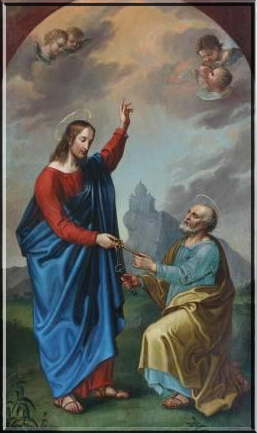
[Introductory photo of reflection retrieved from http://www.topdesignmag.com/62-impressive-examples-of-reflection-photography.  The second work of art is retrieved from http://catholicharboroffaithandmorals.com/St.%20Peter%20Lives%20of%20the%20Popes.html]
[The first song is Be Not Afraid, I Go Before You Always by Harsh Realm.  The second song is My Finest Hour by Matthew West]
[The Greek text used for the New Testament references is the Nestle Aland 28th edition]
[The Greek text used for the Acts of Peter and the kingdom of heaven quotation of Jesus is taken from The Ancient Martyrdom Accounts of Peter and Paul by David L. Eastman]
[Translations from Greek are my own.]

Thursday, December 22, 2016

Raised voices

Reflections are everywhere - in crystal blue lakes and shining, marble surfaces, in the glass of towering skyscrapers and the concave lenses of ever-present cameras. They capture my thinking and mesmerize me, enticing me to look again because there's more in the picture!


 Nobody really likes for the government to give deadlines and force people to conform.  Not now and not in the Roman Empire of old. The story found in Luke 2.1-20 starts with the oppressive Romans forcing their will once again on their provinces.  It began with a royal decree and with two people in a difficult situation that no one in the world had ever really heard of.  Mary and Joseph were married, yes, but they shared no intimacy until the child was born that Mary was pregnant with.  She was about to deliver that child, so the decree to register at a designated census center was awful timing.  It meant traveling about 3 days on foot, disastrous for a woman ready to deliver a child.  And for what?  Just to register for a census?  The world power Romans were demanding a count of people in its provinces.  Ridiculous!  But the two obeyed the decree.

Joseph and Mary both knew the child would be special.  They had had visitations and dreams that God himself was coming to be with his people through their child.  So far, Joseph and Mary and Mary's cousin Elizabeth had shared this secret.  But, the circle was about to widen.  It would start with this census although Mary and Joseph didn't know that.  Once in Bethlehem, Joseph tried to stay at the local inn, but it had no vacancy.  The innkeeper offered them the stables where the donkeys, sheep, and goats were being kept for his tenants.  Since they didn't have a choice, they took the stable.

It doesn't take much imagination to know what a long journey can do to hasten a pregnant woman's delivery.  Joseph set up an area in the stable for sleeping.  But as he was about to settle in, he heard Mary's cry.

"What is it?" he said, turning to look at Mary as she cried in pain.

"He's coming.  I'm having the baby!"  She could barely draw breath to talk because of the contraction seizing her.

He swung into action.  He ran to get a large bowl of water and a number of cloths for both baby and Mary.  Then he delivered Jesus, their baby boy.  After several trips for water, Joseph had both wife and baby washed and clean.  He wrapped the little baby in a cloth.  Mary and he took turns holding their newborn, gazing lovingly into his face.  After a long while, they all needed rest, so they laid him in the trough filled with hay where usually the animals ate.  He settled down next to Mary to admire the new life that had just come to them and to wonder what might lie in store.  It crossed his mind how much less than ordinary this birth was.  This special child was born away from its home, so no relatives were there celebrating his birth.  He lay in a feed trough in a town not his own where nobody knew of his coming into the world.  After all the messages from God to prepare him and Mary for this birth, surely God from his highest place in the heavens hadn't let this birth slip his notice.

In front of the inn, a group of men were running to its entrance demanding to know if a child had been born to anyone that night.  The innkeeper didn't know, so he said, "No!  Everyone with a room was sleeping."

But, the men were insistent.  "No?" they shouted questioningly.  "The answer cannot be no.  We have just experienced something extraordinary.  There has to be a child here.  The rest of the town is silent.  There would be families together in the houses if one of the women of the town had had a baby.  Someone must be here who has had a baby."


Joseph heard the rising tone of voices in front of the inn.  He roused himself from his and Mary's make-shift bed to see if the excitement was a danger to them.  As he rounded the corner, one of the men ran over to him, "Do you know of anyone who has had a baby tonight?"

"Why?  Who are you?" Joseph asked.

"We are local shepherds.  We were watching a flock just on the other side of this hill."  The man's voice betrayed his uncontained excitement.

"Tell me what you experienced that was so extraordinary?" Joseph asked.

Then Joseph heard the astounding sequence of events that had just occurred outside of town.

Verse 9

καὶ ἄγγελος κυρίου ἐπέστη αὐτοῖς καὶ δόξα κυρίου περιέλαμψεν αὐτούς, καὶ ἐφοβήθησαν φόβον μέγαν

(An angel from the Lord stood beside them and the brilliance of the Lord lit up the countryside around them.  They were seized with terror.)

Verse 10

καὶ εἶπεν αὐτοῖς ὁ ἄγγελος· μὴ φοβεῖσθε, ἰδοὺ γὰρ εὐαγγελίζομαι ὑμῖν χαρὰν μεγάλην ἥτις ἔσται παντὶ τῷ λαῷ

(And the angel said to them.  "Don't be afraid!  I am here to deliver news to you that will bring tremendous happiness to everyone.")

Joseph recognized immediately that  God was now starting to announce the special nature of this child to a broader circle.  Mary lay completely exhausted in the stable trying to sleep, but Joseph knew she would want to hear this story, so he brought the shepherds to her for her to hear.  The shepherds repeated their experience to Mary, then continued telling why the angel said they had appeared to them.

Verse 11

ὅτι ἐτέχθη ὑμῖν σήμερον σωτὴρ ὅς ἐστιν χριστὸς κύριος ἐν πόλει Δαυίδ

(because on this day a savior has been born, who is messiah, Lord, in the city of David )

Verse 12

καὶ τοῦτο ὑμῖν τὸ σημεῖον, εὑρήσετε βρέφος ἐσπαργανωμένον καὶ κείμενον ἐν φάτνῃ

(And here's a sign for you - you will find a baby just born, wrapped and lying in his baby bed)


I would imagine Joseph and Mary were brought to tears recognizing the magnitude of what had happened.  God was starting to make others aware of his plan to be among them in this child.  They had to have been ecstatic.  But, the shepherds were not finished.  "That's not all," they spoke with heightened speech.  "Right after the angel told us about a savior being born..."

Verse 13

καὶ ἐξαίφνης ἐγένετο σὺν τῷ ἀγγέλῳ πλῆθος στρατιᾶς οὐρανίου αἰνούντων τὸν θεὸν καὶ λεγόντων

(Suddenly, with the angel, a crowd of many more angels appeared from the sky with these words: )

Verse 14

δόξα ἐν ὑψίστοις θεῷ 
καὶ ἐπὶ γῆς εἰρήνη
ἐν ἀνθρώποις εὐδοκίας

(Great honor to God in the highest heavens!  
And on Earth, peace.
From its inhabitants, their highest praise!)

"That's why we're here.  We had to come see the new baby boy who deserves our highest praise!"


And people everywhere through all generations since that time continue to come see.  That's because we, as did the shepherds, feel the awe and splendor of someone in the highest heavens announcing to us on Earth - peace.  I, for one, am here with my highest praise to tell the story's beginning again... again... again... again...


[Introductory photo of reflection by David Kingham retrieved from https://www.borrowlenses.com/blog/best-seasons-and-locations-for-night-sky-photography/]
[The first song is Oh, Holy Night by Josh Groban.  The middle song is Let the Heavens Open by Kari Jobe.  The last song is I Heard the Bells on Christmas Day by Casting Crowns]
[The Greek text used is the Nestle Aland 28th edition]
[Translations from Greek are my own.]

Tuesday, November 22, 2016

So like me

Reflections are everywhere - in crystal blue lakes and shining, marble surfaces, in the glass of towering skyscrapers and the concave lenses of ever-present cameras. They capture my thinking and mesmerize me, enticing me to look again because there's more in the picture!


It was near Caesarea Philippi that Jesus tested the waters with the question of who he was (Matthew 16.13-20).  Peter reacted as Jesus had hoped, so he knew that Peter was representative of those who had followed his teachings.  His time of teaching and healing was to the point he could leave.  From then on, Jesus pressed to go to Jerusalem.  He had to be face to face with the Jewish leaders, the scholars and groups of Jews who were regarded as the keepers of the Law by the rest of the Jewish nation, to get them to give him due consideration.  Several days later, his meeting and conversation with Moses and Elijah again spurred him to turn his attention to Jerusalem (Matthew 17.1-13).  The stage had been set.

The Twelve followed Jesus into Jerusalem, not realizing that the end was imminent for him.  Matthew presented the public conversation between Jesus and those who represented the only true God on the Earth.  It was clear from the time Jesus entered Jerusalem that the Jewish establishment wasn't going to give him due consideration.  The hours were disappearing.  Jesus was on his collision course with crucifixion.  He knew he had only a moment in time to point out what was happening on Earth here in the heart of the Jewish nation.  He had distinctly different impressions of the Jewish leaders than they did of themselves.  His portrayal of them in Matthew 23 was a clear, unmitigated peeling back the layers of behavior the Jewish leaders had hidden behind for hundreds of years.  He wanted the people to know that they were being misled, misguided, and mistaught.  Jesus began by saying not to imitate the scholars and Pharisaical leaders, and then he exposed their layers one comparison at a time.  His last comparison is recorded in verses 27 and 28.

Verse 27

Οὐαὶ ὑμῖν, γραμματεῖς καὶ Φαρισαῖοι ὑποκριταί, ὅτι παρομοιάζετε τάφοις κεκονιαμένοις, οἵτινες ἔξωθεν μὲν φαίνονται ὡραῖοι, ἔσωθεν δὲ γέμουσιν ὀστέων νεκρῶν καὶ πάσης ἀκαθαρσίας

(Oh-h-h you actors and interpreters - scholars of the Talmud and Pharisees - how disgusting!  You are like tombs that have been whitewashed on the outside, making it clear that dead men's bones and all that is unclean lie behind the rock.)

A tradition had grown up over a couple hundred years with whitewashing tombs.  The stone to the cave of the tomb was painted white as a sign to all that the cave was a tomb so that  people could be warned that this was an unclean place.  The comparison was obvious to Jesus.  The scholars and Pharisees had painted themselves white with all of their demands on those who were giving their best to follow the law.  But everyone could see through their pious facades to the lifeless motions behind.

Jesus was adamant.  The people supposed to be representing God weren't.  Not even a little. They should have been understanding of the human condition.  But no.  They didn't have the desire to accept those who had gone on long journeys with their inheritances, hit bottom in pig sties, and returned to the one who loved them.  They should have helped each other stand against lures that pulled them from the straight and narrow.  But no.  They didn't have the commitment to those succumbing to temptation to stoop and write in the sand to stave off accusers.  They should have turned a listening ear to those who had had life throw them curves.  But no.  They didn't have the compassion for their fellow Jews who had been beat up by life, passing by, instead, with turned heads, leaving someone that they disapproved of to show kindness.

They ignored completely incidents like men getting together to bring a lame friend to Jesus for healing.  And when they found it impossible to get their friend in front of Jesus because of the crowds, they jostled him to the roof, sawed a hole in it, tied ropes to the four corners of his crudely fashioned mat frame, and lowered him to Jesus' feet.  They failed to stand with reckless abandon in the presence of the Almighty, calling out his name, acknowledging that he was all around them in the many and monumental acts of acceptance, kindness, compassion, patience, and mercy of Jesus.  Even dead children and adults were raised to life as they watched.  How could they not look to the skies, then fall to their knees with the name of Yahweh on their lips?!!


Jesus often used puns and he did so here, too, with a metaphor. The words φαίνονται ὡραῖοι, translated "making it clear," has a remote meaning on occasion of "making it beautiful."  Whitewashing was a way to dress up the tombs, making them as attractive as possible, distracting onlookers from knowing the uncleanness inside.  Such were the leaders of the Jewish nation.

Verse 28

οὕτως καὶ ὑμεῖς ἔξωθεν μὲν φαίνεσθε τοῖς ἀνθρώποις δίκαιοι, ἔσωθεν δέ ἐστε μεστοὶ ὑποκρίσεως καὶ ἀνομίας

(This is so like you.  Outwardly you want it to be clear that you are doing all the right things, but inwardly you are actually acting a part, delivering a good speech, and bending rules.)

On the surface, these piercing words against the scholars and Pharisees seem uncharacteristic of Jesus' acceptance of others and his willingness to give people second chances.  On the other hand, the timing of his words make them particularly astute.  In about 48 hours, he would sit around a table to observe the Passover meal, take bread and wine, pass them to each of his Twelve, and announce to them a new covenant that he wanted to make with them.  Very noticeably, Jesus wanted to make this new covenant a time to remember him, his ways, and his teachings - teachings distinctly different from the Jerusalem crowd's "acting, interpreting, and bending rules."  He was replacing the Jewish established leaders as God's representatives on Earth.  He, the Son of Man, the Messiah, the Son of God was offering life and a genuine way of following God to those who would remember him till he came again.  The inner and outward values would be the same genuine article, not arbitrary or merely oratorical.

Something I cannot ignore powerfully draws my attention to these two sayings.  Jesus used the word ὑποκριταί  to refer to the leaders in Jerusalem.  The word was used in a couple of ways.  First, it was used to mean an actor in a play.  Second, it was used of an orator delivering his promises or of an interpreter of what was being said.  Used in Jesus' context, the terms showed how poor an interpreter the leaders had become and how memorized their lines were.  They were lame actors, languid interpreters.  The second, saying uses a different form of the noun, ὑποκρίσεως, meaning the part of an actor, the delivery of the speech, or the manner in which something was translated.  The meanings applied not to the people themselves, but to their actions.  All the Jewish leaders had to do was to look back on their actions... and there were many because their lives were full of them.  On top of that, Jesus framed both sayings in a μὲν ...  δὲ sentence structure.  This structure is perfect for showing absolute contrasts in meaning.  The first statement shows one reality, the second an opposite but equally true reality.  It was one of the Greek ways of showing a particularly poignant paradox.  The leaders themselves could not miss the starkness of how Jesus was portraying them.  Over the next two days they would not rest until they had captured him in the dead of night, accused him of blasphemy against God, and delivered him to the Roman governor who would execute him by morning.

Jesus' words here speak to me deep in my heart.  My tendency to judge others' actions while seeing my own actions without judgment cuts me.  That tendency should have been overridden years ago. All humans are hypocritical in one way or another.  So, who really can cast the first stone?  And Jesus is right.  The judgment I project on others is really just a sign of the rottenness I hide.  My judgment of others boomerangs to judgment on myself, creating a cycle.  The cycle forms a chain, one round link inside another round link, inside another round link, chaining me to acting, pleasing words, and poor translations of God's principles for my life.  But, I hear Jesus' words and realize I need to stop the rattle of those chains because there's a better life, an authentic life.


[Introductory photo of reflection retrieved from http://penniur.upenn.edu/publications, taken by Jason Mirachina]
[The first song is At Your Name by Phil Wickham.  The last song is Chain Breaker by Zach Williams]
[The Greek text used is the Nestle Aland 28th edition]
[Translations from Greek are my own.]

Sunday, September 25, 2016

Two copper coins, almost nothing

Reflections are everywhere - in crystal blue lakes and shining, marble surfaces, in the glass of towering skyscrapers and the concave lenses of ever-present cameras. They capture my thinking and mesmerize me, enticing me to look again because there's more in the picture!


Mark 12

Verse 41

Καὶ καθίσας κατέναντι τοῦ γαζοφυλακίου ἐθεώρει πῶς ὁ ὄχλος βάλλει χαλκὸν εἰς τὸ γαζοφυλάκιον. καὶ πολλοὶ πλούσιοι ἔβαλλον πολλά

(He took a seat facing the collection box and watched how the crowd tossed their copper coins into the collection box.  The wealthy people were tossing in a lot.)

I'm not sure what the point of the story is here.  Jesus, at the end of his last week on Earth, sat across from the box that people put money in.  Why was he there watching that?  He had already cleaned house in the temple courts to say that all the money changing that was going on wasn't what God was about (previous chapter, Mark 11).  He had answered questions of the Jerusalem religious leaders targeting the blasphemous tenants of his teaching in their opinion.  They had tried to trap him all week in saying something that would be against their law.  So, what was his strategy in sitting down to watch people put in money?  The prophet Malachi had made it clear God expected his people to bring their money to him.

Verse 42

καὶ ἐλθοῦσα μία χήρα πτωχὴ ἔβαλεν λεπτὰ δύο, ὅ ἐστιν κοδράντης

(A widow who begged tossed in two of the lowest denomination coins.)

It was just another Passover for this lady.  Passovers were particular grueling for  her.  She had had to figure out how to make ends meet for a while now.  Her husband had been able to do that previously for the two of them, but he had met his end before his wife.  She had been reduced to eeking out a living these days.  During this week, people from all around the whole region were coming to the city.  She didn't have anything to give, but these travelers had good hearts.  They were coming to celebrate with relatives the goodness God had shown them.  By asking them for a little help, she could at least ask for a couple of coins to drop into the collection box at the Temple courtyard to show God that she still placed her trust in him.

When she received this from a generous visitor, she made her way to the Temple courtyard.  She was unashamed.  She had to show appreciation to God for taking care of her these days and for his good care of her husband and her when he had live.  She walked right up to the box and tossed in her coins like any other person even though she knew the coins were a very small amount of money.  She quickly walked away for the next person to come to the box.

Yeah, Jesus noticed.  Immediately, she was the center of his focus.  Although his followers were with him, he didn't know if they had seen just what had happened.  He reigned in their attention.

Verse 43

καὶ προσκαλεσάμενος τοὺς μαθητὰς αὐτοῦ εἶπεν αὐτοῖς· ἀμὴν λέγω ὑμῖν ὅτι ἡ χήρα αὕτη ἡ πτωχὴ πλεῖον πάντων ἔβαλεν τῶν βαλλόντων εἰς τὸ γαζοφυλάκιον

(He called his followers around him and spoke to them, "Honestly, of all those who have tossed into the collection box, this widow who begs has tossed in the most of anybody!")

The Twelve were used to Jesus giving contrasts about what people thought was good and what God thought was good.  They had heard it many times.  Jesus didn't speak about money much, though, so he had their attention.  They might have expected him to comment on the "one-tenth" giving that good Jews were supposed to give or on giving from the great wealth above and beyond the tenth that these Jerusalem wealthy elite were capable of giving.  No.  He said the beggar widow gave more than any other person.  They knew to wait.  Jesus would explain what he meant to them.

Verse 44

πάντες γὰρ ἐκ τοῦ περισσεύοντος αὐτοῖς ἔβαλον, αὕτη δὲ ἐκ τῆς ὑστερήσεως αὐτῆς πάντα ὅσα εἶχεν ἔβαλεν ὅλον τὸν βίον αὐτῆς

("They all tossed in from their great wealth, but she from her abject poverty tossed in as much as she had, everything, from her means of living.")

So, why is his last direct teaching lesson before death done at the giving box at the temple?  Because it was the universal setting to acknowledge appreciation AND trust in God's care of his people.  In the capital city of the Jews, appreciation and trust were doled out in limited measures because of the wealth of the party leaders, their dependence on a written code rather than a living God, and their "place" for God since they had to work most of their daily living with the Roman governors and military commanders to control their own population.  They trusted a great deal in their own wisdom.

Likely Jesus had a day left to live on the Earth.  He had accomplished his teaching mission.  He had come to Jerusalem and tangled with the scholars of the Talmud and the party elites.  He had made a huge statement in cleansing the temple in order to show how far off-base the establishment was in conducting God's business - the temple needed to return to being a house of prayer for the nations, not to continue being a money collection location for God.  He had one last lesson to give to his Twelve.  This was it.   Now he could rest.  The end would unravel over the next several hours.

I don't know that the lady's income was replenished, but if she was like every other person, she had a means or a hope that the little that she put in the box would be replenished.  It was her trust that God would replenish that supply that Jesus complimented.  His last lesson would be about trust.  God gives us what we need.  We simply honor and trust.


The widow woman has a lot to teach me.  Jesus was right to focus my attention on her.  I usually exhibit a lot of pride.  I seem to have a surplus of it.  My years are supposed to have taught me to trust God and honor what he has done.  I'm a slow learner.  So, God draws me again to something his son did.  The lesson he taught before undergoing his last hours on Earth.  I am grateful to have in my mind the picture of the woman who begged giving her two coins amounting to almost nothing.  If only I could have that amount of trust in my God who gives me everything I need and so much more.


[The song is Sovreign by Chris Tomlin]
[Introductory artwork retrieved from http://www.spanishdict.com/answers/267625/la-palabra-del-dia-liso]

[The Greek text used is the Nestle Aland 28th edition]
[Translations from Greek are my own.]

Sunday, September 4, 2016

Break-out

Reflections everywhere capture my thinking - in crystal blue lakes and shining, marble surfaces, in the glass of towering skyscrapers and the concave lenses of ever-present cameras - and mesmerize me, enticing me to look again because there's more in the picture!


It was the end of his life on Earth.  He knew it.  He had deliberately come to Jerusalem in order to encounter the Jewish leaders in the heart of the teaching center of Judaism.  Jesus knew they wouldn't tolerate him any longer, brand him as a heretic, and kill him.  The time in Jerusalem had gone exactly as he had thought it would (or exactly as was planned).

But, his Twelve didn't know this was the end of his life on Earth.  He had to make certain that they understood the unfolding events to the fullest extent possible.  In John 16, Jesus begins by telling the Twelve about events that would happen after he left, such as being ostracized from synagogues, and being martyred.  The purpose was to reveal ahead of time some events so that they would not lose their faith.

He also had a second purpose.  Jesus needed to let them know about someone else - someone who would follow him.  His end was the beginning of the time when another would come to stand beside each of them.  In all their endeavors, they would come to count on this third person to be by their sides.  The Twelve had to be introduced.  And this was the time.

Verse 7

ἀλλ’ ἐγὼ τὴν ἀλήθειαν λέγω ὑμῖν, συμφέρει ὑμῖν ἵνα ἐγὼ ἀπέλθω. ἐὰν γὰρ μὴ ἀπέλθω, ὁ παράκλητος οὐκ ἐλεύσεται πρὸς ὑμᾶς· ἐὰν δὲ πορευθῶ, πέμψω αὐτὸν πρὸς ὑμᾶς

(Truthfully, it is better for you that I leave this world.  If I don't leave, the one who will stand beside you and help you cannot come to you.  If I leave, I can send him to you.)

Jesus answered what the obvious questions would have been if he had stopped talking.  The questions on the table would have been, "When he comes, what exactly will he say or do?  How will he help us?"  But the Twelve didn't have a chance to ask; Jesus knew they needed to know because they lived in a world at large that didn't have a clue what was happening in Judea, nor did they care, and because they lived in a land where people of their own kind would represent God differently than the way Jesus had represented him.  Both groups of people had "worldly notions."

Verse 8

Καὶ ἐλθὼν ἐκεῖνος ἐλέγξει τὸν κόσμον περὶ ἁμαρτίας καὶ περὶ δικαιοσύνης καὶ περὶ κρίσεως

(When he comes, he will refute worldly notions about failure and guilt, about decent living, and about sitting in judgment of others.)


That probably was enough information to answer the obvious question the Twelve would have had.  But, Jesus took it a step farther.  He gave the reasons for his answer.  The Greek word μέν is a word used to show that what followed would be connected to the statement that went before it, usually by way of explanation.  The Greek word δέ following the clause with μέν created a series of parallel phrases that explain.  In this case there were two additional parallel phrases.  This rhetorical formula was perfect for Jesus to succinctly clarify his answer.

Verse 9

περὶ ἁμαρτίας μέν, ὅτι οὐ πιστεύουσιν εἰς ἐμέ

(He will verify what I said about failure and guilt by showing what happens when people don't believe me.)

Verse 10

περὶ δικαιοσύνης δέ, ὅτι πρὸς τὸν πατέρα ὑπάγω καὶ οὐκέτι θεωρεῖτέ με

(He will verify what I said about decent living by showing that I did go back to the father after you didn't see me anymore.)

Verse 11

περὶ δὲ κρίσεως, ὅτι ὁ ἄρχων τοῦ κόσμου τούτου κέκριται

(And he will verify what I have said about sitting in judgment by showing that the ruler of this world has been tried and condemned.)


When a person works with an artist, all the artist needs is the idea, then we can appreciate the idea through the artist's representation of this idea.  People can do this for themselves with the website fotosearch.com by typing in a word in the search bar and then scrolling through the 25,000 photos of the idea.  If I type in summer, I am returned thousands of images of summer, all different, all representations of the season.  In such a way, a linguist can take the words on the surface of an utterance and peer into the mind of a person as to the meanings being represented by words.

One can hear some deafening sounds coming from the words being used here.  The three ideas of failure and guilt, decent living, and sitting in judgment are what the Jews specialized in when it came to representing their law.  They had a narrow view of creating their system of justice for not living what they considered to be a decent life, ostracism and negative critique being a part of it.  The world beyond the Jews was no better.  Their idea of justice, might makes right, made for a harsh and brutal society.  I am deafened by the ideas of bound, break out, and freedom.  The Jews seem to have set themselves up for failure since they expected human beings to miraculously perform to the letter of their law, which was layered with traditions and well-intended rabbis' applications.  Honor, too, was in the world at large, but it was a table set for family members and strong men mostly.  Others were just miserable failures.  I can't help but hear the idea that those outside the ring of honor could not be helped and never would amount to much in life.  And, the idea of judgment came in many forms, but one of the most prevalent was the prestige games of trying to be better than or keep up with the Joneses.  Most people couldn't be better, allowing the ones who were, to condescend to them and judge them as worthless.

Jesus had taught about all three of those ideas.  Now he was turning his teaching over to someone else, someone who couldn't come until he departed.  The Twelve had to know so that they could tell others.  There is another person coming after Jesus leaves.  He will refute the deafening noises of the worldly notions about decent living, failure and guilt, and judgment.  He will verify what Jesus had taught.  He will stand beside them to help them break free of ostracism, low self esteem, and low caste in society.


The Twelve were faithful to tell Christians who followed their generation, and they to the generation after them, and they....  Even today, one of the main differences between my world view and many of the acquaintances I have, is my honor, contentment, and guilt-free mode of operation because of the verification of the appropriateness of Jesus' teachings against their belief of ostracism, prestige, and condemnation of others.  I am free of their view, not bound by it in any way.  People, of course, can't see Jesus anymore, but they see me and the reflection of the one that stands beside me helping me break out.  Yes, that's right.


[The beginning song is Does anybody hear her by Casting Crowns, the second song is Broken Girl by Matthew West, the ending song is Grace Wins by Matthew West]
[Introductory artwork retrieved from http://www.fotosearch.com/CSP859/k8597169/]

[The Greek text used is the Nestle Aland 28th edition]
[Translations from Greek are my own.]